
Suwannee County hears Water First North Florida pitch as residents raise water-quality and local-control concerns
Get AI-powered insights, summaries, and transcripts
Sign Up Free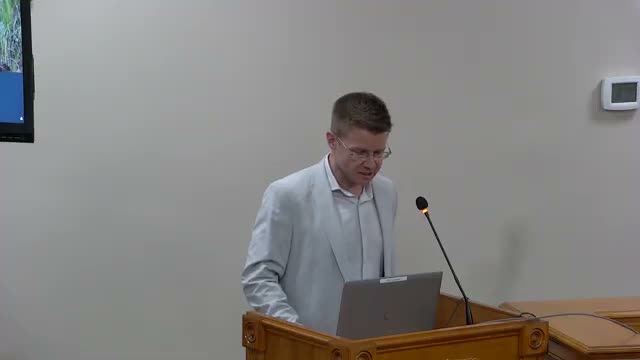
Summary
Suwannee County commissioners heard a presentation Feb. 17 from the Suwannee River Water Management District on the Water First North Florida reclaimed-water aquifer-recharge project, which would deliver about 40 million gallons per day and is still in early siting and design. Dozens of residents pressed officials about contaminants, PFAS, nitrate limits and whether counties have any formal vote on the state-led plan.
Troy Roberts, communications office chief for the Suwannee River Water Management District, told the Suwannee County Board of County Commissioners on Feb. 17 that the Water First North Florida project would deliver about 40,000,000 gallons per day of highly treated reclaimed water, routed through treatment wetlands and used for aquifer recharge to help restore flows in the Lower Santa Fe and Ichetucknee rivers.
"Reclaimed water has to meet higher standards than typical wastewater does," Roberts said, adding that the St. Johns River Water Management District, the Florida Department of Environmental Protection and utilities including JEA are project partners. He said the initiative is in an early study phase, estimated to require roughly 13 years before water would be returned to the aquifer, and estimated the total cost at about $1,000,000,000 with pledges including $400,000,000 from JEA and about $125,000,000 from St. Johns River WMD.
The presentation and subsequent public comment period focused on water quality, monitoring and local authority. "This water for Water First North Florida is water that would not be allowed in the St. Johns River," geologist Haley Hall told the board, citing Senate Bill 64 (2021) and warning that legal loopholes could permit treated wastewater to be routed into Suwannee-area recharge sites. Hall also raised nitrate limits that apply to Outstanding Florida Springs and warned of PFAS bioaccumulation in the food chain.
Roberts repeatedly emphasized that the project would not inject water into the aquifer unless it met all applicable state and federal standards. "We will not be putting water back in the ground unless it meets certain criteria and certain standards that are out there," he said, naming DEP and EPA oversight as part of the compliance regime. On PFAS, he said research and treatment technologies show promise and cited ongoing studies by utilities; he cautioned he is a communications specialist, not a scientist.
Residents questioned technical details and choices. Deepa Tak, a 50-year resident, asked whether the state had already decided and whether local residents could block the project; Roberts replied the project is state-led and would not require county or city approval, though local support is sought. Mariah Clayton asked whether JEA's Buckman Wastewater Plant could fail; Roberts said JEA monitors its water and that checks and balances would be built into the system.
Commissioners also pressed on operational and regulatory points: whether Phase 2 water-shortage restrictions could limit crop irrigation (Roberts said Phase 2 would carry regulatory restrictions set by the district governing board and staff and that the district offers cost-share programs to help agricultural producers modernize irrigation equipment), and who performs water testing (Roberts said utilities and DEP conduct testing and would enforce applicable standards).
Roberts and the video shown during the meeting referenced comparable projects, including the Sweetwater Wetlands Project in Alachua County and the Black Creek Water Resource Development Project in Clay County, as operational examples of treatment-wetland approaches. Roberts said treatment wetlands can remove a significant portion of nitrogen and phosphorus and that data from other districts show measurable nutrient reductions before recharge.
No formal county action was taken on the Water First proposal during the meeting. Commissioners encouraged residents to pursue follow-up at the water management district meetings and noted that the district would continue to answer technical questions and provide contact information.
What’s next: Roberts encouraged attendees to contact district staff and attend future hearings and studies as the St. Johns River Water Management District completes siting studies and utilities refine treatment designs. The district reiterated that residents, local agencies and scientific groups will be part of ongoing review as studies proceed.