
Officials propose model policies, broadened "law-enforcement access" language for S.227 in Education Committee
Get AI-powered insights, summaries, and transcripts
Subscribe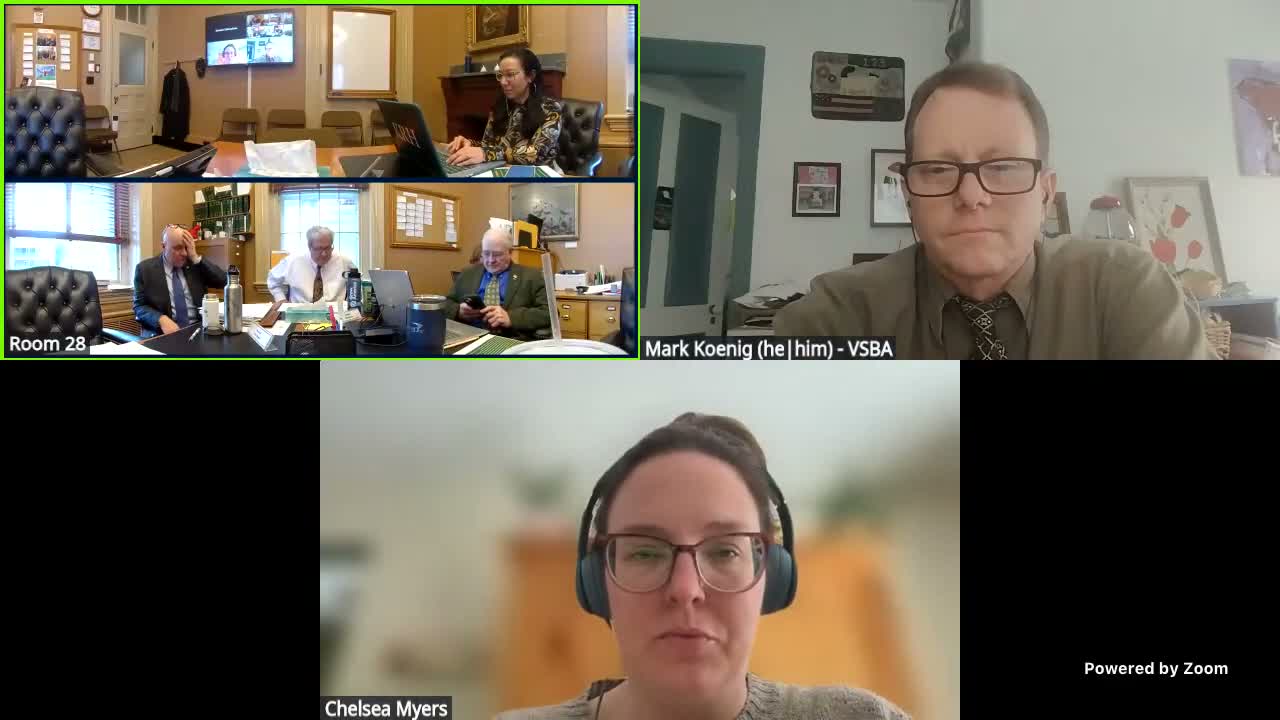
Summary
Presenters from the Vermont School Boards Association and Vermont Superintendents Association told the Education Committee that much of S.227’s operational detail should live in model administrative procedures; one presenter urged broadening references from immigration authorities to 'law enforcement' to avoid potential legal challenges.
During an Education Committee meeting on Feb. 20, officials from the Vermont School Boards Association and the Vermont Superintendents Association outlined proposed edits to S.227 to guide how schools respond when immigration or other law-enforcement officials seek access to school sites.
Mark Koenig, director of policy services and legislative affairs for the Vermont School Boards Association, said the association "supports the intent of this bill" but recommended placing many of the implementation details in administrative procedures rather than in board policy so superintendents and staff can carry out the law. Koenig also urged broadening the bill's terminology so the statute addresses "law enforcement access" broadly rather than singling out immigration authorities, noting a concern raised by the attorney general's office and that the Second Circuit might take issue with focusing on a single governmental agency.
Chelsea Myers, executive director of the Vermont Superintendents Association, recommended that the secretary of education, working with stakeholder groups including the VSBA, create a standalone model policy that districts could adopt or adapt. Myers said the model policy should include three core components: data management and data collection; access of law enforcement to school sites; and provisions about collaborating with immigration authorities. "The model policy is not to recommend that this is a recommended policy," she said, explaining that model policies provide a consistent foundation so individual districts do not each draft a policy from scratch.
Myers and Koenig both argued that highly specific operational items — such as who may enter a building, when and how data are shared — are better placed in model administrative procedures rather than in statute or board policy. Myers noted that several districts already use similar procedures and recommended keeping procedures flexible so local educators can tailor responses to students' needs.
Committee members raised practical questions about point-of-contact arrangements. One member said they preferred that districts identify a local contact in advance; Myers proposed the Agency of Education maintain a centralized list of resources and partnerships for superintendents to access, particularly to support rural districts that may lack local partnerships. Unidentified speakers also noted that the Vermont Asylum Assistance Project travels statewide and is reviewing the language to see how it could support districts.
There were no formal votes or motions recorded during the discussion. Presenters and committee members agreed to circulate and reconcile draft language: legislative counsel (Rick) and outside reviewers (including Rebecca Callaghan and Jill Martin Diaz) have versions under review, and Myers and Koenig said they would submit revised drafts to the committee for posting and further consideration.
The committee indicated it will post the revised draft and consider the updated language in a future meeting; no statutory text was adopted during this session.