How Connecticut Paid Leave works for school employees: eligibility, benefits and applying
Loading...
Summary
The Connecticut Paid Leave Authority reviewed eligibility (minimum $2,325 in a qualifying quarter and covered employer/employee status), types and durations of leave (most reasons permit up to 12 weeks; Family Violence Leave provides up to 12 days), documentation required, application windows, and appeal/reconsideration procedures. Applicants can start an application up to 30 days before planned leave via ctpaidleave.org or by calling the program's 877 number; Aflac handles claims administration.
A representative of the Connecticut Paid Leave Authority described how eligible school employees can apply for income‑replacement benefits and what documentation and timelines to expect. To qualify for Connecticut Paid Leave benefits an applicant must work for a covered employer and meet a minimum earnings test: the claimant must have earned at least $2,325 in the highest‑earning quarter among the first four of the five most recently completed quarters. The Authority, not the employer, makes the eligibility determination.
The presenter summarized the six qualifying leave reasons that commonly generate benefits: medical leave (including organ donation and pregnancy), bonding leave for new parents (12 weeks within 12 months), caregiver leave (broadly defined family relationships), military caregiver leave, qualifying exigency leave, and Family Violence Leave (job‑protected up to 12 days and a qualifying reason for paid benefits). "Over 50 percent, actually 54 percent of all of our claims in the past year were for someone's own serious health condition," the presenter said, illustrating how medical leave drives claims.
Leave formats include block (continuous) leave, reduced‑schedule (temporary part‑time) leave, and intermittent leave for sporadic absences; intermittent leave requires medical documentation estimating expected frequency/duration. Most qualifying reasons allow up to 12 weeks of benefits in a 12‑month period; pregnancy‑related incapacitation can provide an extra two weeks during pregnancy.
Applicants can start the intake process up to 30 days before planned leave and up to 45 days after an unplanned event; filing later than 45 days requires an explanation of "good cause" (for example, hospitalization or natural disaster). The application requires three categories of supporting documentation: identity verification, employment verification (the Authority is developing a schools‑specific form for employers to complete), and documentation supporting the leave reason (for example, a health care provider form for medical leave). The presenter said missing or incomplete documentation is the leading cause of denied claims; roughly 85% of reconsideration requests overturn an initial denial when supplemental documentation is supplied.
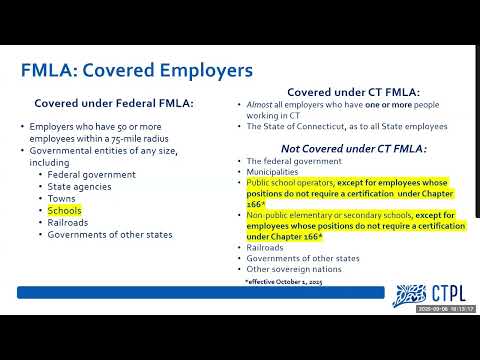
The presenter noted operational details: benefits are issued on Tuesdays for the duration of approved leave, and benefits are payable only for dates the employee would otherwise have been scheduled to work (for example, employees not scheduled to work in July cannot receive benefits for that month). The presenter also reiterated the legal distinction with FMLA: employees must apply separately to their employer for job‑protected FMLA leave; applying only for paid leave does not obligate the employer to hold the employee's job unless FMLA or Connecticut FMLA coverage applies.
For help, applicants should use the Authority’s online portal at ctpaidleave.org or call the program's listed 877 number; Aflac serves as the program's third‑party claims administrator and processes claims and eligibility checks. Denied claimants may request reconsideration with the Authority and may appeal to the Connecticut Department of Labor if reconsideration is denied.