Get Full Government Meeting Transcripts, Videos, & Alerts Forever!
Get email alerts on the Paid Leave Coverage topic
No spam. Unsubscribe anytime.
Connecticut paid leave, Connecticut FMLA expand to most non‑certified school employees Oct. 1
Summary
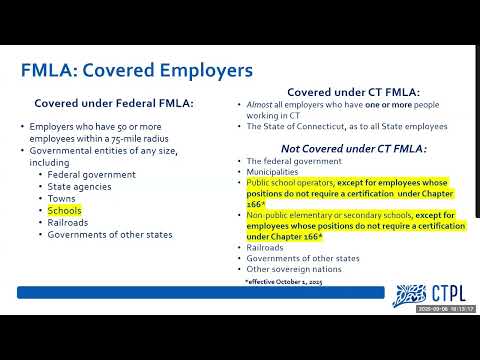
Public Act 25‑174 extends Connecticut Paid Leave and Connecticut FMLA coverage to many non‑certified employees of public school operators and certain nonpublic schools effective Oct. 1; certified positions remain excluded unless a bargaining unit opts in. The Authority will use annual wages divided into four quarters to avoid pay‑calendar disparities in benefit calculations.
A representative of the Connecticut Paid Leave Authority said the state’s recent legislation, Public Act 25‑174, requires that employees of public school operators and nonpublic elementary and secondary schools in positions that do not require certification under Chapter 166 be covered by Connecticut Paid Leave and Connecticut FMLA beginning Oct. 1. The change defines who counts as a "public school operator" and clarifies how eligibility and benefits will be calculated for employees paid on alternate calendars.
The expansion is significant because many school positions that were previously excluded will now have access to income replacement and, where applicable, Connecticut FMLA job protection. "FMLA and Connecticut paid leave are not the same thing," the presenter said, stressing that paid leave supplies income replacement while FMLA provides job protection. For employees paid over different calendars, the Authority will annualize wages and divide by four to determine quarterly earnings so similar annual salaries produce similar benefit calculations.
Under the change, employees whose positions require certification under Chapter 166 are not automatically covered; certified employees can become covered only if their collective bargaining unit negotiates participation. The presenter explained that if one or more bargaining units collectively bargain into participation, the enrollment is prospective and will also bring the employer’s non‑unionized employees into the program. The Authority has adopted a policy that such participation can only be prospective, not retroactive.
The presenter listed exclusions: the federal government and railroads are not covered; the state and municipalities are not broadly covered unless they have covered public employees; and certified positions remain excluded absent bargaining. Employers should review whether positions at their districts meet the Chapter 166 certification requirement and consult collective bargaining representatives where applicable.
The Authority representative also described administrative implications for school employers: register with the Connecticut Paid Leave Authority, remit the 0.5% employee contribution quarterly, and complete the schools‑specific employment verification form when employees apply for benefits. The presenter directed listeners to the Authority’s website for the full guidance and the schools‑specific form and said the Authority will publish guidance ahead of the Oct. 1 effective date.
The Authority advised employers and employees to prepare now for the effective date—employers to register and set up withholding and verification procedures, and employees to review eligibility rules and, if eligible, plan to file applications (applications may be opened up to 30 days before a planned leave).