
House committee questions BGS budget lines for surplus property, purchasing and fee‑for‑space
Get AI-powered insights, summaries, and transcripts
Subscribe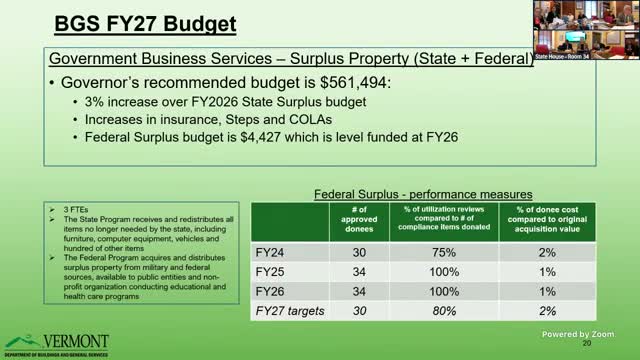
Summary
At a Feb. 20 House Corrections & Institutions hearing, Deputy Commissioner Emily Kosicki outlined how the Department of Buildings and General Services disposes of surplus property, runs centralized procurement under Bulletin 3.5 and manages a $41.5 million fee‑for‑space program; members pressed for follow‑up data on contracted services and competitive bidding.
Montpelier — Deputy Commissioner Emily Kosicki of the Department of Buildings and General Services told the House Corrections & Institutions Committee on Feb. 20 that the agency’s surplus property unit disposes of excess state and federal property and returns proceeds to state operations.
"Surplus property... exist to dispose of excess property," Kosicki said, describing a small Middlesex‑based unit that handles items ranging from office furniture to collected sharps from Leahy Airport and surplus vehicles. She said the governor’s recommended budget for the state surplus program includes a roughly 3% increase and that the unit has three full‑time positions.
Kosicki also described the Office of Purchasing and Contracting (OPC) as the centralized procurement office that enforces administrative Bulletin 3.5, which prescribes competitive bidding and contract processes "to ensure that state monies are spent appropriately and wisely," she said. Kosicki gave examples of statewide contracts that flow through BGS — including winter salt (SALT), ADA accessibility and translation services, and commodity contracts such as uniforms — and noted cooperative agreements with the National Association of State Procurement Officials (NASPO) bring broader purchasing power to Vermont and municipalities.
The committee pressed for more detail on the mix of competitive versus single‑source contracts among roughly 1,400 active contracts. Kosicki said single‑source awards are not the default and pledged to follow up with a breakdown, noting exceptions arise when only one bidder is available or a contract is highly specialized.
Kosicki also reviewed Planning and Property Management and the fee‑for‑space program, led by Director John Hiebert, which covers operations and maintenance (custodial, trades, safety and security and the curator). She said the governor’s recommendation for fee‑for‑space is about $41,500,000 — a 5.3% increase from the prior year — and that BGS uses a district model to calculate rates based on actual costs over the prior two years. Kosicki added that correctional facilities are treated differently in the fee model because their operational costs differ from standard office space.
Committee members asked why FY25 performance measures for on‑time work orders and preventive maintenance dipped; Kosicki attributed the dip to hiring challenges in specialized trades and said BGS has refocused on ticket response and expects improvements in FY27.
The committee agreed to a follow‑up session after the town meeting break to dive deeper into fleet management, telematics and procurement details. Kosicki offered to bring the agency’s fleet manager, Stacy, and to provide follow‑up data on the competitive procurement mix.
The hearing did not record any committee motion or formal vote on these budget lines. The next procedural step is the committee’s post‑town‑meeting focus sessions and the capital bill markup scheduled after the break.