
Committee asks staff to map options for banning or licensing 'gas-station drugs' and vaping retailers
Get AI-powered insights, summaries, and transcripts
Subscribe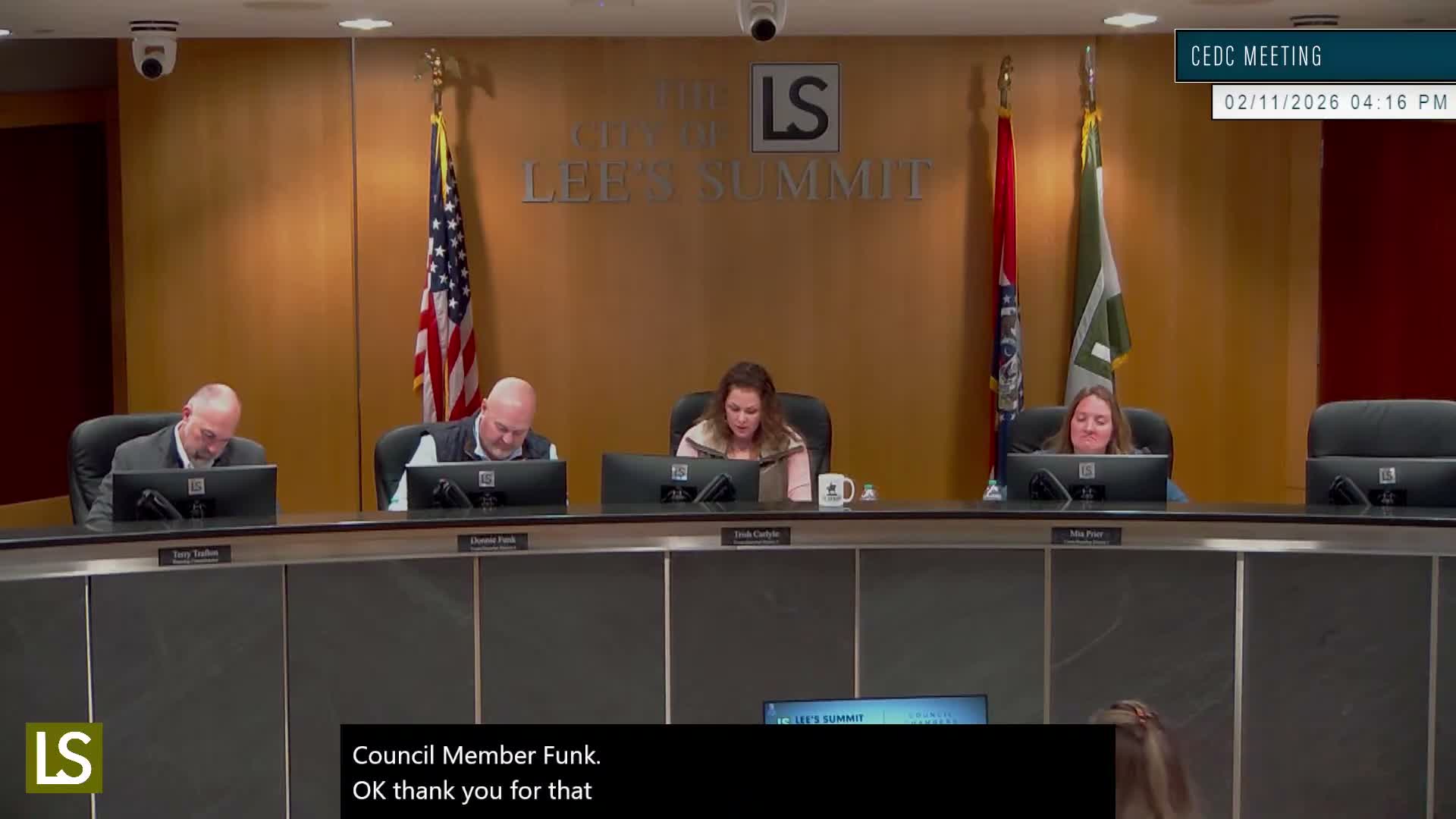
Summary
After a staff presentation on products sold at gas stations and vape shops, including a concentrated kratom derivative described in the presentation as '70H,' the committee asked staff, legal and police to research enforcement, licensing, zoning and possible prohibition strategies and return with recommended draft options.
Lee's Summit's Community and Economic Development Committee spent significant time reviewing options for local regulation of products sometimes described as "gas-station drugs" and for vaping retailers.
Tracy Albers of Development Services summarized state and regional activity and explained the policy choices facing the city. Albers said Missouri Senate Bill 927 is addressing the regulation and sale of kratom products and noted that Kansas City has proposed local restrictions. During the presentation, she described a concentrated kratom derivative referenced in staff materials as "70H," which she characterized as "a very potent opioid" and said "they say it's approximately a dozen times stronger than morphine." Albers outlined approaches other jurisdictions have used, including buffering requirements, population-based limits on the number of stores, business-licensing conditions (for example, an e-cigarette-specific retail license) and additional security requirements.
Committee members expressed interest in strong action. One member said they wanted to "see 70H illegal in our city" and to make it "really hard for gas stations to sell" those products. Police staff cautioned that enforcement and prosecution depend heavily on how an ordinance is written and whether local crime-lab testing and court procedures can reliably identify the substances. "The only big issue on that and how to get in front of it, it's gonna take the...legal staff to do that, write those ordinances," said a police representative, adding that laboratories and prosecutors are often necessary to support charges. Legal counsel advised the committee to consult the prosecutor (referred to in discussion by staff) to determine whether proposed language would be actionable in court and offered to draft ordinance language to the extent feasible.
Rather than adopt immediate prohibitions, the committee asked staff, police and legal to further research options — including criminal prohibitions, business-licensing approaches, and land-use restrictions — and to return with recommendations and draft language. Committee members noted that a coordinated approach with neighboring jurisdictions (and monitoring Kansas City's pending action) would be helpful for consistent enforcement.
Next steps: staff will research enforcement and drafting issues, consult prosecutors about prosecutability and testing, and return to the committee with recommended options, potential licensing frameworks, and suggested ordinance language. No ordinance or licensing requirement was adopted at this meeting.