
Committee directs staff to draft floodplain ordinance updates to align with FEMA
Get AI-powered insights, summaries, and transcripts
Subscribe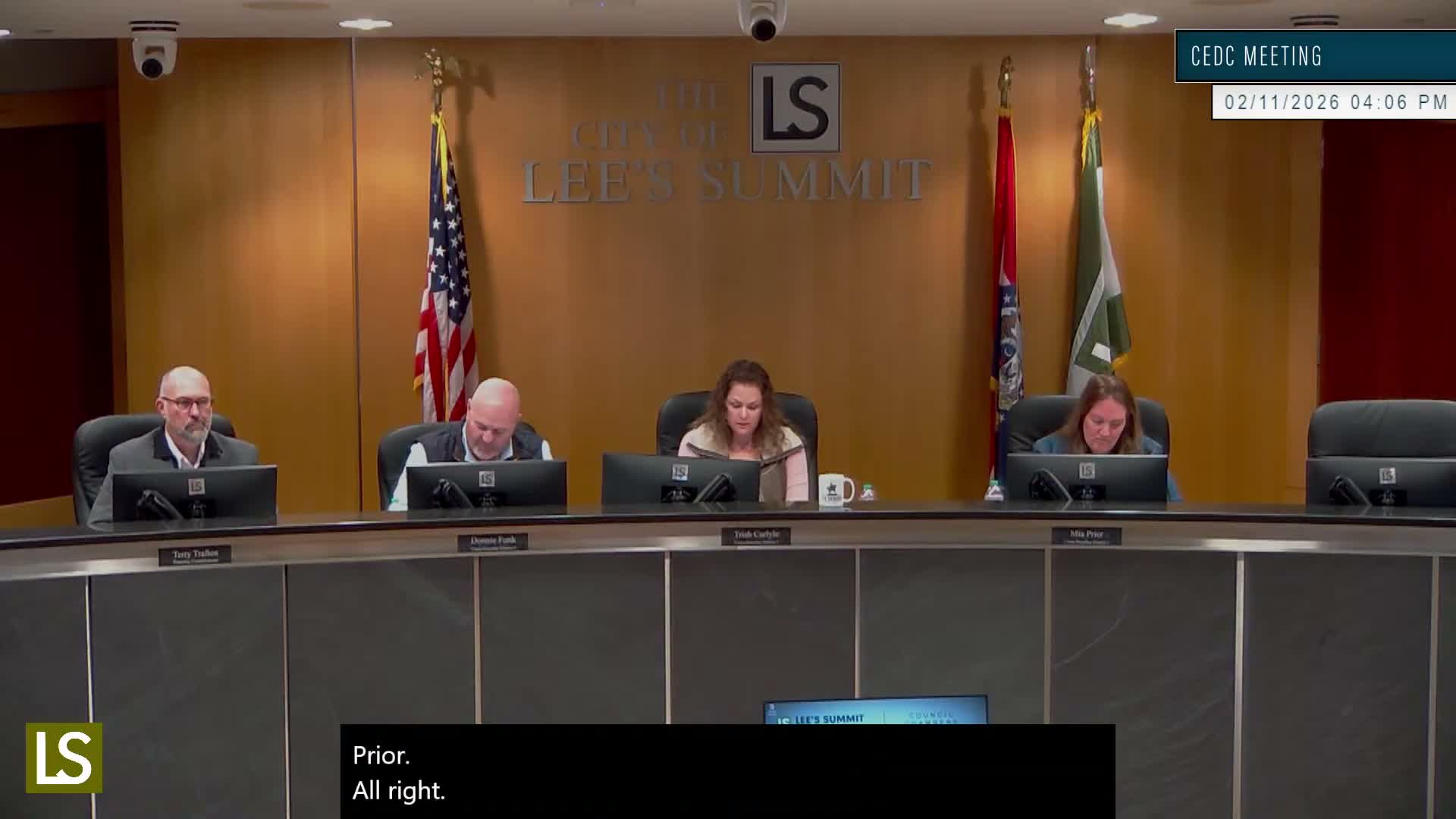
Summary
Lee's Summit's Community and Economic Development Committee directed staff to prepare a formal ordinance updating the city's floodplain provisions in the Unified Development Ordinance to match FEMA standards, codify current practices (including FEMA Technical Bulletin TB10), clarify definitions, and change a 10-year tracking period to a rolling five-year practice.
Lee's Summit's Community and Economic Development Committee voted to direct staff to prepare an ordinance amending the city's floodplain regulations (UDO Article 5, Division 2) so the city remains aligned with Federal Emergency Management Agency (FEMA) requirements and the National Flood Insurance Program.
"This ordinance brings consistent development standards so that...floodplain insurance can be obtained by owners, renters, and business owners," said Sue Piles, development engineering manager, during a staff presentation that summarized proposed redlines and clarifying language. Piles told the committee the updates would codify existing practice — including the use of FEMA's Technical Bulletin TB10 for assessing structures built on fill — and correct language and definitions to avoid confusion when property owners submit documents to FEMA.
The presentation explained several substantive changes: codifying the TB10 analysis the city has required, requiring a city no-rise certificate for fill in floodway fringe while noting FEMA’s letter of map revision remains a separate (FEMA) process, updating terminology to refer to a floodplain administrator, matching Community Rating System terminology used by the federal program, and changing a periodic tracking provision from 10 years to a rolling five-year period for consistency with other city processes.
Committee members asked for local context. Kara Starlin, a certified floodplain manager in public works, said the 33rd and Ward area includes two city-owned detention ponds (plus one within a subdivision) that have managed flooding and, to her knowledge, "we have not had any reports of flooding in that neighborhood since COVID." Committee members also asked how many acres are in the regulated floodplain; staff described roughly 3,000 acres of mapped floodplain spread across the city.
After questions, a committee member moved to instruct staff to prepare an ordinance reflecting the working drafts prepared by public works and development engineering; the motion was seconded and the committee recorded affirmative votes and directed staff to advance the draft to the Planning Commission and City Council for consideration.
Next steps: staff will prepare a formal ordinance for Planning Commission and City Council review and return with a draft, technical attachments and suggested redlines. No final ordinance was adopted at the meeting.