
Pima County recorder unveils mobile voting unit, defends single‑envelope mail ballots amid public concern
Get AI-powered insights, summaries, and transcripts
Subscribe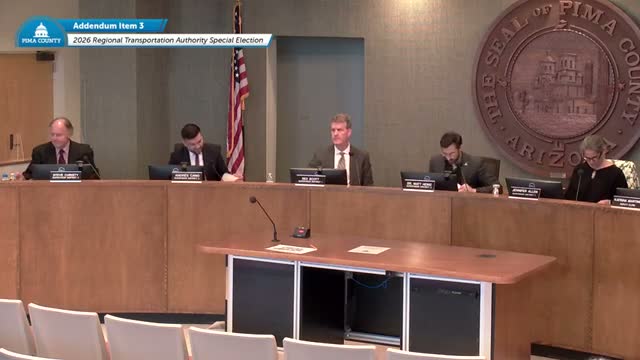
Summary
The county recorder described a new 'vote mobile' meant to provide replacement ballots and rural access and defended a single‑envelope mail‑return system and plans to expand secure drop boxes; the board pressed for outreach and clarity about observers and ballot security.
County Recorder Casarez Kelly presented the board on Feb. 4 about administration of the Regional Transportation Authority special election and the county’s first deployment of a mobile voting unit designed to deliver replacement ballots and in-person services in rural communities.
Recorder Casarez Kelly said the trailer‑based mobile voting unit will visit four locations (two confirmed, two tentative) including Ajo, Sells, Sahuarita and Nanini and is equipped with space for bipartisan staff, observers, and secure processing. The unit will be staffed in a bipartisan manner and is intended to address access gaps in sparsely served areas.
The presentation came amid robust public comment and questions from supervisors about three issues: the decision to use a single‑envelope ballot return (which makes a voter signature visible on the outer envelope), the number and distribution of ballot drop boxes across Pima County, and safeguards for ballot chain of custody. Casarez Kelly said Pima’s single‑envelope return is already in use elsewhere in Arizona (citing Maricopa County) and that additional security information (such as the requirement of extra identification data to alter or misuse ballots) remains protected by state law. She also described existing bipartisan handling, scanning, signature verification processes, and voter notification systems to confirm receipt.
On drop boxes, the recorder said the county plans to expand box distribution but that procurement, cost, surveillance and intergovernmental agreements slow rapid roll‑out; existing boxes are on county property, opened only during active elections, and are under camera monitoring though not 24‑hour active surveillance. On observers, Casarez Kelly said she met with party chairs and designed observation space in the unit and in office facilities; observers are permitted by law subject to operational safety and observation rules.
Supervisor Christie and others pressed for better distribution of services in rural areas and for a clear public outreach plan for seniors in Green Valley and other places where voters are less familiar with all‑mail elections. Several supervisors asked administration to continue direct outreach to community partners and local offices and to provide cost estimates for additional secure drop boxes.
Next steps: the recorder’s office will finalize vehicle wrap and equipment, run a ribbon-cutting, publish locations and schedules, continue outreach to community partners and the board asked staff to provide additional cost and implementation details for ballot drop boxes and mobile‑unit deployment.