Get Full Government Meeting Transcripts, Videos, & Alerts Forever!
Get email alerts on the Board Appointments topic
No spam. Unsubscribe anytime.
Greenville County committee debates tightening board-appointment rules and briefly raises legal executive session
Summary
Committee members proposed moving application and posting windows earlier and discussed adding a rule disqualifying applicants involved in legal claims against the county; members also moved toward an executive session about case 2023-CP-23-04287, an item that was later withdrawn with no recorded action.
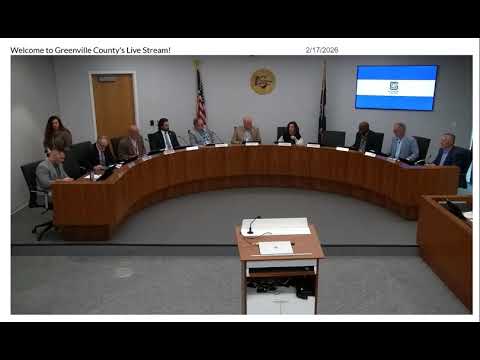
Members of the Committee of the Whole in Greenville County on Feb. 17 reviewed proposed amendments to the county's boards-and-commissions appointment policy, agreeing to specify application months and to consider language barring applicants who are part of active legal claims against the county.
A committee member (Speaker 1) proposed moving appointment start dates to January from February to allow new appointees time for orientation and training before their terms begin, and recommended changing posting deadlines to Dec. 15 and June 15 with application windows in January/February and July/August. "I think it's pretty important that applicants should not be a part of any active legal action against the county of Greenville or the board of commission," that committee member said when introducing suggested eligibility language.
The clerk (Speaker 9) told the panel that the eligibility wording was discussed previously by an ad-hoc committee and that the phrase "tort claims" had been considered in earlier drafts. The county attorney (Speaker 7) cautioned that phrasing such as "as much as possible" and overly rigid preferences can cause confusion and said the county can set preferences so long as they remain within qualifying criteria. The attorney explained how tort-claim forms and insurance-handling often result in settlement without a full lawsuit and urged careful drafting to avoid unintended exclusions.
Speaker 2 said they would oppose the fifth bullet of Section 4 if it barred applicants simply for having a legitimate claim against the county, and noted concern about whether the county has authority to broadly remove the right to apply in such cases. "Somebody could legitimately have a claim against the county and want to serve on a board, so I don't want to take that right away," Speaker 2 said.
On district representation for filling unexpired terms, members discussed referencing state law. Speaker 3 cited state statute 6-29-3-10(c), saying that when appointing planning commission members the appointing authority should consider professional expertise and community knowledge and that members should represent a broad cross section of interests. Committee members agreed to draft clarified language (including possible "duly qualified" language) and to circulate it to the county attorney and clerk before resubmission.
To give applicants and staff more time for training and transition, the committee also agreed to shift interview months to April (for the spring cycle) and October (for the fall cycle) and to back up related dates so interviews and appointments would follow the moved application windows.
Late in the discussion, a committee member (Speaker 4) moved that the panel go into an executive session for the "receipt of legal advice" relating to pending or potential claims, citing case number 2023-CP-23-04287. The county attorney (Speaker 7) later stated that the Committee of the Whole had gone into an executive session on Feb. 17, 2026 to receive legal advice on the same case and that "no action was taken during that executive session." The transcript records procedural disagreement about who had placed the item on the agenda and about whether an executive session could be held without the attorney present; Speaker 2 withdrew the agenda item and the transcript shows no subsequent vote on the motion to enter executive session.
Next steps the committee recorded included drafting and circulating revised language on district representation and eligibility for review by the county attorney and clerk, and finalizing a consolidated schedule of posting, application, interview and appointment dates to be distributed and approved at a future meeting.
The transcript contains no formal recorded vote on the eligibility language or the executive-session motion; committee members instructed staff to produce revised text and to refile formal amendments for a future meeting.