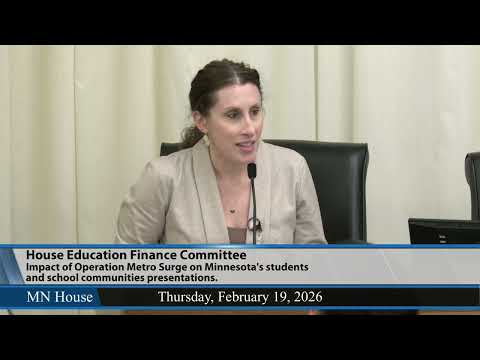
Educators and parents tell Minnesota committee ICE surge is driving students from classrooms and straining school budgets
Loading...
Summary
Dozens of educators, parents and school leaders told the Minnesota House Education Finance Committee that recent ICE enforcement operations — referred to in testimony as "Operation Metro Surge" — have spurred sharp attendance declines, driven students to virtual learning and produced immediate budget shortfalls and mental-health burdens across districts.
At a hearing of the Minnesota House Education Finance Committee, dozens of educators, parents and school leaders described widespread fear and operational strain in schools following an escalation of federal immigration enforcement operations in recent weeks.
Heidi Nissler, assistant superintendent of specialized services for Saint Paul Public Schools, said disruptions have hit students receiving special education services especially hard: “For a student with an IEP, consistency isn't just a preference. It's an educational necessity,” she told the committee, and described district vehicles carrying vulnerable students being stopped by federal agents.
Multiple superintendents and principals reported large enrollment shifts and attendance spikes. Brenda Lewis said her district lost 112 students and estimated a loss “of at least $1,200,000 in annual revenue,” while another superintendent described daily absences jumping from roughly 230 to nearly 600 and a single-day peak of 1,214 students absent. Speakers across urban and Greater Minnesota districts reported families choosing virtual options or keeping children home out of fear after agents appeared near schools, bus stops or neighborhood residences.
Witnesses described operational consequences beyond lost seats. Educators said schools have absorbed food distribution, legal-navigation support and expanded mental-health services. Kalandra Hines urged lawmakers to “allocate funding for trauma-informed support and attendance recovery initiatives,” noting that translation, legal consultation and transportation adjustments have raised administrative costs.
Union and legal advocates described individual cases that illustrate wider harms. Chris Stinson, policy director for SEIU Local 284, recounted a member who was detained and transferred out of state and later released after a habeas petition; Stinson said a judge found the detention unlawful. Testimony also included accounts of agents using chemical irritants during an incident at Roosevelt High School, reports that agents boxed in buses and detained people near schools, and community responses including parent patrols.
Speakers warned of cascading fiscal effects. Several witnesses noted that Minnesota’s enrollment-based funding rules can turn temporary absences into immediate reductions in state aid, and that districts already planning cuts may need further reductions absent legislative stabilization. Carlo Franco, treasurer for Saint Paul Public Schools, said the district had already moved thousands of students temporarily online and projected substantial budgetary consequences next year without state intervention.
Education organizations asked the committee for targeted relief and flexibility. Joey Chienyan, executive director of the Minnesota Association of Charter Schools, asked for fiscal stabilization, flexibility on testing and compliance, and security funding for charter schools facing “40 to 50 percent” swings in attendance in some cases. Other witnesses sought expanded funding for counselors, multilingual staff and recovery programs.
Committee leaders did not take votes during the testimony period. The hearing concluded with members adjourned after a day of emotional, data-driven testimony about the immediate effects of enforcement activity on students, staff and district finances.