
Minnesota budget office: HR 1 and agency actions could strip hundreds of millions from state programs
Get AI-powered insights, summaries, and transcripts
Subscribe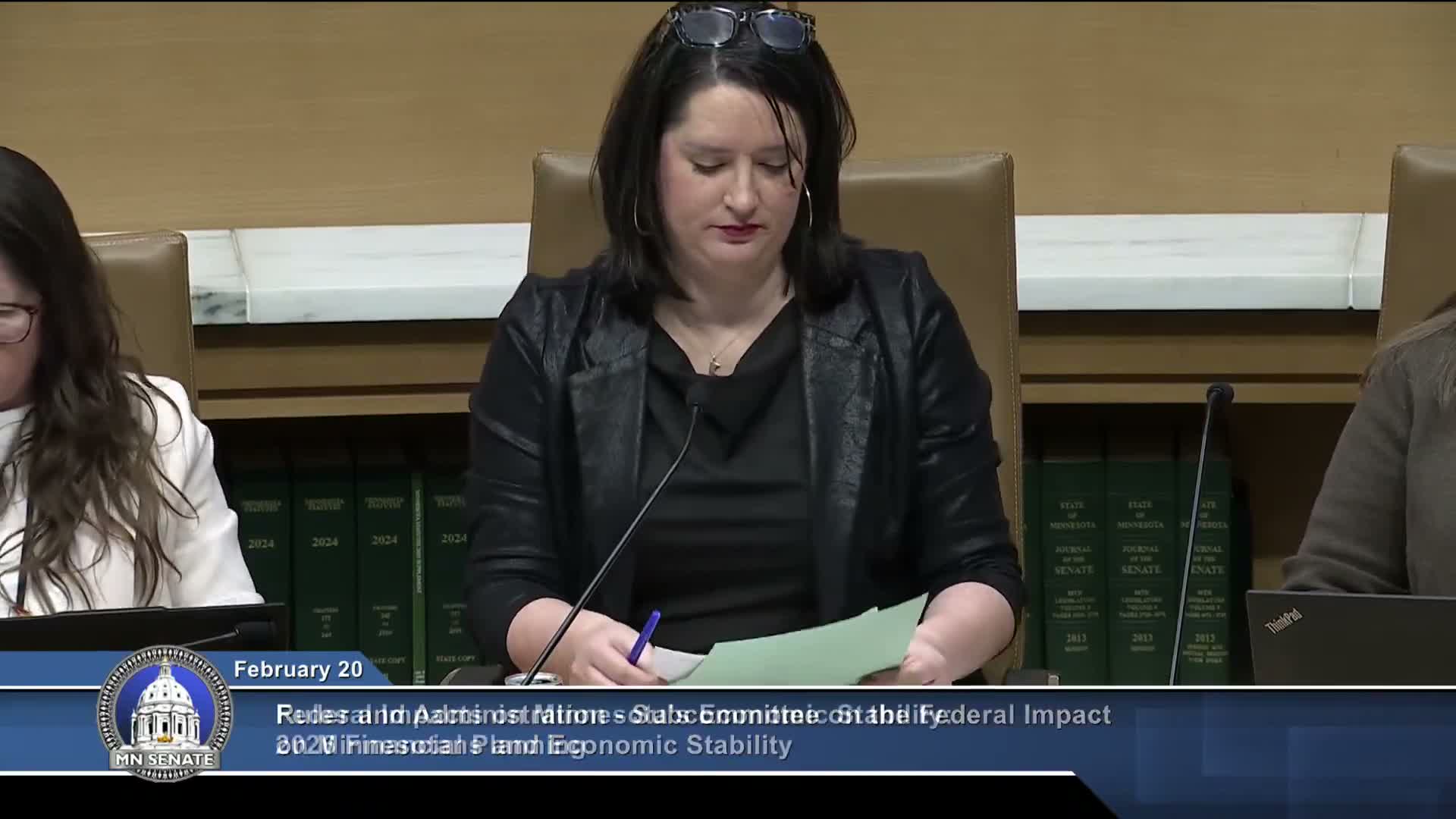
Summary
Minnesota Management and Budget Director Anna Menge told a Senate select subcommittee that HR 1 and federal agency actions are already reducing or threatening federal funding for state-administered programs — MMB estimates roughly $327 million in reduced federal funds this biennium and about $1.6 billion in the next biennium, with other actions creating broader fiscal risk.
Anna Menge, Minnesota's state budget director, told a Senate select subcommittee on Feb. 20 that federal changes since January 2025 — including the federal reconciliation bill known as HR 1 and executive actions by the federal administration — are creating tangible fiscal risks for the state.
"Federal dollars make up more than 1 in every $3 that the state government spends," Menge said, describing MMB's work to analyze the law's provisions and related federal actions. MMB manages roughly 650 distinct federal awards totaling about $23,000,000,000 this year, she added.
Why it matters: Many of those federal awards support health and human services entitlements. Menge said the state estimates HR 1 will lead to $327,000,000 less federal funding in the current biennium and about $1,600,000,000 in the next — figures MMB broke down into (a) automatic state forecast impacts, (b) state costs needed to comply with new federal rules, and (c) impacts to providers and beneficiaries outside the state budget.
Key details: Menge identified several categories of effect: changes in eligibility (including new or expanded work-reporting requirements), limits on provider payments and retroactive coverage, and new constraints on provider taxes and penalties for eligibility errors. On SNAP, she said HR 1 creates a nonfederal share tied to payment-error rates and reduces administrative federal reimbursement from 50% to 25% starting this October, which raises costs for both the state and counties.
MMB also summarized the near-term totals that are already reflected in the state forecast and those that are not. The agency reported roughly $223,000,000 in "automatic" forecast costs in the current biennium and $480,000,000 in the next for state-forecasted items, with additional compliance and external pressures layered on top.
On potential large-scale withholds, Menge described a Jan. 6 letter from the Centers for Medicare and Medicaid Services (CMS) that "indicated that they intend to withhold $515,000,000 per quarter in future federal funds" for 14 high-risk services; because timing and duration were unknown, she said annualized figures could exceed $2,000,000,000 a year and that the Department of Human Services has filed an administrative appeal.
What lawmakers asked: Committee members sought clarity on methodology (MMB used the November forecast baseline and enrollment projections), whether the presented totals included recent one-time supports to health-care entities, and how state and local governments will absorb administrative cost increases. Menge said some items are already in the forecast while others are contingent on guidance, litigation outcomes, or additional federal action.
Next steps and procedural actions: After discussion, the committee voted to adopt nonpartisan summaries of earlier hearings. Senator Rasmussen proposed an amendment to insert a sentence stating "director Mengi testified that federal funding for Minnesota's Medicaid program will increase year over year," which members debated and ultimately rejected in a roll-call vote before adopting the summaries by voice vote.
Bottom line: MMB presented a mix of quantified near-term losses and broader, harder-to-quantify risks. The agency warned that while the state's current biennial surplus provides a cushion, large or poorly timed federal withholds or cancellations would force policy choices and could require near-term legislative action.