
Fire districts press Xcel on cameras, weather stations and site‑specific wildfire plans in Albert County hearing
Get AI-powered insights, summaries, and transcripts
Sign Up Free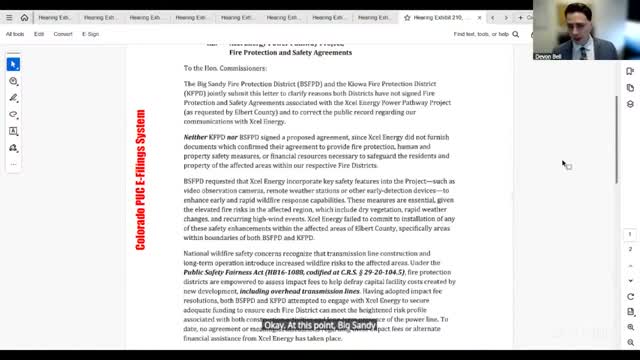
Summary
Volunteer fire districts and county consultants told the PUC that Xcel’s filings lacked project‑specific wildfire mitigation details and signed local fire‑district agreements; Xcel said it has a statewide plan, has offered Pano AI camera access, and will coordinate further if approved.
At the Feb. 19 evidentiary hearing on Xcel Energy’s Segment 5 application, local fire‑safety concerns took center stage alongside routing disputes.
Albert County’s technical reviewer, SWCA principal Stephanie Blochowiak, told the commission the county’s completeness review and technical memorandum identified gaps in the company’s submissions: precise mapping of temporary construction areas, locations and counts of easements, definitive pole locations, and evidence that local fire districts had received and reviewed the materials they had asked for. "The information submitted was very generalized...we were looking for the specifics," Blochowiak said.
Two volunteer fire districts — Big Sandy and Kiowa — filed a public comment with the PUC in late January 2026 that asked Xcel to commit to safety features including "video observation cameras, remote weather stations, or other early detection devices to enhance early and rapid wildfire response capabilities." That letter was placed into the hearing record and discussed during cross‑examination.
Xcel’s wildfire witness, Patrick (recorded as Patrick Paterich/Kuretic), described the company’s wildfire‑risk mapping and monitoring program. He said the company operates weather stations and has deployed Pano AI camera units that can detect smoke and help triangulate fire locations; he cited real‑world detections at ranges the company has observed. "We've seen upwards of 40 miles," he said when describing the effective triage and detection range seen in some camera deployments.
Xcel told the commission it has offered access to its camera feeds and other monitoring data to local emergency responders; Tri‑County indicated that it wanted access. The company also submitted a separate commitments document promising to coordinate with fire districts, provide training and share camera or monitoring access as a mitigation measure; the commission admitted that document subject to county comment.
County witnesses said the company’s submissions did not show where cameras or weather stations would be sited, what monitoring data are already in place, and how those elements would be scaled or changed in response to the particular route through Albert County. The county asked for more project‑specific engineering and response planning before the county could find the filings complete.
What’s next: The PUC kept these items in the evidentiary record and requested follow‑up materials. The immediate practical issues in front of the commission include whether the company’s statewide mitigation approach suffices for site‑specific permitting questions and whether offering camera access after a permit is issued fully addresses the county’s procedural and safety concerns.