
PUC hearing spotlights clash over Xcel’s Segment 5 route, county denial and $2.5 million impact fee dispute
Get AI-powered insights, summaries, and transcripts
Sign Up Free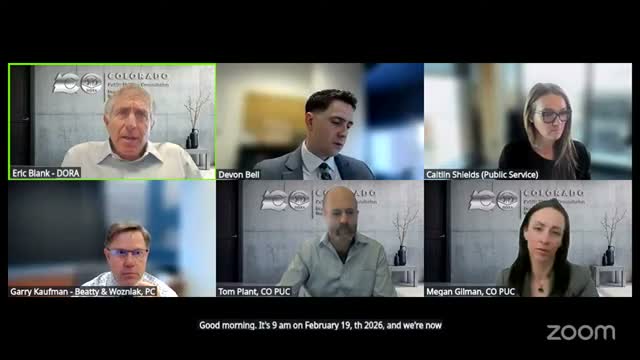
Summary
At a Feb. 19 evidentiary hearing, Xcel Energy defended the need for Segment 5 of the Colorado Power Pathway while Albert County and its experts said the company’s application lacked site‑specific wildfire planning and local signoffs; local officials also pressed that the route through the Kiowa/Highway 86 corridor would cause unacceptable local impacts even if fees were paid.
Public Utilities Commission Chair Eric Blank convened an evidentiary hearing Feb. 19 in docket 25ADashO354E to examine Public Service Company of Colorado’s (Xcel) request to construct Segment 5 of the Colorado Power Pathway through Albert County.
Xcel witnesses argued the line is necessary for statewide transmission capacity and to support the company’s resource plans. "The Pathway Project is an essential part of the infrastructure that will deliver the resources that the company has selected," said Jared Lunar, a regulatory policy specialist for Public Service Company of Colorado. Lunar told commissioners the company has identified the project as needed and that delay would increase curtailment risk for selected resources.
Albert County attorneys and witnesses disputed the sufficiency of the company’s local filings. Gary Kaufman, counsel for Albert County, and county consultant SWCA identified missing technical information in Xcel’s pre‑application and later submissions — including detailed mapping of temporary construction areas and pole locations, counts of easements acquired versus needed, and evidence of coordinated wildfire response with local fire districts. "The information submitted was very generalized," said Stephanie Blochowiak of SWCA, who testified the county sought project‑specific engineering and coordination details that were not present in the record.
A second line of dispute focused on fire‑safety assurances and money. Two volunteer fire districts, Big Sandy and Kiowa, filed letters with the PUC asking for specific safety measures such as video observation cameras and remote weather stations; they also conditioned signatures on the fire protection forms on payment of locally adopted fees. Xcel said it has offered access to its Pano AI camera network and that some districts have accepted or inquired about the offer. Patrick Paterich (recorded as Kuretic), Xcel’s director of wildfire strategy, described camera detection ranges and the company’s offer to provide feed access to local responders.
The parties also debated local impact fees. Xcel said Albert County’s code would have produced a construction/impact fee in the range of about $2.5 million on the preferred route; the company urged the PUC not to adopt the county’s fee methodology as a precondition of statewide siting. County witnesses said the fee alone would not fully offset local harms and stressed that the primary dispute remained the route’s location. "It's not about the money to me," Albert County Commissioner Mike Buck told the commission. "It's about the route and what it does to our county as a whole."
The county record includes a July 2025 board resolution denying Xcel’s local land‑use permit applications; that resolution cites wildfire risk, missing fire‑district signoffs and unresolved mapping and public‑safety questions as reasons for denial. The commission admitted many exhibits into the record but held Xcel’s Exhibit 206 (certain Albert County witness materials) for later consideration when the witness is called and privilege questions are resolved.
What happens next: The hearing produced detailed factual disputes about what mapping and mitigation Xcel provided and what the county reasonably required. Commissioners asked the parties to submit additional materials and the record includes a company commitments document that Xcel said it would follow if permitted; the commission admitted that document subject to county comment. The hearing continued with witnesses addressing wildfire mitigation, camera monitoring and the routing study. The PUC left several exhibits for overnight review and scheduled follow‑up sessions for the next day.
Provenance: Transcript discussion began when the docket was called on FEB. 19 (hearing start) and continued across multiple testimony blocks through the close of the day's record (notably Jared Lunar's testimony, Jennifer Chester's cross‑examination and county commissioner testimony).