
State rule lets approved charter sponsors apply to replicate; Senate and House diverge on committee recommendation
Get AI-powered insights, summaries, and transcripts
Sign Up Free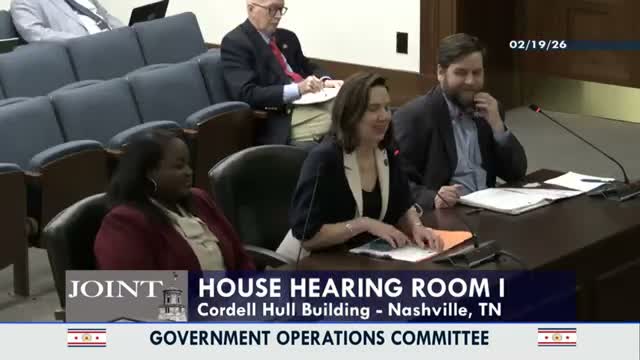
Summary
The Tennessee Public Charter School Commission explained rules implementing 2025 law that allow commission‑authorized sponsors to apply to replicate within the same LEA after one year of operation; the Senate gave a negative committee recommendation while the House issued a positive recommendation, producing split chamber responses.
The Joint Government Operations Committee considered permanent rules from the Tennessee Public Charter School Commission on Jan. 26 that implement a 2025 change allowing certain charter sponsors to apply for replication under the commission.
Tess Stovall, executive director of the Tennessee Public Charter School Commission, said the rule mirrors existing Newstart application processes and the statute (Public Chapter 275) by allowing a sponsor that already has at least one open school authorized by the commission to apply to replicate within the same geographic district. “The allowance is for a charter school sponsor who has at least one school open for one calendar year under the commission to apply for replication within the same geographic district under the commission,” Stovall said.
Members pressed the commission on local control and whether the commission could or should give additional weight to a local school board’s denial. The commission and its general counsel described the process as a de novo review that weighs the LEA’s rationale alongside applicant material; there is no statutory rubric that automatically gives overriding weight to a local board’s preference.
Several lawmakers asked how the application evaluates academic performance and community saturation. Stovall said the application rubric (created by the State Board of Education and publicly available) asks applicants to describe enrollment projections, community demand, and the academic performance of surrounding schools so authorizers can assess whether there is sufficient demand.
The committee’s recommendations were split. During the Senate roll call the motion did not receive enough votes to carry (2 ayes, 3 noes), producing a negative recommendation from the Senate. In the House the item received a positive recommendation (6 ayes, 3 noes). The split recommendations mean the rule will advance to full legislative consideration with differing committee reports from the two chambers.
Supporters described the statute and rule as a targeted, streamlined pathway intended to avoid redundant review when a sponsor seeks to replicate an already‑approved model; critics warned that the process can undercut local school districts and argued for clearer criteria to account for community saturation.
The commission said it follows the statute and that the rule itself implements statutory directives rather than creating new policy. The matter will proceed to the respective full committees and to each chamber for a floor vote where legislators can further debate or propose amendments.