
Tennessee House approves bill clarifying Fourteenth Amendment does not bind private actors after heated debate
Get AI-powered insights, summaries, and transcripts
Subscribe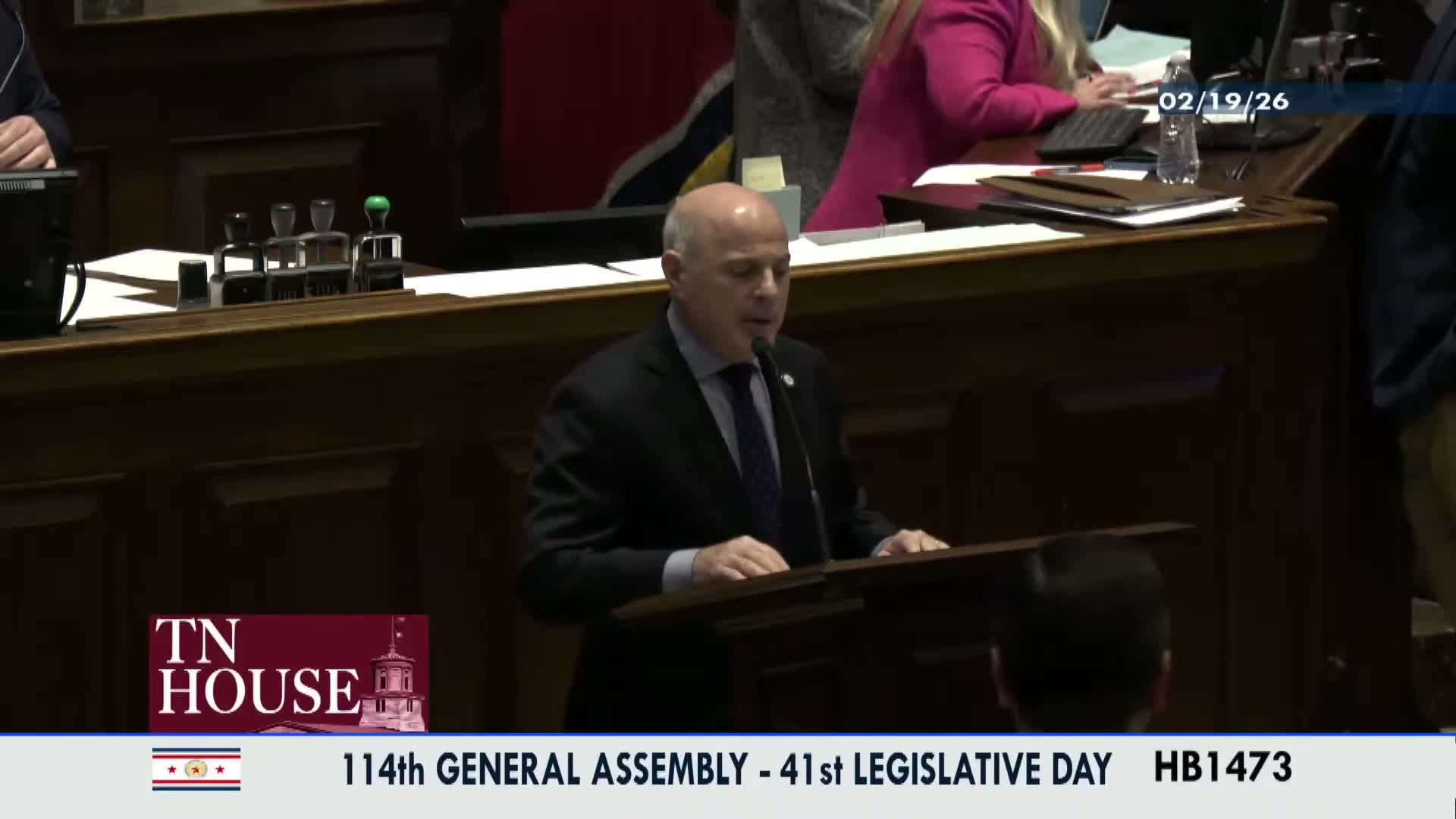
Summary
The Tennessee House passed HB 14-73 on third reading after extended floor debate over whether the bill attempts to limit application of the Fourteenth Amendment to private individuals and organizations; opponents raised supremacy-clause and caption concerns and an amendment to remove the word 'purported' failed.
NASHVILLE — The Tennessee House of Representatives voted to pass HB 14-73 on third and final consideration after more than an hour of floor debate about the scope and constitutionality of language in the bill.
Sponsor Chairman Boso opened debate saying the bill "simply clarifies" that the Fourteenth Amendment’s clauses "do not bind private citizens," and cited historical U.S. Supreme Court decisions he said support that interpretation. An amendment offered by Representative Salinas that would have removed the word "purported" from the bill failed on the floor.
Opponents pressed the sponsor on legal and procedural grounds. Representative Harris asked whether the bill would deny equal protection or due process rights, noting the Fourteenth Amendment’s text on citizenship and congressional enforcement powers. "A state cannot override the U.S. Constitution or give anyone in that state permission to override the U.S. Constitution," Harris said during questioning. Chairman Clements and Representative McKenzie argued the bill likely exceeds its caption — which describes the measure as "relative to marriage" — and warned that the proper forum to resolve constitutional questions is the courts, not a legislative body.
Sponsor and supporters responded by citing Supreme Court precedent stating Section 1 of the Fourteenth Amendment constrains state action rather than private actors. Representative Bosa told colleagues the Supreme Court has repeatedly held the amendment "does not apply to private citizens," pointing to cases from the late 19th and 20th centuries.
Members also debated practical implications raised on the floor: whether private businesses could lawfully deny services, whether private health-care providers could refuse treatment, and whether other constitutional provisions (for example, Section 3 on insurrection) would be affected. The sponsor declined to offer legal opinions on application of federal anti-discrimination law or state statutes outside the bill’s stated scope.
After a failed motion to re-refer the bill to the House Judiciary Committee, the House voted on the measure and the Speaker declared the motion carries. The Clerk recorded the final vote as Aye 68, No 24 (as announced on the floor). The bill’s supporters said it seeks to restate existing law in Tennessee code; its opponents said the language is legally and constitutionally problematic and predicted litigation would follow.
The House record shows the amendment to remove the word "purported" was defeated (23 Aye, 70 Nay) and an attempt to re-refer the bill to Judiciary also failed (Aye 24, Nay 69). The sponsor indicated the measure responds to the U.S. Supreme Court’s 2015 Obergefell decision and similar precedents.
What happens next: The vote sends the bill to the enrollment process; opponents said they expect legal challenges. The House did not adopt the Salinas amendment or the re-referral motion, and floor debate included repeated reminders from multiple members that constitutional questions typically are resolved in court.