
Senate committee adds liability requirement and advances minimum-insurance bill for highway remediation firms
Get AI-powered insights, summaries, and transcripts
Subscribe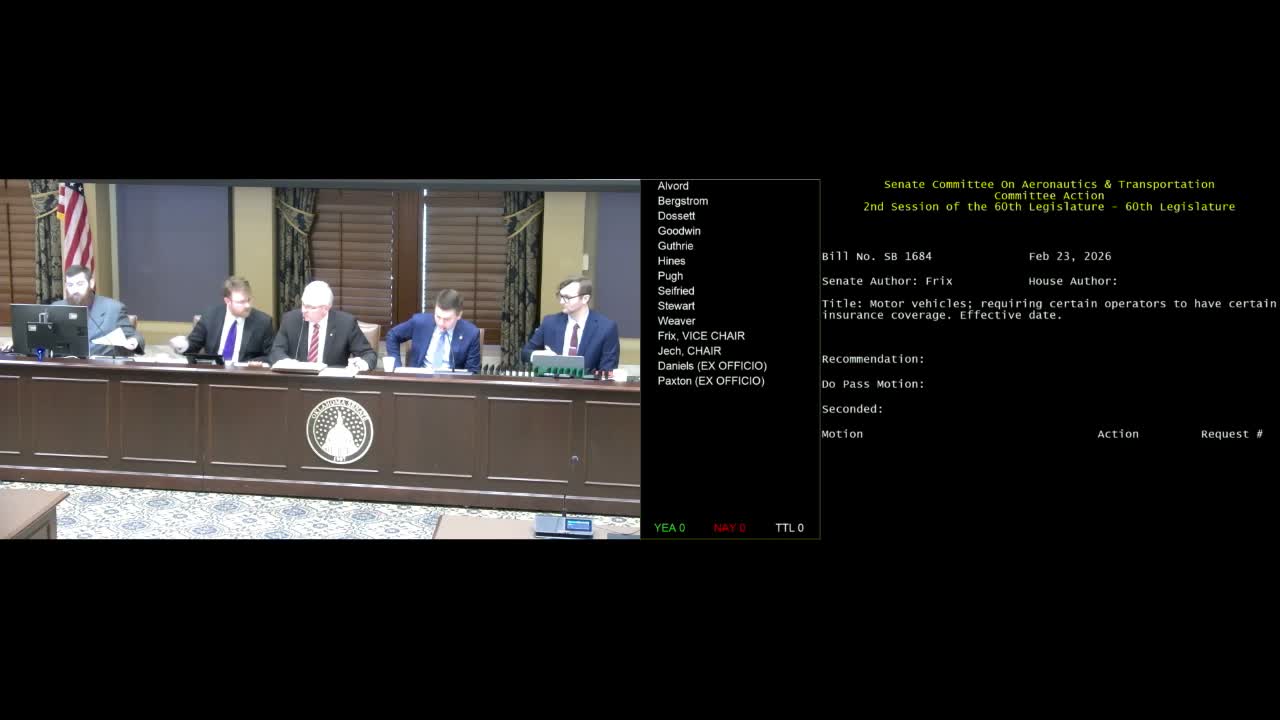
Summary
The committee amended and advanced SB 1684 to require companies performing highway remediation to carry at least $3 million in liability insurance; members adopted an amendment inserting the word "liability" and voted 12–0 to advance the bill.
Vice Chair Fricks and sponsor Senator Fricks said Senate Bill 16 84 seeks to require companies that enter roadways for highway remediation to carry a minimum amount of insurance. Fricks introduced an amendment lowering the statutory floor from $4 million to $3 million and later agreed to an additional clarifying amendment inserting the word "liability." "This bill simply attempts to require any companies that are entering the roadway to do highway remediation to have a minimum amount of insurance," Fricks said, urging adoption.
Committee members asked whether the requirement existed already, whether the threshold would push smaller firms out of the market, and what prompted the change. Fricks said most companies reported carrying about $5 million in coverage and that the statutory minimum would not be intended to put companies out of business but to address safety when hazardous materials are involved. Senator Stewart proposed specifying the type of insurance; Fricks accepted an amendment to insert "liability" before "insurance."
The committee adopted the amendment and debated subcontractor and prime-contractor dynamics; Fricks said a prime contractor carrying the required coverage should be sufficient if it hires subcontractors. After adoption of the amendments and a short debate on safety implications, the clerk recorded a unanimous vote of 12 ayes and 0 nays and the committee advanced SB 16 84.
The committee did not cite a specific incident that prompted the bill; the sponsor said the change came from conversations with industry and a desire to ensure coverage when firms work with hazardous materials on dangerous roadway scenes. The sponsor and committee members flagged the need to clarify prime/subcontractor responsibilities in statutory language before implementation.