
Think-tank analysis: Minnesota's per-capita GDP premium plummeted since 2014; human capital and productivity flagged
Get AI-powered insights, summaries, and transcripts
Sign Up Free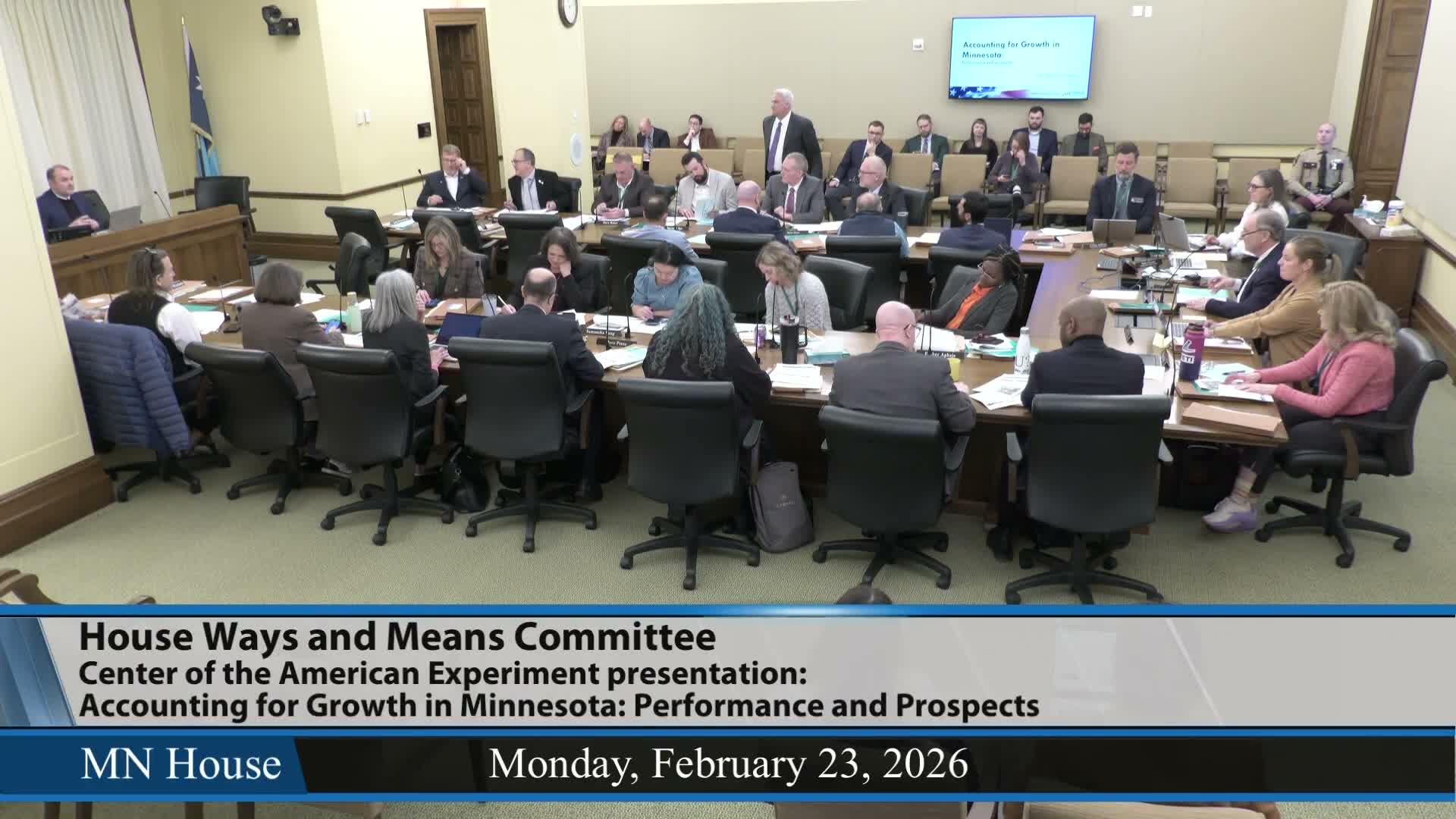
Summary
John Phelan of the Center of the American Experiment told the House Ways and Means Committee that Minnesota's per-capita GDP premium fell from $4,658 in 2014 to $239 in 2024 and that stagnating human capital, lagging physical capital growth and a TFP gap contributed to the shortfall.
John Phelan, an economist with the Center of the American Experiment, presented a growth-accounting analysis to the House Ways and Means Committee on Feb. 23, 2026, concluding that Minnesota's long-standing per-capita GDP premium over the U.S. has narrowed sharply in the past decade.
Phelan said his analysis, which applies a standard growth-accounting framework to Bureau of Economic Analysis data, found Minnesota's per-capita GDP premium fell from $4,658 (inflation-adjusted) in 2014 to $239 in 2024. "By 2024, that has fallen to just $239 per Minnesotan," Phelan said, summarizing the change.
Using the decomposition into human capital, physical capital and total factor productivity (TFP), Phelan reported that human-capital growth per capita stagnated (declining roughly 0.1% annually during the period he examined), while per-worker physical capital grew at about 1.2% (ranking near the middle of states). He said TFP accounted for the largest share of Minnesota's recent growth (he cited roughly 66% of per-capita growth since 2014) but that Minnesota's TFP growth has fallen behind the national rate since about 2019'20, opening a gap with the U.S.
Phelan focused on policy implications during questions: he recommended that the state pursue strategies to retain and attract educated prime-age workers, encourage investment in capital-intensive sectors, and support entrepreneurship to boost TFP. On housing and migration, he told members that an adequate supply of housing and attention to regional amenities matter for attracting and retaining workers.
Committee members pressed for data sources and for more granular follow-up about migration flows and the effect of recent tax and policy changes; Phelan said his analysis uses BEA data and that more detailed work on policy levers is forthcoming.
The committee thanked Phelan and moved to preview a state budget forecast hearing scheduled for the coming Friday; no legislative action was taken at the session.