
Commerce: rising distribution costs and federal tax‑credit changes could raise Minnesota utility bills
Get AI-powered insights, summaries, and transcripts
Subscribe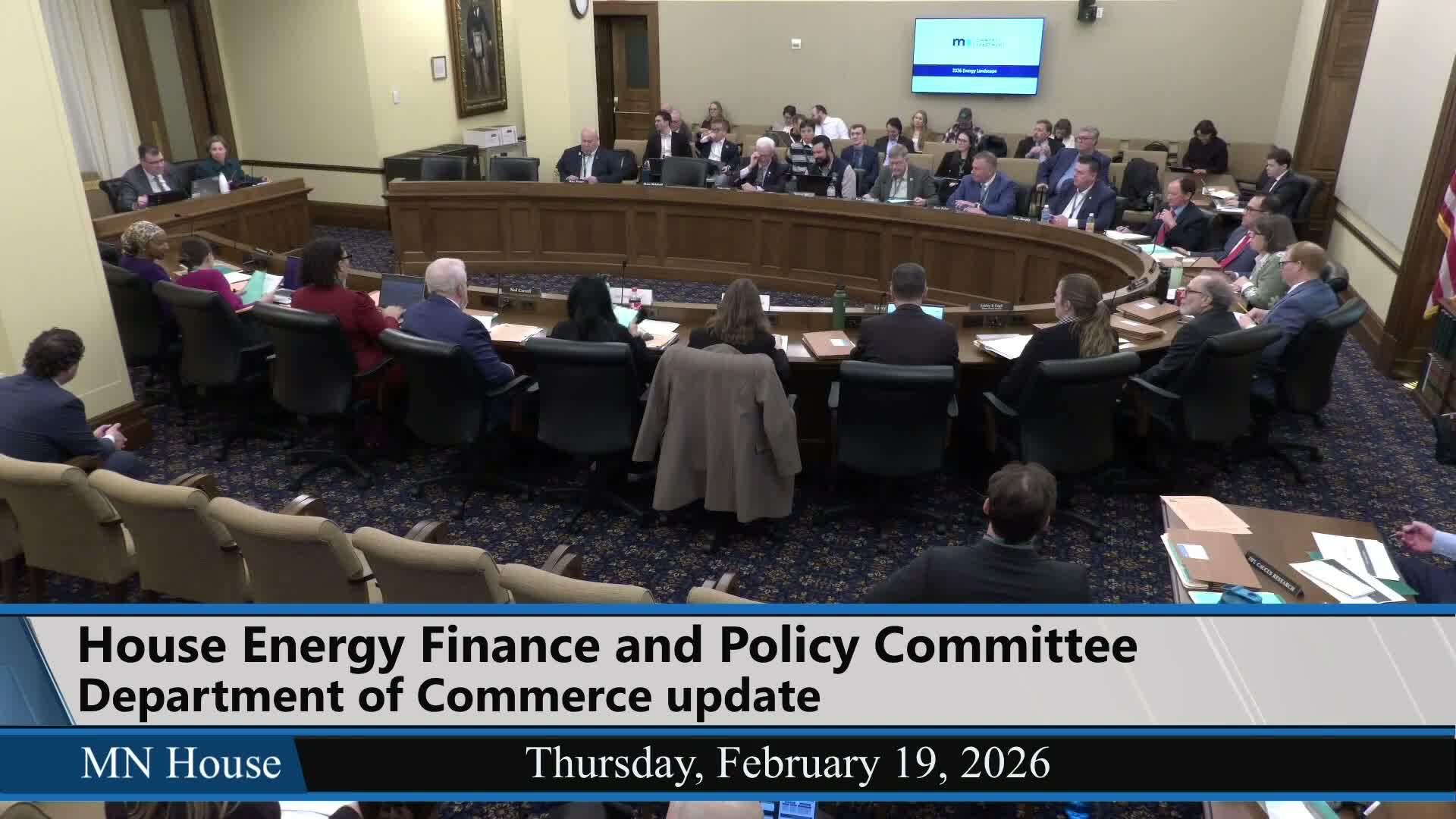
Summary
Department of Commerce warned the committee that growing distribution-system investment, the end of some federal clean‑energy tax credits and rising gas export prices could push Minnesota utility bills higher even as generation costs from wind and solar remain low.
Deputy Commissioner Pete Wyckoff of the Minnesota Department of Commerce told the House Energy Finance and Policy Committee that near‑term electricity demand is beginning to rise after years of stagnation, driven by heat pumps, electric vehicles and large industrial users such as data centers. "We can expect near term electricity demand in the U.S. to increase," he said, framing the state’s planning challenge.
Wyckoff said generation costs have fallen substantially as the system has shifted away from coal toward gas, wind and solar, but that transmission and distribution work are becoming the principal upward pressure on customer bills. "That distribution system is actually the biggest driver of cost increases," he said, urging closer regulatory scrutiny and better transparency from utilities about distribution planning and spending.
He warned that recent federal policy changes could amplify upward pressure on rates. Commerce calculated about $7,000,000,000 in tax credits in approved integrated resource plans for Xcel Energy, Minnesota Power and Otter Tail Power are at risk because of changes to commercial‑scale clean energy tax credits, and he cited a conservative model suggesting Minnesota rates could rise about 10% over the next two to three decades if projects lose federal support. Wyckoff also flagged the scheduled termination of a clean hydrogen production tax credit in 2027, which could undercut planned green‑hydrogen and green‑ammonia projects in the state.
Wyckoff described state responses to the federal changes: a Commerce program to accelerate 'solar on public buildings' that funded 199 projects statewide so projects can qualify for expiring credits, and targeted incentive work to capture incentives still available (he also cited geothermal tax credits as continuing). He said some federally awarded grants have been delayed or canceled and that legal action by Minnesota’s attorney general has preserved many state‑level awards in theory, though administrative approvals and sign‑offs remain slow.
On data centers, Wyckoff said the legislature’s data‑center package aims to ensure very large customers pay costs associated with new load so those costs do not spill over to other ratepayers; he warned of two failure modes to avoid: large loads that increase peak demand without paying for needed infrastructure, and transient loads that depart before infrastructure costs are recovered.
Members pressed Commerce on accountability for rising distribution costs and on planning. Wyckoff said cooperatives, municipals and investor‑owned utilities face different incentives, which can produce different investment decisions, and recommended stronger joint planning across generation, transmission and distribution to find least‑cost solutions.
Wyckoff also cited an estimate that keeping a barely‑used coal plant online in another MISO state could cost about $300 million annually; when asked, he estimated about 14% of that burden (roughly $42 million) would fall to Minnesota ratepayers. He said the Commerce team can provide more granular MISO‑region figures on plant counts and retirement schedules.
Wyckoff closed by urging the committee to consider low‑cost options such as energy efficiency, demand response, virtual power plants and grid‑enhancing technologies as ways to meet rising demand without excessive capital build‑out. "Those are cheap, those are good uses of resources, and those are things we're going to need to push at least on the IOUs," he said.
The committee did not take formal action on any bill during the briefing; Wyckoff said Commerce will return with further details and data as requested.