
County veteran service officers urge stronger fraud protections, training and property-tax updates
Get AI-powered insights, summaries, and transcripts
Subscribe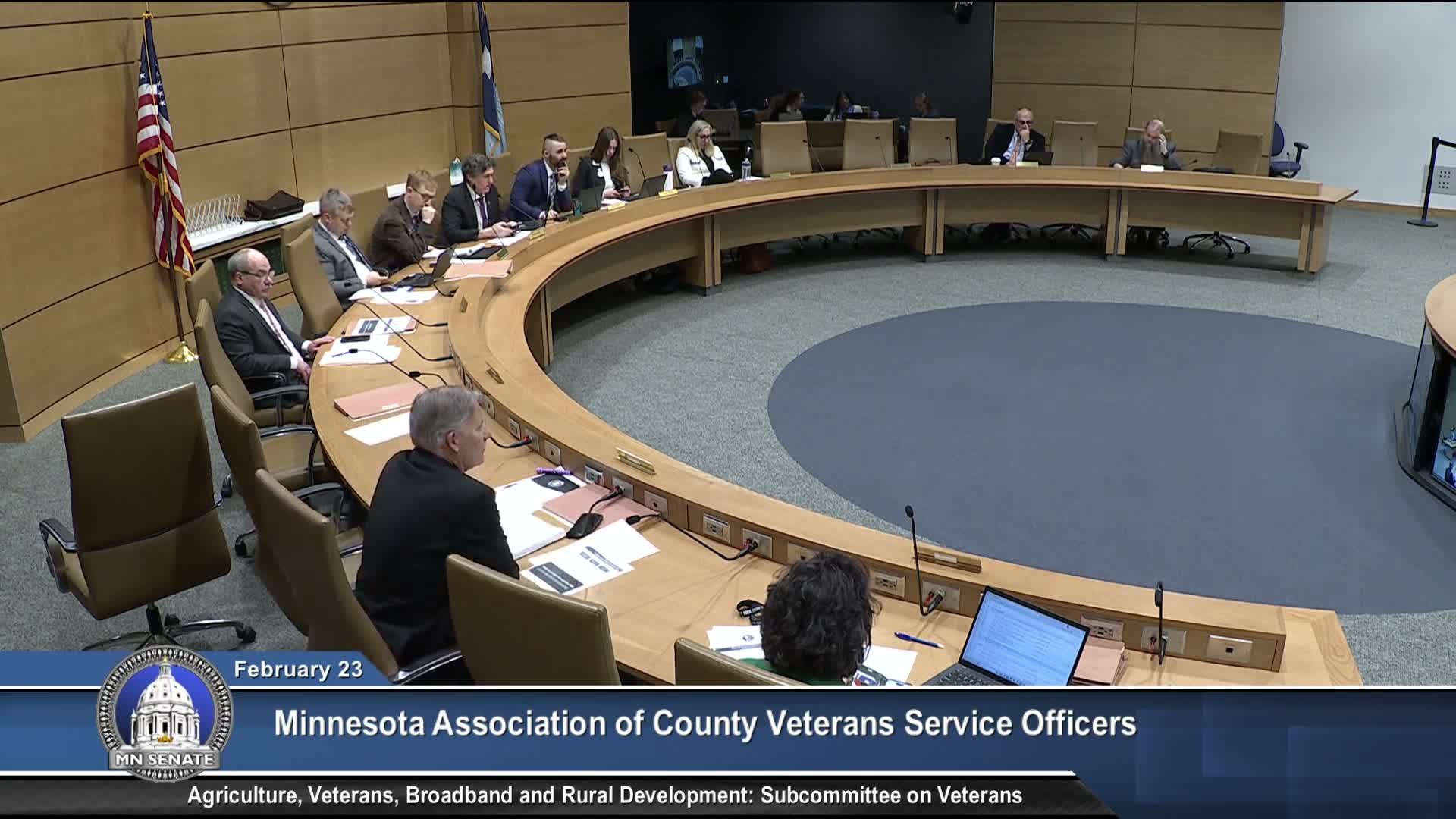
Summary
Representatives of the Minnesota Association of County Veterans Service Officers told the Senate subcommittee CVSOs provide free, accredited claims assistance, urged stronger consumer protections against predatory 'claim sharks,' and asked the legislature to modernize the disabled-veteran homestead exclusion to reflect current housing costs.
Larry Fonder, legislative chair of the Minnesota Association of County Veterans Service Officers (MACVSO), and several county VSOs testified to the Senate subcommittee on Feb. 23, 2026 about the role and needs of county veteran service officers (CVSOs).
Tom Anderson, president of MACVSO and veteran service officer for Winona County, described daily CVSO work — filing disability claims, enrolling veterans in VA health care, connecting veterans to housing and crisis resources — and emphasized that CVSOs are federally accredited, subject to state appointment and continuing training, and provide services at no cost. "Our services are always free," Anderson said while explaining the combination of federal Title 38 standards, the VA’s M21 guidance and state law that govern CVSOs.
David Gergen (Lyon County, MACVSO suicide-prevention technical adviser) described rural access challenges such as limited transportation and inconsistent broadband, reported that his office works with nearly 1,100 active case files and noted that Minnesota averages roughly one veteran suicide every 3–4 days. Christina Ross (Ramsey County CVSO) highlighted SGU veteran outreach and verification work under recently enacted state law and raised concerns about predatory actors targeting elderly veterans. Elisa Selick (assistant CVSO, Wright County) urged updated consumer protections and indexed property-tax relief for disabled veterans and surviving spouses.
MACVSO witnesses asked lawmakers to strengthen licensing and enforcement to curb unaccredited paid actors who charge veterans for services that CVSOs provide for free, and to modernize the disabled-veteran homestead exclusion (currently capped at market-value exclusions of $150,000 or $300,000 depending on rating) so it keeps pace with housing costs. Witnesses also described training requirements and a recent operating grant example: a county-level operational grant of $15,000 used for accreditation and training rather than marketing.
Committee members asked whether CVSOs face recruitment or retention issues; witnesses said turnover has brought younger veterans into the profession and that statewide training and peer support networks help maintain quality. No formal legislative action was taken during the hearing.