Get Full Government Meeting Transcripts, Videos, & Alerts Forever!
Get email alerts on the Yellow Envelope Linked Autism topic
No spam. Unsubscribe anytime.
Advocates push for statewide rollout and coordination of yellow envelope and Linked Autism Safety Project
Summary
Council members and a special education transition counselor urged state-level management of Connecticut’s new yellow envelope program and support for the volunteer-run Linked Autism Safety Project so envelopes, registries and training reach families, schools, first responders and DDS caseworkers equitably.
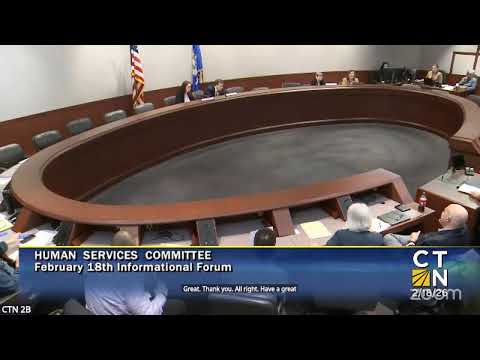
Deirdre Toole, a Stonington special-education transition counselor and council member, told the Human Services Committee that Connecticut’s green (deaf/hard-of-hearing), blue (autism) and new yellow envelopes aim to improve safety and communication between people with disabilities and first responders.
Toole described the yellow envelope as a voluntary packet that an individual can keep in a car or home and present to first responders, and she said it comes with optional accessories such as a bracelet and decals. She urged the committee to manage distribution from the state level because, she said, local uses of "yellow" envelopes (for example, a separate municipal "yellow dot" program for seniors) risk confusing first responders and families.
"We need to get these into the school systems, to community partners, to pediatricians, to libraries, and of course, to DDS and DDS caseworkers," Toole said, adding that limited program funding has left many towns without envelopes or training.
Toole also spotlighted the Linked Autism Safety Project, a volunteer nonprofit that provides a voluntary registration process, sensory kits and training for police, fire and EMS. The Linked founder (appearing by Zoom) described the program as a three‑year-old nonprofit partnering with municipal police, fire and EMS and teaching at police and fire academies. "There's no specific legislation around Linked," she said; "it's programming we as an organization have been providing and working with various municipalities."
Committee members and witnesses discussed common-sense distribution channels such as municipal clerks, municipal agents and routine clinical sites, and recommended targeted outreach with a small public-information budget to make the envelopes accessible to families who do not visit a DMV or police station frequently.
What happens next: advocates asked the committee to recommend that a state office (Human Services or an appropriate agency) coordinate distribution and training so all towns receive the yellow envelope packets and associated training. No formal action was taken at the hearing.