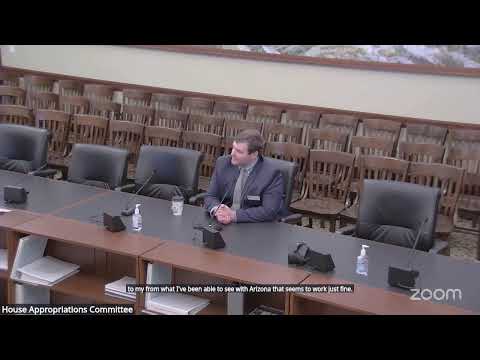
Committee approves House Bill 129 to license internationally trained physicians, 7–0
Loading...
Summary
The Joint & Standing committee voted 7–0 to send House Bill 129, the Expanding Physician Access Act, forward with an appropriation to build licensing and renewal functions; sponsor said fees from new licenses would fund the program and emphasized the measure is likely to add only a small number of physicians to the state workforce.
The Joint & Standing committee voted unanimously to advance House Bill 129, the Expanding Physician Access Act, recommending it “do pass” with an appropriation to support licensing and screening of internationally trained physicians.
Representative Wasserburger, the bill sponsor, told the committee the bill creates a process to license physicians trained abroad, adds “a little bit more guardrails” compared with a prior version and includes background checks. “If we were able to add 5 physicians to our state, I think that’d be a much bigger difference,” Wasserburger said, describing the proposal as a targeted step to address provider shortages rather than a comprehensive solution.
Committee members focused on the bill’s fiscal components. Representative Pendergraft asked specifically about a $40,000 contractual-services line item. Wasserburger said that amount was recommended by a member of the Board of Medicine to evaluate applicants and to process licensure and training verifications. Committee staff clarified the $40,000 would pay for an initial build of licensing and renewal components in the board’s existing database and online application functions, and that an annual license-database subscription fee of $3,500 was anticipated thereafter.
Vice chair and other members reviewed the bill’s fiscal notes and asked whether revenues generated by new licensing fees would offset program costs. The committee recorded projected special-revenue increases across fiscal years referenced in the record; Wasserburger confirmed his understanding that those special revenues would be used by the agency to cover the program’s costs.
Chairman Bair asked which countries would be considered source countries for applicants. Wasserburger said last year’s draft included a specific list modeled on Arizona’s approach but the committee chose not to limit source countries this year; he cited examples used in other states, including the United Kingdom and Australia, and said he would not object to the committee adopting an explicit country list.
There was no public testimony. A motion to advance the bill was moved by Representative Angelos and seconded by Representative Smith. The roll call vote recorded Aye from Representatives Aleman, Angelos, Chairman Bair, Pendergraft, Sherwood, Smith and Vice Chairman Harrelson for a 7–0 recorded passage.
The committee closed by asking members to check calendars for interim meeting dates and adjourned. The bill will proceed to the next floor consideration with the committee’s fiscal recommendation.