
Marlington board reviews capital projects: esports, paving, gym floor and a community weight room concept
Get AI-powered insights, summaries, and transcripts
Subscribe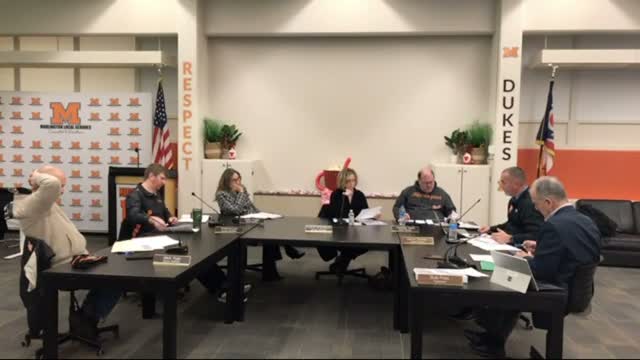
Summary
Superintendent presented a book of potential capital projects including an esports program (~$25,000 start‑up), multiple paving and lighting bids, an EPA‑required fence (~$8,524), a middle‑school gym floor (~$72,000) and a conceptual 3,000–6,000 sq ft community weight room with a booster‑club fundraising plan.
Marlington Local School District leaders reviewed a packet of possible capital projects and fundraising options at Thursday's work session, discussing everything from an esports program to large facility renovations.
"Start up is roughly around $25,000," the superintendent said when describing an esports program the district explored previously; he added Mount Union is available as a potential partner and that the program would primarily require one‑time startup equipment costs plus a modest coach stipend.
Board members then reviewed a set of vendor quotes and scopes for paving and lighting projects. The superintendent said two contractors (Vasco and Jefferies Construction) supplied bids after the district standardized scope to make apples‑to‑apples comparisons. Lighting quotes by building were described in the packet (Lexington about $45,000; Washington about $59,000; Marlboro about $43,000).
Several facility repair items were identified as priorities. An EPA‑required fence around the Marlboro wastewater treatment plant was quoted at $8,524; the superintendent said Washington Elementary has older chain‑link fencing that may need replacement (about $13,000). For facilities the district uses immediately with students, the superintendent recommended addressing required items first.
Athletics and large projects were a major focus. The middle‑school gym floor was described as worn and unstable; the superintendent presented a replacement quote of approximately $72,000. The district also discussed a future track resurfacing that could cost in the range of $600,000 or more when the district schedules full replacement.
On a larger scale, the superintendent floated a conceptual addition near the Mullin Center — a 3,000–6,000 square‑foot weight/wellness room intended for students and Marlington residents — and outlined a fundraising approach. He proposed that the Booster Club try to raise $700,000–$800,000 toward the project and that the board set aside a dollar‑for‑dollar match if fundraising succeeds. The presentation includes a high‑end commercial cost assumption of roughly $2.50–$3.50 per square foot and stated a 6,000 sq ft build would be in the ballpark of $1.4 million.
The superintendent emphasized the concept was at an early brainstorming stage and not a finalized project, and he noted the board would not be expected to commit to construction without further design, architect estimates and a formal bidding process. He also raised the possibility of working with community partners: the transcript records that the YMCA plans to relocate closer to the district, which could affect latchkey and summer programming and reduce some district program costs.
Board members asked staff to compile a comprehensive prioritized list (fields, gym floor, track, Mullin Center updates) with estimated costs and proposed timing to support donor outreach and a potential multi‑year plan. No capital project votes were taken at the Feb. 5 work session; several items will be returned to the board with additional cost breakdowns and procurement steps.
(Reporting note: cost figures presented in the article reflect numbers and ranges given during the Feb. 5 work session packet and discussion.)