
Marlington officials: Ohio tax changes will cut district revenue starting 2027; forecast shows near‑term strain
Get AI-powered insights, summaries, and transcripts
Subscribe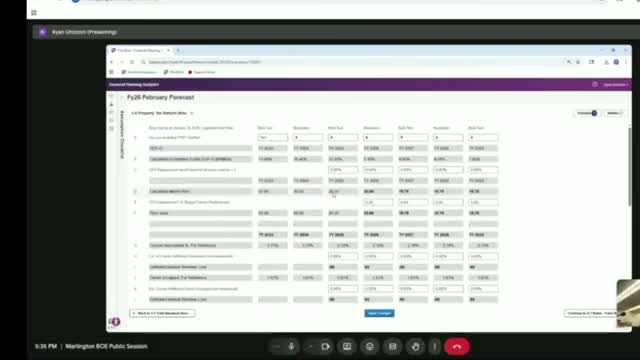
Summary
Board members were told at a Feb. 5 work session that recent Ohio property‑tax reforms will produce a $561,000 state look‑back credit to taxpayers and reduce the district’s future revenue beginning in tax year 2027. Staff said the district is not in a financial emergency but faces multi‑year deficits without further adjustments.
Marlington Local School District officials were told Thursday that recent Ohio property‑tax reforms will reduce the district’s future revenues and require continued budget adjustments.
"They're gonna get a credit on their current tax bill of $561,000," said Ryan Gazzini, the finance presenter, describing a state‑paid look‑back credit the presenter said results from recent legislation. Gazzini told the board the state will pay that look‑back amount on behalf of the district this year, but that the district will stop receiving the related revenue beginning in tax year 2027.
The fact that the state will pay one year’s look‑back credit does not erase the longer‑term impact, Gazzini said: "So what that means is you do have this is a loss of funding to the school district." He and staff framed the change as a structural reduction in the district’s projected growth compared with the October forecast.
Why it matters: the presentation said Marlington remains positioned short‑term — staff characterized the district as not in a financial emergency now — but the combination of property‑tax reform and other factors could produce operating shortfalls later in the five‑year window. Staff showed the board a February forecast that compared the October projection to the new assumptions and highlighted the key drivers of the decline.
Key numbers and drivers presented to the board included a state look‑back credit of $561,000, the implication of a roughly $1,000,000 difference in 2027 when the reforms take full effect, and guarantee changes the presenter said would cost the district roughly $4.0 million in 2027 and $5.3 million in 2028 if the state guarantee were removed. Staff also cited expense pressures for 2026 — higher tuition/contracted services for students with special needs and a projected $175,000 transfer to cover a current service‑fund deficit — which together raise 2026 spending by about $369,000.
Gazzini summarized the near term as: "As of right now, February, we still have five months to go ... You're within a $134,000 out of balance budget," and he warned that without further actions the district could see about a $500,000 operating deficit the following year.
Board discussion focused on how the new law (described in the presentation as a series of bills including references to House Bill 335 and House Bill 186) alters millage calculations and how future levies or alternative revenue options would interact with the look‑back credit. Gazzini and the superintendent walked the board through scenarios in which a district that later goes off the 20‑mill floor and passes a levy can see some credits return to taxpayers after reappraisal. Board members asked operational questions about possible tax alternatives (noting the longer ramp‑up for an earned income tax) and collection of payments in lieu of taxes that staff said they are still confirming.
The superintendent emphasized ongoing cost‑drivers the board cannot control, including increased need for special‑education services: "In preschool right now, we have 24 kids that currently have some type of learning disability already," he said, noting those students require additional supports and resources.
Next steps: staff told the board they will continue to refine the forecast and provide additional details on income‑tax mechanics and PIL receipts. No formal vote on budgets or levies was taken at the session; board members asked staff to monitor the next two triennial reappraisals and state budget actions and return with updated options.
(Reporting note: numerical figures and bill identifiers quoted here replicate how items were stated during the Feb. 5 work session. Where a precise statutory citation was not provided in the transcript, the article reflects the transcript wording.)