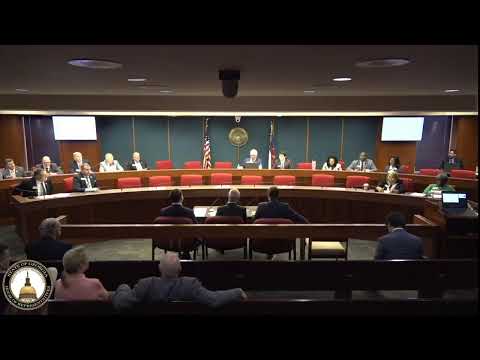
Committee advances bill allowing retailers to round cash totals to nearest nickel after penny production ceased
Loading...
Summary
Committee approved a bill permitting retailers to round cash transactions to the nearest five cents according to set rules (round down on totals ending in 1,2,6,7; round up on 3,4,8,9), while preserving pennies as legal tender and keeping tax calculated on the pre-rounded sales price.
The committee advanced a bill intended to help retailers cope with the end of federal penny production by allowing regulated rounding of cash transactions to the nearest nickel under specified rules.
Representative Barrett, sponsor of the retail cash-rounding bill (LC 620427S), said the measure would standardize how retailers treat cash totals when pennies are scarce: if a cash total ends in 1, 2, 6 or 7 cents the cashier may round down to the nearest nickel; if it ends in 3, 4, 8 or 9 cents the cashier may round up. The sponsor said the bill is aligned with other state practices and is not intended to force stores to round—retailers may continue to accept and give exact pennies as legal tender.
Members asked whether the bill requires retailers to post signage or disclose rounding practices; the sponsor said it does not mandate signage and that disclosure might be addressed in future legislation. The Department of Revenue representative clarified tax treatment: sales tax is calculated on the actual sales price before rounding and the subsequent rounding affects only the cash change given. A committee member noted an estimate—described as approximate in the hearing—of about $1.14 billion worth of pennies still in U.S. circulation.
A motion to "do pass" was made and seconded; the committee approved the bill by voice vote. Sponsors said small businesses may opt to continue issuing exact change and that the bill's intent is to create consistent rules of engagement rather than to advantage or disadvantage consumers.