
Senate committee advances bill to codify post‑election audits after Weston County errors
Get AI-powered insights, summaries, and transcripts
Subscribe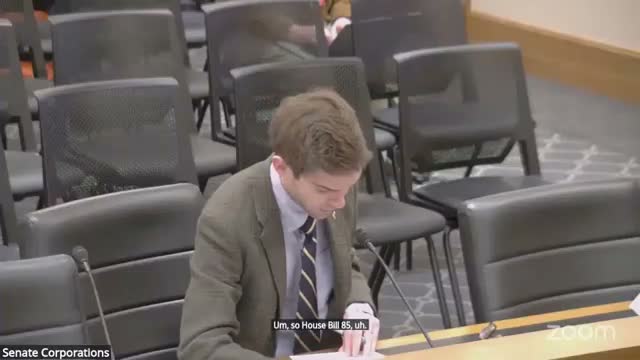
Summary
The Senate Corporations Committee advanced House Bill 85 to require minutes, sworn observers and public notice for post‑election audits after a Weston County sample found 21 errors in 75 ballots; clerks warned about room capacity and ballot security during the process.
CHEYENNE — The Senate Corporations Committee voted to advance House Bill 85, a measure to formalize post‑election audit procedures after errors surfaced in a Weston County review.
The bill, discussed Wednesday in committee, would add requirements to Wyoming Statute 22‑6‑130 that minutes be taken of post‑election audits, that county clerks notify political‑party representatives and that at least two electors “of different political affiliation” be present as observers. The bill also references the oath for election officials in Wyoming Statute 22‑8‑115 and sets an effective date of July 1, 2026.
Mister Rubino, who explained HB85 to the committee, said the measure stems from work by a Weston County subcommittee of the management audit committee following a verified complaint from the 2024 general election. “This came out of the Weston County subcommittee,” he said, and the bill’s changes are intended to increase record‑keeping, transparency and public participation in the audit process.
Mary Langford, speaking for county clerks, said clerks helped shape the bill but warned that many county election spaces are small. “The ballots are secret and need to be secured and protected,” Langford said, adding that chain‑of‑custody and equipment security limit how many observers a clerk can safely accommodate.
The committee also heard technical background on how audits are performed. Langford and other witnesses explained the post‑election audit compares ballot images to the cast‑vote record on a statistically significant sample of ballots; it is not a hand count. The statute requires audit results to be reported to the Secretary of State’s office at least one day before the state canvassing board meets, which generally occurs after county certification.
The Secretary of State summarized why lawmakers sought statutory changes. “In Weston County, it was 75 ballots. And 21 of those 75 ballots had errors that were not reported to our office,” the secretary said, describing that mismatch between ballot images and cast‑vote records as the anomaly that prompted the subcommittee’s work. The secretary said the intent of the bill is to ensure witnesses are present to verify that an audit actually occurred.
Members of the public also testified. Brett Moline of the Wyoming Farm Bureau Federation said members favored “fair, accurate, transparent elections” and supported changes that would be administrable in every county. Gail Simmons of Civics 307 urged clearer statutory limits on observers tied to official room capacity, warning that too many people in a small room could increase the risk of mistakes.
Senator Steinmetz proposed an amendment to preserve a minimum of two observers while allowing a cap “not more than a number that will ensure an orderly audit.” The committee amended language to allow representatives of different political affiliations and to add “members of the public” in a limited way.
On a roll‑call vote the committee reported the bill favorably, the chair announcing the tally as four ayes and one no. The committee said it would seek a floor sponsor and expected the bill to move to the Senate floor for further consideration.
What remains unresolved in committee discussion is the precise statutory language that balances guaranteed partisan witnesses with practical limits on room capacity and ballot security; committee members asked staff to refine the amendment before floor debate.