Virginia Senate HHR subcommittee reviews fiscal impacts of about 20 health bills
Loading...
Summary
Staff briefed the Senate Health and Human Resources subcommittee on the projected general‑fund effects of roughly 20 health‑related bills, flagging a centralized child‑protective‑services intake proposal with multi‑million‑dollar costs and noting several regulatory changes that will be reflected in the budget report to the full Senate on Sunday.
The Health and Human Resources subcommittee of the Virginia Senate heard a staff briefing on the projected general‑fund impacts of about 20 health‑related Senate bills during a brief session in Senate Committee Room 1300. The chair opened the meeting saying, "I don't think we have any votes today, but I wanna call this meeting to order," and staff walked members through line items on a committee spreadsheet.
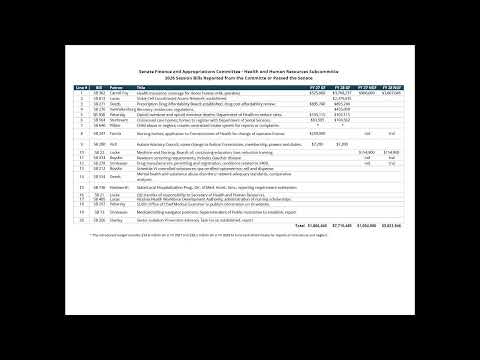
Staff said the bills range from regulatory changes to new programmatic spending and identified several items likely to affect the state budget. "You can see on the spreadsheet that y'all have before you," staff said, and then summarized individual bills including coverage for donor human milk (Senate Bill 362), a Sickle Cell Access Network (identified in the transcript as SB 813), and the Prescription Drug Affordability Board (SB 271), whose operating costs would be incorporated into the budget.
The briefing spotlighted one item with the largest explicit dollar figures: staff said the centralized intake provision in SB 640 (child protective services) carried the largest introduced budget entry, citing roughly $14.6 million general fund in year one and $18.1 million in year two in the introduced budget. Staff added that, because the centralized‑intake measure was not advancing in full, the subcommittee would likely retain a smaller allocation—"probably in the magnitude of $1.0 to $2.0 million"—to fund vendor work and studies related to the proposal.
Other bills noted for specific budget or administrative impacts included SB 564 (requiring registration of certain unlicensed care homes and one Department of Social Services position), SB 270 (recovery‑residence regulation with IT and position costs at the Department of Behavioral Health and Developmental Services), SB 405 (transferring administration of nursing scholarship programs to the Virginia Health Workforce Development Authority), and SB 374 (adding Gaucher disease to newborn screening, with labs expected to use the newborn screening fee to cover costs). Staff said several regulatory items would have little or no direct general‑fund effect because they would be paid from licensing or dedicated fee revenue.
The chair and staff emphasized that this session was a review; there were no votes. Staff closed by estimating the combined general‑fund footprint of the listed bills at "a little shy in the $9 million to $10 million general‑fund range," while noting offsets and that specific entries would be finalized in the budget report the subcommittee prepares for the full Senate on Sunday. "So with that, mister chair, are there any questions? That's it," staff concluded.
The subcommittee did not take formal action during the briefing session. The committee is scheduled to report the HHR budget items to the full Senate on Sunday, according to staff.