Get AI Briefings, Transcripts & Alerts on Local & National Government Meetings — Forever.
Burbank police outline 2025 military-equipment inventory as residents urge limits on "less-than-lethal" tools
Loading...
Summary
At a city community engagement meeting, the Burbank Police Department presented its 2025 military equipment inventory and use policy under Assembly Bill 41; residents raised concerns that so-called "less-than-lethal" tools can still cause serious harm and urged redirecting funds to community programs.
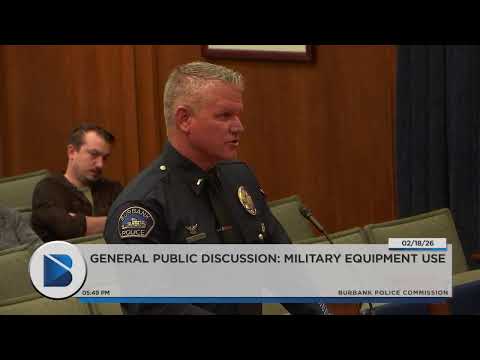
The Burbank Police Department presented its annual military equipment inventory and use policy at a community meeting, outlining what the department classifies as military equipment and how often the items were used in 2025. Residents attending and calling in urged the department to limit or divest such tools and to prioritize spending on mental-health responders and youth programs.
The presentation, introduced as compliance with Assembly Bill 41, explained that the law (signed Sept. 30, 2021, effective Jan. 1, 2022) requires local law enforcement agencies to adopt a military equipment use policy and publish an annual report. The department said it has made the policy and report available on its website under the Transparency tab and referenced Policy 709 for details on authorized uses.
Lieutenant John Fromer, the departmenttactical commander, described the departmentinventory and how items are intended to be used. He said the department did not acquire equipment through federal military surplus programs and that most items were purchased from vendors that manufacture equipment for law enforcement. Fromer said the newer SWAT "recon" robot was deployed six times in 2025 and that the departmentdrones were flown 47 times in 2025. "These devices are used to locate a dangerous subject without exposing our officers," Fromer said, describing infrared cameras and lighting on the small robot.
On armored vehicles, the department described its Bearcat armored rescue vehicle as a ballistic-protection vehicle purchased in 2008 with grant funding and nearing end of life. Fromer said the department secured federal grant funding this year to replace it and expects a decision from federal authorities in the coming months. The Bearcat, used primarily to provide cover and to rescue injured civilians or officers in active-threat incidents, was deployed five times in 2025.
The presentation listed deployment counts for several items: flash diversionary devices (commonly called "flashbangs") were deployed five times; chemical agents (CS and OC) were deployed 11 times in 2025, nine of those via an MK-9 stream aerosol device that can deliver an aerosolized agent into enclosed areas; a pepper-ball launcher (which delivers PAVA powder) was used six times; and a 40-millimeter launcher firing sponge rounds was deployed six times.
Residents and callers raised repeated concerns about terminology, safety and accountability. Joseph Morales, a phone caller, said the city is "in a deficit and militarizing our police force does nothing to keep us safer," adding that "less-lethal weapons are still lethal." Caller Nolan described seeing armored vehicles at a community "night out" event and said the display made him uncomfortable bringing his children. Caller Ally asked that the city "not move forward with purchasing these military-grade weapons" and instead invest funds in schools and community programs.
At the meeting, Micklyn Rogers asked whether remotely operated devices reduce the "human touch" in policing. Fromer responded that drones and robots provide an overview but are followed by officer contact so people ultimately have a human interaction with a Burbank police officer. He also noted current two-way audio on small drones often is ineffective because of noise. "When we use the drone, in the end we're going to talk to every individual involved with the incident," he said.
On the use of chemical agents, Fromer clarified the department uses CS and OC and said the agency does not use CN (a different wartime gas) and that deployments occur under incident-commander direction at lieutenant level or higher. He acknowledged risks: "Anything there are times when things can become lethal when not intended," Fromer said, and added the department prioritizes getting medical attention for people exposed to such agents.
Residents pressed whether the department would use the equipment against local protesters; Fromer said such tools would be used only when a protest has escalated into a riot or unlawful assembly and when there is criminal conduct or a credible threat of serious harm. "It has to be declared an unlawful assembly," he said, adding that use is intended for subjects engaging in violent criminal behavior.
The department invited attendees to review the report and Policy 709 online (BurbankPD.org under Transparency) and offered to continue community engagement, including the possibility of a community academy or demonstrations so residents can better understand the tools. The meeting concluded without any formal vote or policy change; staff said they would respond to a public email submitted about the report.
What happens next: the department will await federal notice regarding grant funding for a replacement armored vehicle and continues to publish its annual report and policy online; the public was encouraged to contact the department with further questions.