Get Full Government Meeting Transcripts, Videos, & Alerts Forever!
Get email alerts on the Public Records topic
No spam. Unsubscribe anytime.
Committee advances LSO public-records draft after wide testimony; plea-agreement language added
Summary
After a lengthy working-group update and broad stakeholder testimony, the committee moved forward LSO draft 51 on public records with amendments that include treating plea agreements and nonconfidential portions of sentencing memoranda as public records. The ombudsman recommended more stakeholder work; the committee advanced the draft by roll call.
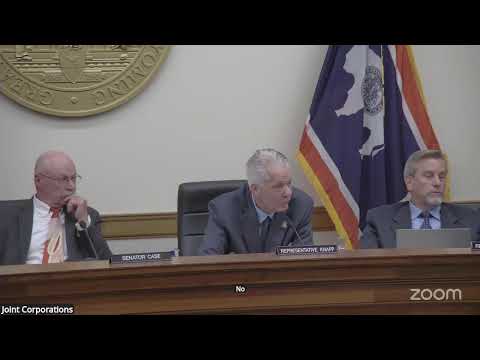
The Corporations, Elections & Political Subdivisions Committee on Feb. 23 advanced a Legislative Service Office draft (26 LSO 51) that would revise Wyoming’s Public Records Act after a multi-stakeholder working group and a day of testimony.
Darlena Potter, the public records ombudsman, reviewed the working-group process and recommended pausing the measure until the general session to complete stakeholder work; she offered compromise edits — for example, acknowledging requests in 5 business days (rather than 3), providing records within 10–15 business days (rather than shorter windows), and allowing a 20-business-day extension for complex requests. Potter emphasized a training-first enforcement approach (education, remediation, then penalties) and urged attention to fee schedules and the capacity of small entities.
Press representatives and local newspapers urged the committee to move the LSO draft forward. Bob Bonner of the Wyoming Press Association said the legislation would improve accountability and asked the committee to adopt the LSO draft without the working-group amendments; he also urged striking the phrase "knowingly or intentionally" from the penalty provision to reduce a perceived loophole. The state auditor, Christy Racines, supported uniform fee language and stronger transparency but warned that shorter timelines increase the risk of inadvertent violations and suggested cautious, simple rules.
Local governments, special-district representatives, and school boards urged protections for small and volunteer-run entities, tiered timelines, and clear guidance for custodians — citing real constraints (seasonal fieldwork, volunteer clerks, and one-person offices). The committee adopted an amendment to explicitly include plea agreements and the nonconfidential portions of sentencing memoranda in the definition of official public records and then voted to advance the LSO draft as amended.
On a roll-call vote the committee recorded 13 ayes; the motion carried. Members said they expect continued work during the session to refine timelines, fee structures, and enforcement details.