
Regional planners ask lawmakers to tweak Act 181 to speed amendments, clarify designation rules
Get AI-powered insights, summaries, and transcripts
Sign Up Free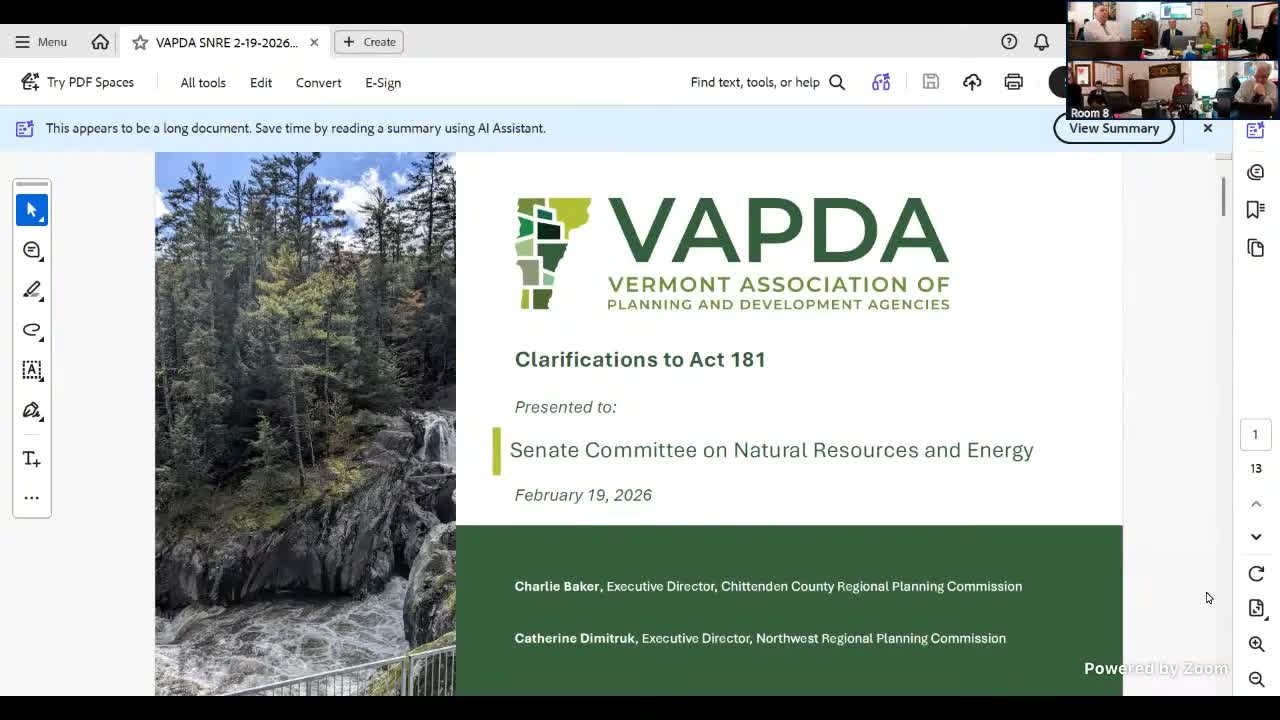
Summary
Regional planning commissioners told the Natural Resources & Energy committee Feb. 19 that modest statutory edits to Act 181 could reduce municipal frustration, speed housing-ready mapping and let towns more easily access designation incentives; they asked for a faster amendment process, clearer definitions and short extensions for expiring plans.
Trevor Baker of the Chittenden County Regional Planning Commission and Catherine Ventura of the Northwest Regional Planning Commission told the Natural Resources & Energy committee on Thursday that targeted changes to Act 181 would make regional planning and town participation easier without altering the law’s policy goals.
Baker said the heart of the work is aligning regional growth-area maps and state housing targets, and noted the Vermont Housing Finance Agency and the Department of Housing Community Development set regional goals for 2030 and 2050. "In the 2050 goal, there's a lower target and an upper target, basically a range from 79,000 to 172,000," he said, adding that Vermont currently has roughly 300,000 housing units for context. He told the committee the RPCs break those targets down by housing type to plan mixes of single-family homes, small apartments and larger buildings.
The presenters described four concrete changes they recommend. First, they want Community Investment Board comments moved earlier in the review so towns and regions can incorporate incentives and tax-credit feedback up front. Second, they proposed a streamlined amendment process for regional plans: for limited changes such as adding a town to a tier 1b-eligible area or adjusting a future land-use map after sewer or water becomes available, the presenters asked for a 2–3 month amendment pathway rather than the current 6–9 month process.
"We're really trying to unlock the market and have the market start responding," Baker said, explaining the intent behind faster, more predictable regulatory steps.
Third, the RPCs recommended clarifying statutory language that defines the four land-use categories that feed the designation program. The presenters said qualifying language is scattered across statute and occasionally conflicts; consolidating definitions into the future land-use section would reduce ambiguity and let smaller or emerging centers access baseline designation benefits. Catherine Ventura noted this would allow the basic benefits of the designation program to apply without National Register eligibility while reserving greater benefits for places that meet that higher standard.
Fourth, presenters asked the Legislature to restore a "smart growth" definition that was inadvertently removed in prior edits and to update it to reflect current practice.
On mapping and scale, Ventura said tier 1b areas are limited but meaningful: RPC mapping to date suggests roughly 2–3% of Vermont could be mapped as tier 1b-eligible — a substantial increase from legacy downtowns, which previously covered about 0.3% of the state. She summarized tier 1b as enabling up to 50 housing units on 10 acres without a separate Act 250 review in qualifying areas.
Baker said five regions have submitted draft maps for the Land Use Review Board's early 60-day review and three have received comment letters; those RPCs are working through comments. He said regional plans remain on track for board adoptions later in the year but acknowledged that three regions (including Rutland and Addison) have plan expiration dates in June and could benefit from a short extension or a brief grace period to avoid losing eligibility during map adjustments.
The presenters said they would supply specific statutory language and commentary for the committee’s consideration. They characterized the proposals as process-focused fixes — moving review points earlier, shortening limited amendment procedures, clarifying definitions and restoring a statutory term — rather than changes to program intent.
The committee did not take formal action during the presentation; presenters were asked to submit language for review and to follow up on the regions that need short plan extensions. The RPCs said they will continue local outreach as they refine maps and respond to review-board comments.