Get Full Government Meeting Transcripts, Videos, & Alerts Forever!
Get email alerts on the School Closures topic
No spam. Unsubscribe anytime.
Baltimore City Schools outlines formal closure and charter renewal process, cites funding shortfalls
Summary
City Schools told a council committee that school‑closure recommendations follow board policy and state rules, include public hearings and transition supports, and are driven by academic, utilization and facility factors; the district highlighted a multi‑year facilities funding gap and said it extends post‑vote transition support.
Baltimore City Public Schools officials gave the City Council’s Education, Youth and Older Adults Committee a detailed walk‑through of how the district recommends school closures and handles charter renewals.
Angela Alvarez, senior executive director for the Office of New Initiatives, said the district follows state regulation and Board policies (including board policy FCA/FCA‑RA for traditional schools and IHBJ/IHBJ‑RA for charter renewals). For traditional schools the process begins with board briefings and public announcements in November, school‑based meetings and steering committees, two board hearings devoted to public comment, and then a public board vote followed by a final report and notice about appeals roughly 30 days later. Alvarez said the district posts reports and related letters on the City Schools website and uses newspapers, letters and phone calls to notify families.
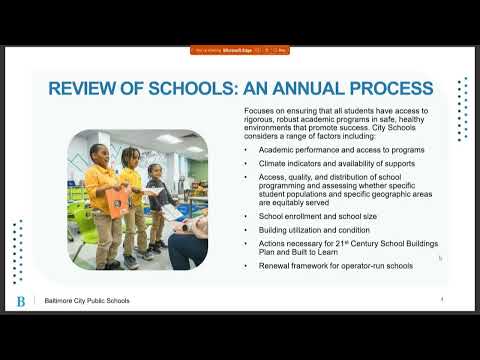
Alvarez listed the primary factors that drive recommendations: academic performance and the ability to deliver programming; climate indicators such as suspensions and chronic absenteeism; demographic and special‑program needs; enrollment and school size; building utilization and physical condition; and operator‑renewal findings. She said undersized schools (commonly defined as under about 300 students) face particular program and staffing limits that make it hard to provide electives and specialized instruction.
The presentation placed closures in the context of the district’s 20 First Century (Built to Learn) facilities strategy. Alvarez said the plan required surplusing dozens of buildings (26 initially; with refinancing the district ultimately targeted work on 29 buildings affecting about 34 school communities) and set a utilization target near 87 percent. She said the system receives roughly $155 million annually for facilities but estimates it requires about $530 million to maintain its portfolio, creating an approximate $375 million shortfall; Alvarez cited a per‑pupil facilities funding figure of about $231 compared with much larger amounts in neighboring counties.
Alvarez emphasized that the district has expanded transition support in recent years: instead of ending support at a vote, the district holds transition committees and provides two to three years of assistance to receiving schools, hosts family events and ‘‘mini fairs’’ so families can meet potential receiving schools, runs walk audits with the Department of Transportation to check safety for new routes, and creates memory books and cultural displays to preserve closed schools’ histories. ‘‘We hold on to support of school communities for 2 to 3 years,’’ she said.
Principal Monica McClain of Park Heights Academy described one merger the district facilitated. McClain said her school’s enrollment rose from about 190 students in 2019 to a projected more than 400 next year after combining with another community; she listed added electives, new HVAC work and playground improvements and said, "Now our kids have a real school."
Council members pressed the district on whether earlier notification would blunt the shock families feel when recommendations are announced; Alvarez and other officials said the district previously used a shorter timeline and expanded it, but warned that announcing too early can prompt families to leave a school before decisions and worsen enrollment declines. The district said it tries to align closure timelines with enrollment and school‑choice calendars so families have time to enroll elsewhere if needed.
Alvarez also outlined the charter renewal process, which begins in the penultimate year of a charter contract and combines quantitative metrics (state assessments, growth measures, college‑ and career‑readiness participation) with qualitative reviews (site visits, family and staff focus groups and SchoolWorks observations). Renewal recommendations proceed from an advisory charter board to the CEO and then to the Board of School Commissioners; operators may appeal nonrenewal to the Maryland State Board of Education.
The committee’s informational hearing did not produce votes or directives. Council members said they appreciated the level of detail and asked the district to continue publishing clear timelines and annual follow‑up reports on schools that were closed or merged.