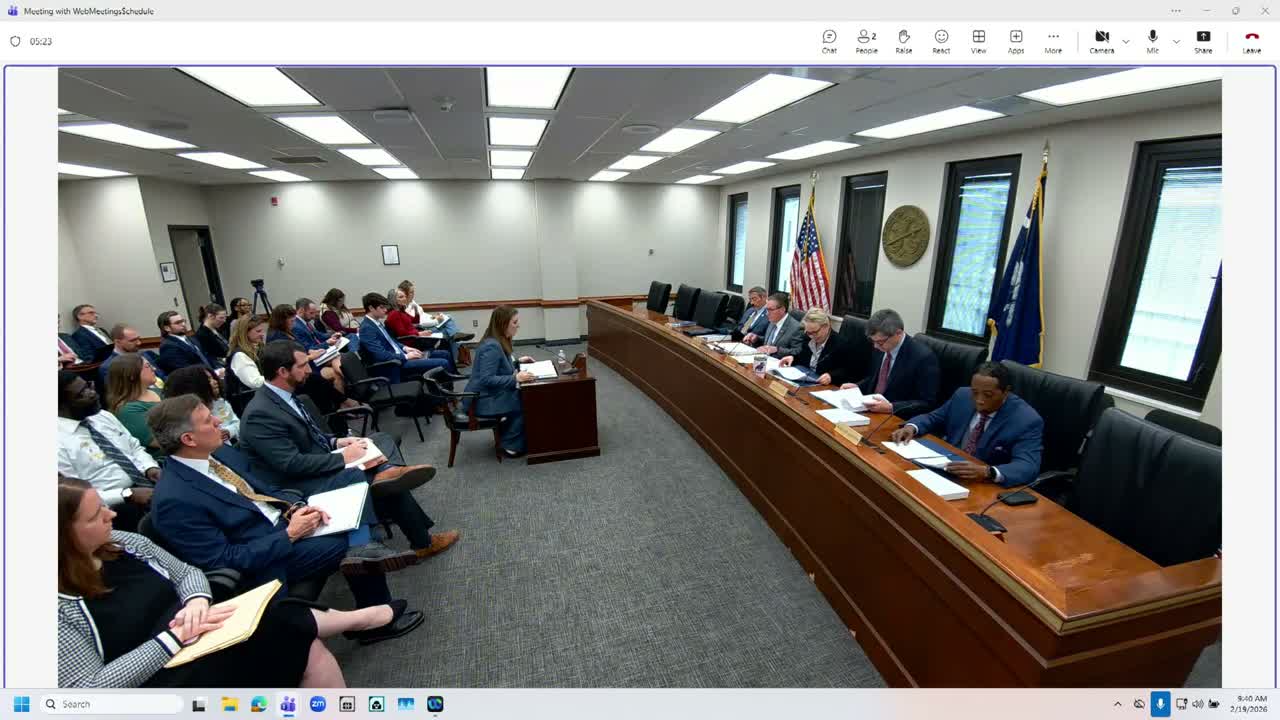
State education officials tell Senate committee ESTF 'unbundling' fits statute; senators press on homeschool exclusion and accountability
Loading...
Summary
South Carolina Department of Education testified to a Senate committee that its implementation of the Education Scholarship Trust Fund (ESTF) permits parent‑directed 'unbundled' services under Act 11 (2025); senators pressed for data on how many enrollees were previously homeschoolers, testing outcomes, vendor vetting, and transition plans if the Legislature revises the law.
State Superintendent of Education (unnamed in the transcript) told a Senate committee that the department believes Act 11 of 2025 authorizes Education Scholarship Trust Fund (ESTF) recipients to use funds for parent‑directed, ‘unbundled’ services and that the agency lacks authority to deny applicants who meet statutory criteria.
"We do not have discretion, we believe, to deny an applicant who satisfies the statutory criteria," the superintendent said, describing the department's position that the statute anticipates students not enrolled full time and ties eligibility to enrollment verification, income checks, annual testing and spending controls. She added the department provided written guidance and an FAQ to both chambers during the legislative process.
Senators pushed back, saying the Legislature intended to exclude traditional homeschooling from ESTF. One senator told the superintendent, "We wrote it wrong. We screwed it up," and repeatedly pressed for a clear commitment that the department would support legislative changes to align implementation with the Senate's intent. The superintendent said she could not pledge support to a policy before seeing final bill language but offered to work with the Senate on a transition that would protect students already enrolled.
Committee members sought specific operational data. The department said it had removed more than 1,100 students during the 2025–26 school year for affidavit, enrollment or testing noncompliance and that over $4,000,000 had been returned to the trust fund. Two suspected fraud referrals were sent to the State Law Enforcement Division (SLED), the superintendent said.
Senators pressed on the program's scale and composition. The superintendent said roughly 1,182 students had been described in testimony as using 'unbundled' or hybrid arrangements but that the department did not have a definitive breakdown of how many of those enrollees had been home‑schoolers previously and pledged to try to produce more precise year‑one numbers. She reported the department had received "over 30,000 applications" for the 2026–27 cycle and noted law‑defined application priority windows; current law contemplates roughly 15,000 program slots for the year in question.
On testing and academic accountability, the department told senators it had collected testing data for enrolled students, removed about 78 students who failed to provide required test results, and planned to transmit compiled testing to the Education Oversight Committee (EOC) for analysis within a week. The superintendent described permitted assessments (Iowa, Stanford 10, and the CLT) and a crosswalk intended to allow comparisons with state tests.
The committee also questioned enforcement options. The superintendent said the statute does not give the department authority to remove students from the program solely for poor test results; however, the agency can suspend accounts, return funds when appropriate and remove vendors from the approved vendor list after vetting and due process. The department described its vendor vetting process, education service provider (ESP) application requirements, degree/licensure checks for service providers, platform security, and background checks coordinated with SLED and the Department of Social Services.
Senators repeatedly framed the issue as both legal and a "trust problem." The superintendent acknowledged that concern and urged lawmakers to consider the impact of statutory changes on current students while offering continued collaboration.
The committee concluded by asking for additional data and clarifications; the superintendent said the department would follow up and work with the Senate on potential statutory language and operational details.