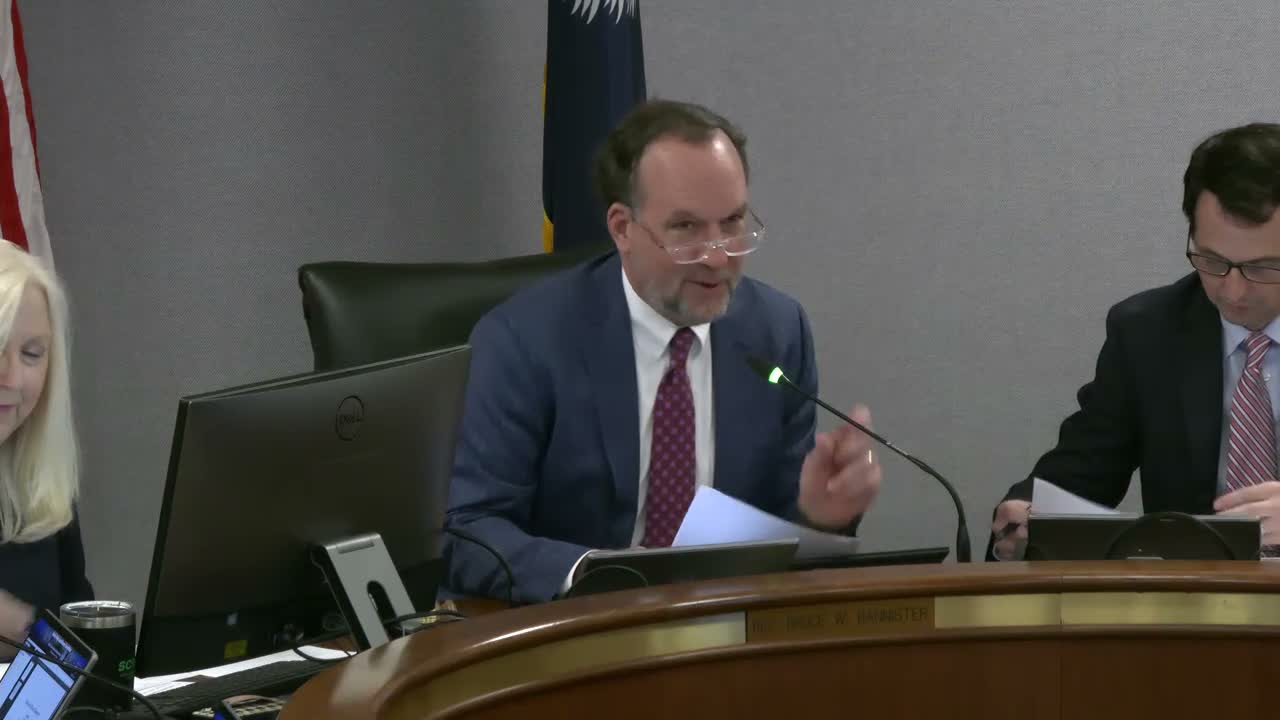
Ways and Means Committee adopts annual budget; approves teacher pay increases and major infrastructure investments
Loading...
Summary
The South Carolina House Ways and Means Committee voted to adopt the annual general appropriations bill (H.51 26) and the Capital Reserve Fund bill (H.51 27), approving targeted increases including a starting teacher salary bump, a 2% state employee base raise, and large transportation and higher-education investments. (Roll calls recorded as 25–0.)
The South Carolina House Ways and Means Committee voted to adopt the annual general appropriations bill (H.51 26) and the Capital Reserve Fund bill (H.51 27) after a day of subcommittee reports and a sequence of proviso amendments. The committee’s roll-call on the annual bill was recorded as 25–0 in favor.
The package places priority on infrastructure and personnel. Representative Whitmire, chair of the K–12 subcommittee, told the committee “this year, the committee allocated $150,000,000 new dollars to raise the starting teacher’s salary to $50,500,” and said the budget also provides a $2,000 increase across all lanes of the teacher pay schedule. Whitmire also reported a $75,000,000 capital fund for public and charter schools and an additional $23,000,000 to expand the Education Scholarship Trust Fund to serve 15,000 students.
Representative Kaske, chairing the constitutional subcommittee, described a 2% across-the-board base pay increase for state employees and investments in data and AI modernization, saying the budget directs $6,200,000 to the Office of Statewide Data to support evidence-based policymaking. The constitutional package also included funding for four additional circuit court judges and a rural courthouse stabilization fund.
Higher education received notable one-time funds. Representative Ballantyne reported more than $371,000,000 in nonrecurring appropriations for institutions of higher learning, including $175,000,000 entrusted to the Medical University of South Carolina (MUSC) to support work on a comprehensive cancer hospital and a new recurring funding model called "South Carolina FIRST." Ballantyne also described a new Meeting Street Scholarships public-private partnership to target students with both high need and high promise.
Transportation and public-safety investments were also highlighted. Representative Crawford said the proposal includes a major allocation for the Department of Transportation to address congestion and backlog, and proposed $70,000,000 for airport improvements. Representative Lowe reported a seven-year replacement plan for radios under SLED with an investment of $24,000,000 to modernize statewide communications. Conservation and natural-resources funding were raised as priorities as well, with combined conservation investments reported at $65,000,000.
Committee members asked for clarifications during subcommittee Q&A. Representative Gilda Cobb Hunter questioned whether statutorily required evaluations of the voucher program had been received and raised concerns that the current funding formula disadvantages rural districts; Whitmire said staff would follow up and the subcommittee would review formula impacts. Representative Long stressed that scholarship demand appeared to exceed funded slots — staff estimated applications around 30,000 while the fund was set to serve 15,000 students.
Amendments and technical changes: the committee considered and adopted a series of proviso amendments (d1 through d12), which included formalizing the 2% state employee pay increase, distributing EIA surplus funds, restructuring tuition-mitigation to the South Carolina FIRST model, and other programmatic and technical adjustments. Representative Cobb Hunter moved, and the committee approved, a motion to give staff authority to make technical corrections to proviso language to conform to subcommittee actions.
Votes at a glance - H.51 26, Annual General Appropriations Bill — Committee roll-call: 25 yes, 0 no; outcome: adopted and reported favorably. - H.51 27, Capital Reserve Fund Bill — Committee roll-call: 25 yes, 0 no; outcome: favorable report. - Amendments d1–d12 — adopted (voice votes recorded during the meeting).
What happens next: With committee adoption and favorable reports, the measures will move to the House floor for further consideration. Committee leadership thanked staff and agency partners for the work that prepared the spending packages, and the chair adjourned the session.