Get Full Government Meeting Transcripts, Videos, & Alerts Forever!
Get email alerts on the Public Procurement topic
No spam. Unsubscribe anytime.
Milwaukie staff propose major rewrite of public contracting rules, seek equity measures and higher thresholds
Summary
At the Feb. 17 work session, procurement staff outlined a proposed rewrite of Milwaukie’s public contracting rules to align with state law, raise intermediate procurement thresholds, clarify retainage, increase surplus limits, and require outreach to COVID‑certified businesses for intermediate solicitations.
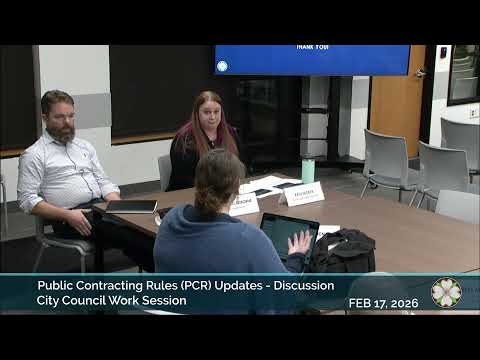
Kelly, a procurement and finance staffer, presented proposed comprehensive revisions to Milwaukie’s public contracting rules at the Feb. 17 work session, saying the changes are intended to align city rules with recent state law updates, remove ambiguity, and reduce administrative burden.
Why this matters: the proposed rewrite would change how the city solicits and awards contracts for goods, services and construction, adjust dollar thresholds that determine procurement methods, formalize options for retainage on construction contracts, and add equity‑focused outreach requirements that could increase opportunities for diverse local firms.
Key proposals and context
• Thresholds and surplus: staff proposed raising the intermediate procurement maximum from $150,000 to $250,000 (to match state/federal thresholds), increasing micro‑purchase authority from $10,000 to $15,000, and raising the personal property surplus authorization from $1,000 to $10,000 to reduce administrative processing for small items.
• Public improvements and retainage: staff recommended restructuring rules so public improvements (construction) are centralized in a single rule, moving general terms and contract conditions into a standalone exhibit, and clarifying retainage options. Under recent state changes the city may accept cash retainage, a retainage bond, or a contractor‑held interest‑bearing account; staff said contractors will now bear setup costs for escrowed retainage accounts.
• Equity and COVID certification: Kelly said the city adopted equity requirements into its contracting rules in 2022 and made modifications in 2023. To increase contracting with certified diverse firms, staff proposed that for intermediate solicitations departments invite at least one COVID‑certified business (Oregon’s certification for business inclusion and diversity) among the three qualified sources solicited, with an exemption process when no certified firm is available. Staff presented FY2025 data showing 24 intermediate solicitations, eight instances where a COVID‑certified business was invited, and four contracts ultimately awarded to certified firms — a gap staff said could be reduced by required outreach and better tracking.
• Electronic processes and controls: Kelly noted the city has used an electronic procurement system for about 18 months; procurement now reviews all formal and intermediate solicitations before posting and negotiates contracts for those solicitations, which staff said prevents problems seen earlier when work began before a contract was signed.
Council discussion touched on implementation details, how to identify and invite qualified certified firms, whether other local organizations could assist with outreach (for example MISO or chambers of commerce), and whether requiring certification as the only proxy for equity is the best approach. Staff offered an exemption process and suggested building an internal directory and doing departmental outreach and training as immediate next steps.
Next steps: staff said they are prepared to return on March 3 with the ordinance for adoption and that the council could ask staff to separate or delay the equity components for additional study. All amounts, certification rules and timing described were from the Feb. 17 presentation and are subject to revision pending council direction.
Direct quotes in this article are taken from the Feb. 17 meeting transcript and attributed to procurement staff and council members who spoke at the session.