
South Carolina subcommittee hears competing testimony on S.199, the Student Physical Privacy Act
Get AI-powered insights, summaries, and transcripts
Subscribe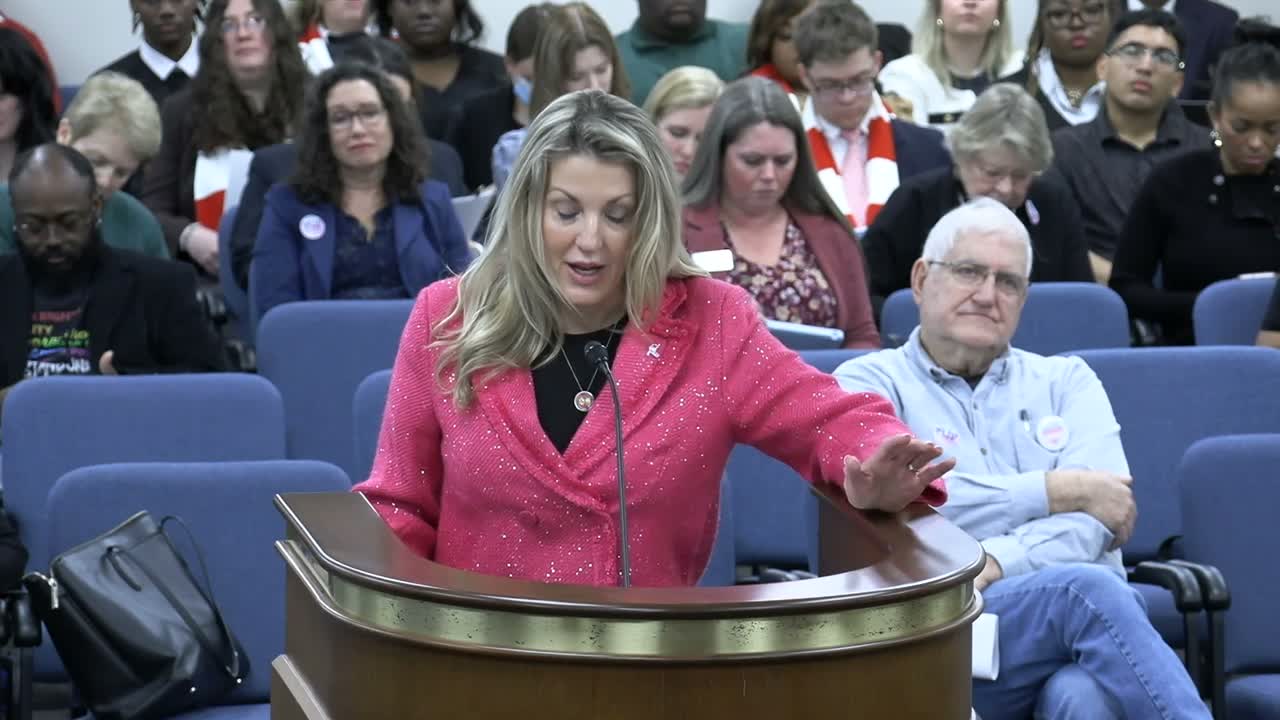
Summary
A Senate subcommittee in Columbia heard hours of pro‑ and con‑testimony Feb. 18 on S.199, the Student Physical Privacy Act, with witnesses debating privacy, medical consensus, and legal risk; the panel did not vote and said it will reconvene to consider House language and other amendments.
A South Carolina Senate subcommittee heard more than a dozen witnesses Feb. 18 during a hearing on S.199, the Student Physical Privacy Act, as lawmakers weighed competing claims about student privacy, safety and the bill’s vulnerability to federal court challenges.
Representative Cromer opened the hearing by asking the panel to consider what she described as a restoration of privacy protections for girls. Representative Cromer told the subcommittee that S.199 ‘‘draws that line’’ around sex‑segregated facilities and would allow reasonable accommodations while holding institutions accountable, and she urged the committee to advance ‘‘the strongest legislation possible’’ including a private right of action for affected students.
The bill’s supporters framed S.199 as a privacy measure. In her testimony, Representative Cromer described an instance in which she said a 35‑year‑old biological male used a women’s restroom at a college and said students had been told little could be done unless ‘‘something inappropriate’’ occurred. She told senators the burden of protecting privacy currently falls on female students and that the bill would place responsibility on institutions.
Opponents — including students, parents, faith leaders, civil‑rights advocates and attorneys — urged lawmakers to reject S.199 or to adopt narrower language. Skyler Clark, who identified as a trans woman, said transgender people ‘‘don’t want to hurt you’’ and warned lawmakers against repeating historical patterns of dehumanizing vulnerable groups. ‘‘Let’s focus on making these vulnerable spaces safer for everyone,’’ Clark told the panel.
Legal risk surfaced repeatedly. Grant Burnett LaFever, an attorney who said he represents teachers and students, urged the committee not to move S.199 because, he said, federal precedent counsels against laws that exclude transgender students from facilities that correspond with their gender identity. LaFever cited Fourth Circuit rulings that struck down similar policies and described a pending South Carolina challenge to a budget proviso that a federal court enjoined; he said passage of S.199 would invite years of litigation and financial exposure for public institutions.
Courtney Thomas, advocacy director for the ACLU of South Carolina, echoed that position, saying the Fourth Circuit has ‘‘already rejected policies identical to this bill,’’ and asked lawmakers to respect binding precedent. Staff for the committee likewise noted that a House version of related language (identified in the hearing as House bill 47‑56) includes definitions and multi‑occupancy provisions that some institutions requested to preserve flexibility.
Other witnesses tied the bill to harms for transgender youth. Reverend Austin Lippert, speaking for a faith perspective, cited peer‑reviewed research he said showed increases in suicide attempts in states that enacted laws like S.199 and said legislators should not accept those consequences. Multiple parents and advocates described personal decisions to seek private schooling or to craft day‑to‑day accommodations for transgender children because they feared public‑school settings would be unsafe.
Proponents and some senators discussed practical accommodations: staff pointed out language in the House draft that would recognize multi‑occupancy or multi‑use facilities and permit single‑user restrooms as alternatives. The staff summary also noted that the House draft includes a two‑year statute of limitations for civil actions and authorizes recovery of reasonable attorney’s fees; injunctive relief language also appears in the materials the panel reviewed.
Committee members asked detailed questions of witnesses about which court decisions apply, whether cited cases involved school bathrooms or employment settings, and how a U.S. Supreme Court ruling in a related employment case affects Title VII protections. LaFever and ACLU testimony emphasized Title VII and Title IX arguments, while several witnesses cited medical organizations (American Medical Association, American Academy of Pediatrics, Endocrine Society) and research summaries (Williams Institute, Nature Human Behavior) in support of inclusive policies.
No final action was taken. The subcommittee chair directed staff to prepare a ‘‘strike‑and‑insert’’ that would put House language into S.199 for the panel to consider, and senators agreed to reconvene for a short session before the next full committee meeting to consider amendments and to attempt to vote. The hearing record shows the panel expected to review amendments on Tuesday; a vote on S.199 was not recorded that day.
What happens next: staff will prepare amendment language that incorporates the House provisions discussed at the hearing; the subcommittee expects to meet again to consider those changes before the next full committee meeting.