
Committee hears bills to require timely recording of sheriff's deeds to protect homeowners' redemption rights
Get AI-powered insights, summaries, and transcripts
Sign Up Free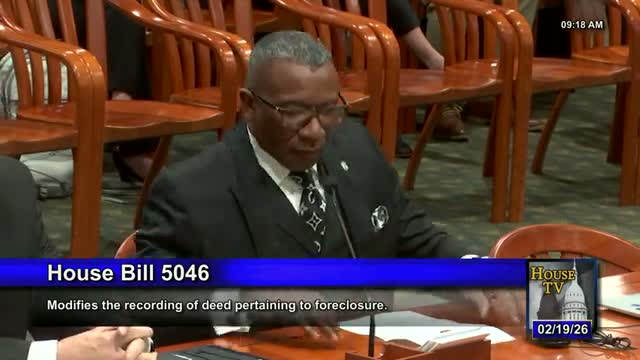
Summary
Representatives advanced discussion on HB 5045 and HB 5046 after testimony from county registers of deeds and the Real Property Law Section; bills would clarify that when a sheriff's deed is not recorded within 20 days the statutory redemption period and interest accrual begin on recording date.
The House Regulatory Reform Committee heard testimony on two bills, HB 5045 and HB 5046, aimed at closing a procedural loophole that can leave homeowners with little time to redeem foreclosed properties.
Rep. O'Neil told the committee the bills would close a gap in current practice in which deeds from sheriff's sales are not always recorded promptly, which can shorten the practical redemption period a homeowner believes the law guarantees. "Our bills state that the redemption period starts when the paperwork is actually recorded," Rep. O'Neil said, arguing the change will ensure homeowners receive the full statutory redemption window.
Stuart (Stu) Sanders, Register of Deeds for Newaygo County and legislative co‑chair for county registers of deeds, described patterns he said his office and others around the state have observed: "Some bad actors, third party bidders, play games by waiting to record the sheriff's deeds until closer to the end of the redemption period," he said. Sanders told the committee recording is generally expected within 20 days of the sale under current law but enforcement is weak; when deeds are recorded late, homeowners may not be able to obtain payoff amounts or information necessary to redeem.
Committee members explored operational fixes and costs. Representative Wozniak asked whether municipalities or the sheriff could be made responsible for recording; Sanders said that is not currently the practice but it "might be" more efficient. Sanders gave typical recording fees as about $30 for a quick claim and $35 for the sheriff's deed example discussed.
Roxanna Zaha, vice chair of the Real Property Law Section of the State Bar of Michigan (appearing by Zoom), said both bills clarify how redemption periods and interest accrual are computed following the Michigan Court of Appeals decision in Kessler v. Longview (2023). She summarized the court ruling and the bills' correction: if a sheriff's deed is recorded within 20 days, the redemption period and interest accrual run from the sale date; if the deed is not recorded within 20 days the redemption period and interest accrual would begin from the recording date, not the sale date.
Committee members did not take a final vote on these bills during the hearing. Sponsors said they had worked closely with stakeholders including county registers of deeds and the State Bar's Real Property Law Section on the language and asked the committee to move the bills forward for further consideration.