
Senate deadlocks 17-17 and defeats charter school bill after broad debate
Get AI-powered insights, summaries, and transcripts
Subscribe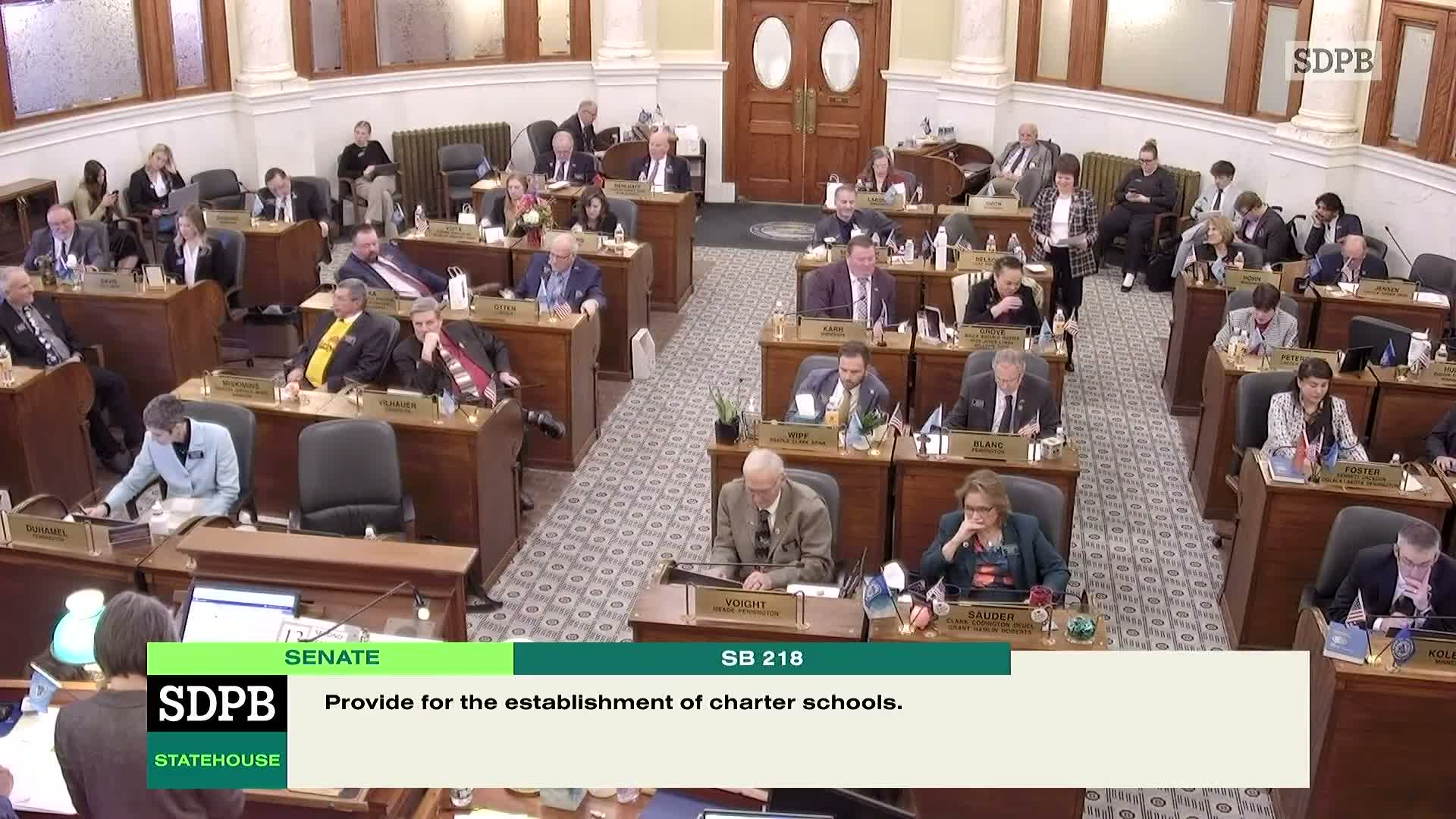
Summary
The South Dakota Senate on Feb. 19, 2026 defeated Senate Bill 218, which would have created a framework for public charter schools. Proponents argued the measure would expand options, especially on tribal lands; opponents raised concerns about funding diversion, accountability, certification standards and constitutional uniformity.
Senator Nelson, the bill’s prime sponsor, told the Senate that Senate Bill 218 would allow public charter schools — nonprofit-operated public schools authorized by local boards or the Department of Education — to open under a rigorous application and accountability process. “South Dakota is one of only three states without a public charter school law,” Senator Nelson said, arguing that charter schools would offer new options for families and help communities tailor education to local needs.
Supporters said the bill would require rigorous plans for academics, operations and finances; require that charters meet the same academic standards and special-education obligations as traditional districts; use a random lottery if capacity is exceeded; and fund charter schools with per-pupil dollars that follow the student. Nelson emphasized that initial operating contracts would run five years and that failure to meet performance benchmarks could lead to closure.
Opponents — including Senator Sauter, Senator Wipf and several others — described the bill as creating a parallel public system that could divert funding and weaken local accountability. “This is not something that we need in our South Dakota schools,” Senator Sauter said, warning that charter schools would be governed by independent executive boards rather than locally elected school boards. Concerns voiced during debate included the potential loss of local funding and staff, the ability of charters to operate with noncertified teachers and administrators, and whether the proposal complied with the state constitutional requirement for a uniform system of public education.
Lawmakers also discussed the bill’s possible benefits on tribal lands, where Senator Nelson said demand and need are greatest, and the bill’s administrative-fee and fee-allocation clarifications included in amendment 218C. Proponents said the application process would be rigorous and community-driven; critics said available flexibility could create inequities and reduce parent influence over public dollars.
After extended debate, the Senate took a roll call on final passage. The result was 17 yeas and 17 nays with one excused member, so the bill did not receive the affirmative vote of a majority of the members elect and was declared lost. Senator Nelson’s intent to reconsider was noted on the record.
The failure of SB 218 leaves South Dakota without an enacted charter school framework for the current session; sponsors said they may pursue amendments or reconsideration on a future day.