
Committee approves amended safer‑skies drone bill, grants DPS rulemaking authority and raises penalty
Get AI-powered insights, summaries, and transcripts
Subscribe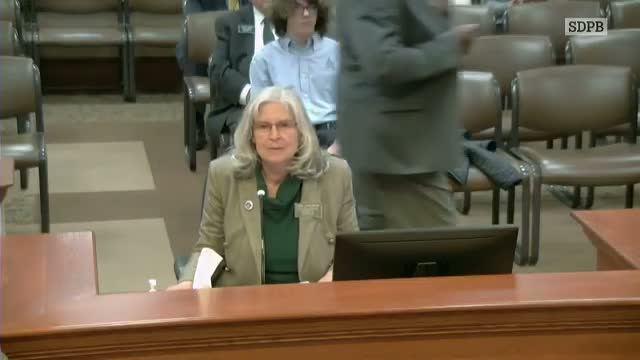
Summary
The committee approved (do‑pass) an amended House Bill 12‑80 to allow Department of Public Safety rulemaking to identify mitigation techniques for unlawful drone activity over protected facilities and to raise penalties to a class 6 felony; supporters emphasized public‑safety needs and coordination with federal guidance.
PIERRE, S.D. — Law enforcement groups and the Department of Public Safety won committee approval for an amended bill that would give state authorities limited rulemaking power and increase penalties for unlawful drone operations over certain protected facilities.
Scott Rectenbaugh of the Department of Public Safety asked lawmakers to support HB 12‑80 as amended, saying DPS, the Department of Military, DOT and the governor’s office worked with the sponsor to pare the bill to conform with pending federal guidance. Rectenbaugh said federal action, including the Safer Skies Act and recent congressional legislation, allows states to play a greater role once required training and operational standards are finalized.
The amendment grants rulemaking authority to DPS under SDCL 50‑15‑3 so the department can adopt rules identifying mitigation techniques and countermeasures that trained law enforcement officers may use to address unlawful drone activity in narrowly defined protected areas. The amendment also increases the penalty for violations from a class 1 misdemeanor to a class 6 felony, a change proponents said was needed to deter malicious or reckless conduct.
Savannah Cruz of the Police Chiefs Association and Stacy Ackerman of the South Dakota Sheriffs Association testified in favor, calling the measure a measured step for local and national security. An online proponent from the Ellsworth Development Authority also voiced support.
Committee members asked clarifying questions about judicial discretion for criminal penalties; sponsors and colleagues noted judges retain sentencing discretion even when statutory maximums increase. Representative Schubach moved a do‑pass recommendation; the committee voted 11 yeas with 2 excused and agreed to place the bill on the consent calendar for next week.
Speakers quoted include Scott Rectenbaugh (Department of Public Safety), Savannah Cruz (Police Chiefs Association), and Stacy Ackerman (South Dakota Sheriffs Association).