
Panel sends election‑board overhaul bill to 40‑first day after contentious testimony
Get AI-powered insights, summaries, and transcripts
Subscribe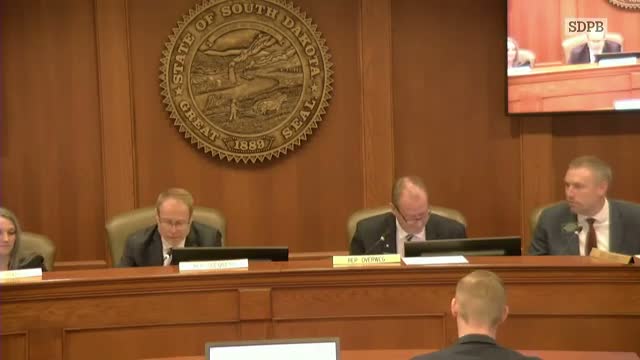
Summary
House Bill 13‑24 — which would abolish the State Board of Elections and transfer authority to the Secretary of State — drew sharply divided testimony over technical oversight, statutory drafting and public process. The committee moved the bill to the 40‑first day for further work.
PIERRE — A bill to abolish the South Dakota State Board of Elections and shift duties to the Secretary of State’s office drew extensive testimony and was sent to the 40‑first day for additional drafting and review.
Representative Aaron Allward, sponsor of HB 13‑24, said the bill would place election oversight under an elected official and address perceived problems with the appointed board. "I believe this would be more appropriate underneath the Secretary of State’s office, underneath an elected representative rather than an appointed board," he said.
Proponents — including county auditors and private citizens — described instances they said reflected inadequate board oversight: failure of board members to attend public equipment testing, abbreviated or virtual testing that limited public participation, and concerns over technical competence. Cindy Meyer (Minnehaha County) told the committee she watched certification activity where board members were not present for testing of tabulation equipment and that key peripheral equipment was not tested in public.
Opponents, including Christine Lierkamp, director of the Division of Elections in the Secretary of State’s office, and county and legal officials, urged delay. Lierkamp said the bill contains numerous drafting conflicts across 86 sections, would curtail necessary contested‑case timelines by shortening statutory deadlines for HAVA complaints and contested cases, and — as currently written — would both abolish the board and leave residual cross‑references intact, creating legal uncertainty.
Austin Hoffman, a county state's attorney and a current board member, told lawmakers the bill removes or changes dozens of statutory definitions and cross‑references, which could render multiple statutes inoperable and concentrate rule‑making authority in a single office in a way that would limit public participation.
Proponents countered that the bill aims to align certain timelines with federal requirements and to address perceived gaps in technical oversight. Rick Weibel, a proponent, argued some board members lack technical training and that the bill’s changes would provide clearer accountability.
After questions and debate about procedural issues, statutory conflicts and whether the bill is ready for floor consideration, Representative Overwig moved to send HB 13‑24 to the 40‑first day (seconded by Representative Baum Mueller). The motion passed on a roll call (12 ayes, 1 excused), meaning the bill will be revisited later in the session after further redrafting.
Action: HB 13‑24 sent to the 40‑first day for additional work and clarification.