
Committee backs bill to make Future Fund employer fee voluntary after contested hearing
Get AI-powered insights, summaries, and transcripts
Subscribe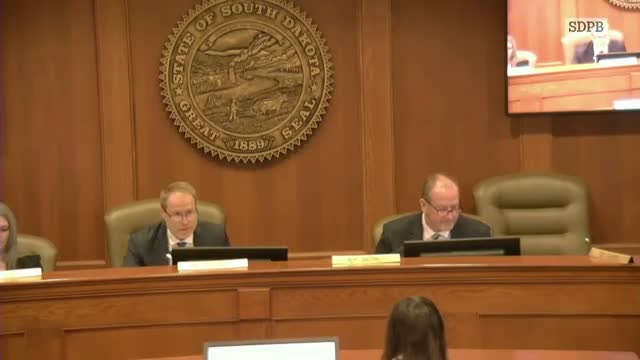
Summary
After an extended hearing with administration and business groups opposing it, the House State Affairs Committee voted to give HB 12‑30 a due‑pass recommendation to the floor. The bill would change the employer's 'Future Fund' fee from automatic collection to voluntary opt‑in, with opponents warning of administrative costs and harm to statewide economic programs.
PIERRE — The House State Affairs Committee voted to advance House Bill 12‑30 to the full House after a divided hearing on the bill that would change South Dakota’s employer "investment in South Dakota’s future" fee from automatic collection to voluntary opt‑in.
Sponsor Representative Carla Lembs (District 16) told the committee the bill is about “choice and transparency” for employers and would not eliminate the Future Fund. "If an employer sees value in contributing, they can opt in," she said, framing the measure as restoring consent and trust for small businesses.
Opponents — including Marcia Holtman, secretary of the Department of Labor and Regulation, and officials from the Governor’s Office of Economic Development and business groups — warned the bill would impose significant administrative burdens and risk the Future Fund’s revenue. "Adding the requirements of this bill would impact our priorities," Holtman said, explaining the department’s mainframe would need about 5,000 developer hours and an estimated $525,000 in one‑time costs, and initial quarterly mailing costs of about $27 per employer.
Joe Fiala, deputy commissioner at the Governor’s Office of Economic Development, said the Future Fund has supported thousands of awards statewide and cited programs such as BUILD SOUTH Dakota that have provided scholarships to about 3,000 students.
Business groups including the South Dakota Chamber of Commerce and trade organizations urged lawmakers to reject the bill as a threat to a collective funding mechanism for workforce development. Mike Bochrani, representing the Economic Development Professionals Association, warned the change could set a precedent for opt‑out options on other taxes.
Representative Liz May, a co‑sponsor who also testified, said the bill would not dismantle the program and emphasized that many small business owners are unaware they are paying the fee; she described the change as shifting a default rather than ending participation.
Committee members questioned how the fee appears on employer tax notices and whether employers have reasonable notice or a practical opt‑out today; Holtman said the future fee, UI rate, and admin fee appear as line items on year‑end tax notices, and that opt‑out in some cases is possible through reserve‑ratio mechanics but is not a simple "check a box" process.
After debate, Representative Gosh moved a due‑pass recommendation (seconded by Hansen). The committee approved the motion on a roll call, with a tally of 7 ayes, 4 nays and 2 excused. HB 12‑30 will go to the House floor with a due‑pass recommendation.
The committee discussion remained focused on tradeoffs between administrative cost and preserving a stable revenue stream for economic development programs. No final changes to implementation details or funding offsets were adopted in committee; proponents emphasized quarter‑based timing for participation decisions to limit manipulation.
Action: HB 12‑30 advanced to the House floor with a due‑pass recommendation (committee vote 7–4, 2 excused).