
Lake Forest Park council retreat zeroes in on $2 million biennial shortfall and levy options
Get AI-powered insights, summaries, and transcripts
Subscribe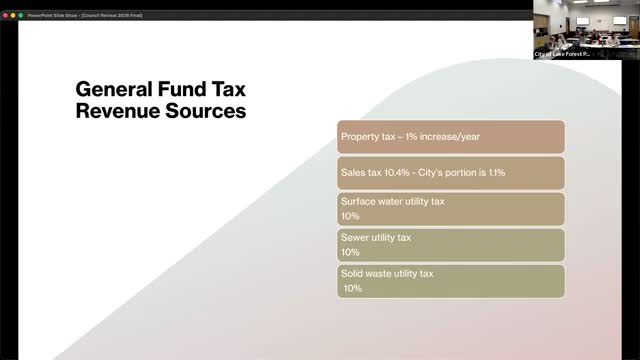
Summary
Council heard a six‑year forecast showing an approximate $2 million biennial deficit, debated reserve targets (60–90 days), and discussed levy sizing, timing and a three‑bucket approach (emergency reserve, budget stabilization, strategic opportunity) to restore fiscal stability.
City Administrator Hill and Finance Director Vaughn told the Lake Forest Park City Council at its Feb. 21 retreat that the city faces a growing structural shortfall and limited levers to close it.
“We started the 25–26 biennial budget adopted with an $862,000 deficit,” Vaughn said, and after mid‑biennial adjustments the administration’s current estimate of the biennial gap is about $2,000,000 absent new revenues or spending cuts. Hill noted the city’s property‑tax base generates roughly $3.5 million per year and that small rate increases yield modest revenue: “every year, council can take a 1% increase … that’s $35,000 in new revenue,” he said.
Why it matters: council members said the forecast reduces future flexibility for capital projects, staffing and unavoidable state mandates. Officials repeatedly emphasized the need to choose a clear reserve policy and communicate it to residents before pursuing voter approval for new revenues.
Reserve and budget design options: council debated three principal approaches. Several members favored increasing the policy beyond the current 16% reserve guideline (about 60 days of revenue) toward a 90‑day target to buffer against unfunded mandates and court‑system changes. Others proposed a structured “three‑bucket” plan: a high‑risk emergency reserve, a budget‑stabilization fund to smooth annual deficits, and a strategic‑opportunity fund for one‑time community investments.
Levy mechanics and timing: staff ran a property‑tax calculator during the retreat showing how levy rates would affect average household bills. Hill explained deadlines tied to election calendars: to appear on an August primary ballot city decisions are needed by May 1; for a November general election the deadline is earlier in the budget cycle. Councilors weighed the trade‑off between an earlier ballot (faster revenue but compressed outreach) and a later special or February vote (more time for community engagement but another year of drawdown).
Communications and trust: several council members said the last levy campaign faltered partly because proposals were perceived as too abstract. They urged clearer earmarks (what each levy dollar would buy), visible short‑term deliverables and more neighborhood‑level outreach — from targeted mailers to roving coffees and participatory budgeting — to rebuild trust.
Next steps: council directed staff to develop options for (1) a reserve target and three‑bucket allocations, (2) levy sizing scenarios tied to explicit deliverables, and (3) a communications strategy. The Budget & Finance Committee will shepherd technical work and bring recommendations back to full council for decision on timing and ballot placement.