Get Full Government Meeting Transcripts, Videos, & Alerts Forever!
Get email alerts on the Early Learning Underspend topic
No spam. Unsubscribe anytime.
Oregon early‑learning agency reports $66.6 million underspend, outlines reallocation and monitoring plan
Summary
The Department of Early Learning and Care told the Ways and Means education subcommittee that $66.6 million in 2023–25 state funds went unspent — largely because grantees did not claim allocated dollars — and described new controls, a reallocation plan and targeted technical assistance to reduce future underspend.
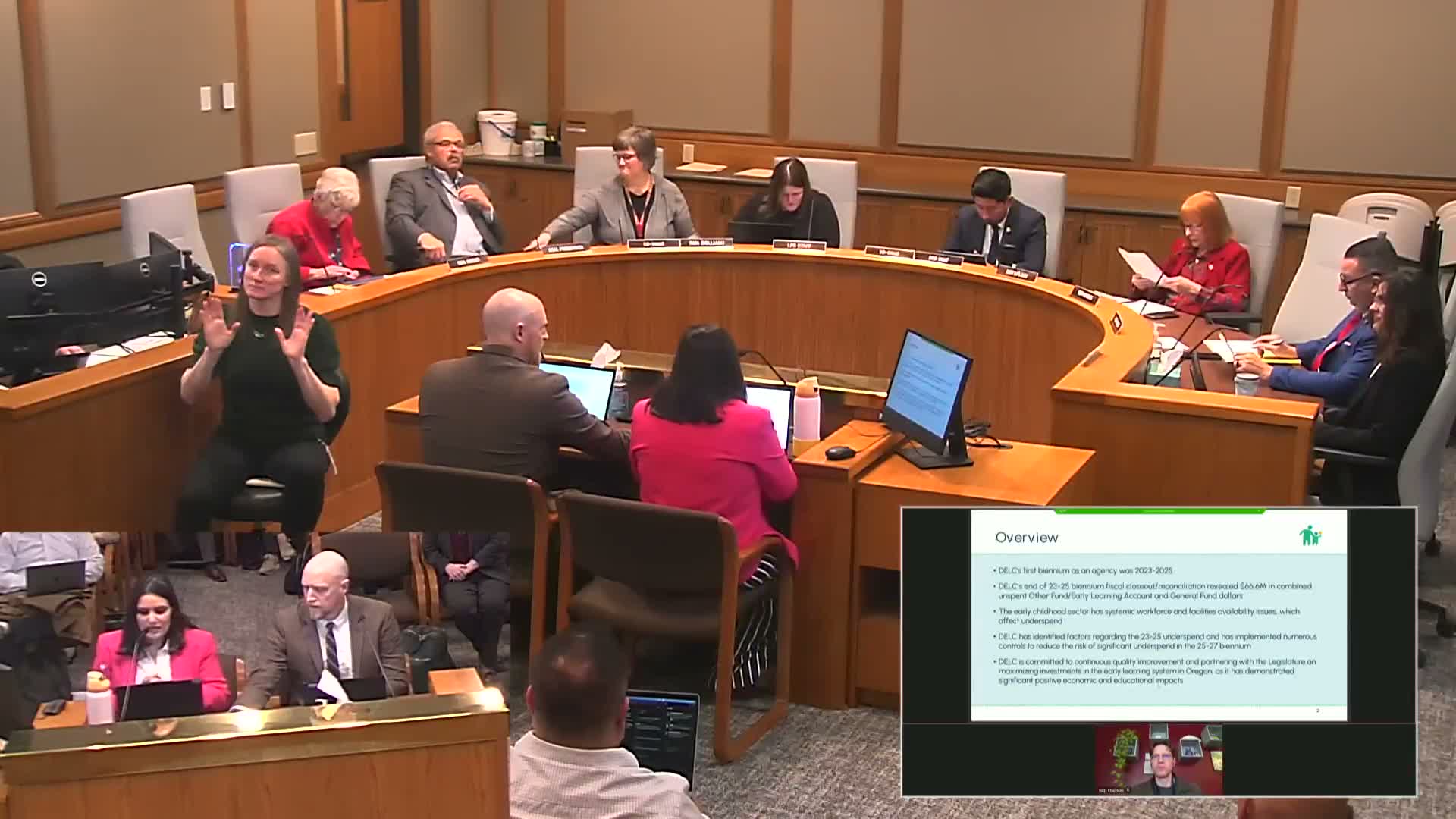
Alyssa Chatterjee, director of the Oregon Department of Early Learning and Care, told the Joint Ways and Means Subcommittee on Education on Feb. 3 that the agency identified about $66.6 million in underspend from the 2023–25 biennium and outlined steps to reduce similar shortfalls going forward.
Chatterjee said the majority of the underspend was ‘‘unclaimed funds’’ — money awarded to grantees that was not spent by the end of the biennium — rather than unobligated dollars that the agency never assigned. She said roughly $42 million of the total came from the Early Learning Account; the remainder was general fund dollars. "We did have a little over 66,000,000 in underspend," Chatterjee said during the presentation.
The nut graf: DELC (the Department of Early Learning and Care) told lawmakers the shortfall reflects a mix of agency start‑up challenges, grantee capacity problems and sector‑wide workforce shortages, and that the agency has launched two complementary efforts — a Fiscal Integrity Project and a Program Integrity Project — to improve oversight, communications and reallocation of at‑risk funds.
Cooper Brown, DELC deputy director of operations, described the two projects in detail. The Fiscal Integrity Project will strengthen tracking of dollars and create an in‑biennium reallocation process so funds identified as unlikely to be spent can be redeployed to grantees who can use them. The Program Integrity Project will standardize policies, improve technical assistance to the wide range of grantees (from school districts to family child‑care homes) and clarify claiming and reporting expectations.
Brown also said the agency has deployed a real‑time staff tool that shows grantee allocations and spending and is building a baseline from the 2023–25 data to improve forecasting. He noted the burn‑down rate in January for the 2025–27 biennium stood at about 19 percent, but cautioned that burndown snapshots early in a biennium lag because grantees have 45–60 days to submit invoices and the agency needs additional processing time.
Lawmakers pressed DELC on specifics during a lengthy question period. An LFO staffer and agency leaders clarified that general fund underspend reverts to the state's general fund, while Early Learning Account dollars remain in that account and are available for future redistribution. Chatterjee confirmed the $19,000 figure cited in the presentation refers to the average annual amount parents pay for infant care, not state per‑slot spending.
Multiple legislators — including Representative McLean and others — praised the agency for conservative stewardship while urging faster execution where possible. Several members raised workforce and contracting issues as root causes: unopened classrooms, unfilled staff positions and slow contracting tied to other parts of state government contributed to grantees' inability to spend allocated dollars.
Chatterjee and Brown outlined near‑term actions: targeted outreach to grantees at risk of underspending; clearer claiming and reporting policies; a reallocation plan to be executed mid‑biennium; and continued technical assistance to help grantees start up new programs. They also noted a recent $7.5 million Preschool Development Block Grant awarded in 2026 to support financial controls and accountability work that must be spent this calendar year.
The subcommittee did not take formal action on DELC's informational presentation; co‑chairs closed the informational session after questions and discussion. DELC pledged to return with more detailed recommendations and data as the projects progress.
Ending: DELC will continue to monitor spending and implement the fiscal and program integrity projects; members asked staff to return with follow‑up recommendations and to track mid‑biennium reallocation results.