Get Full Government Meeting Transcripts, Videos, & Alerts Forever!
Get email alerts on the Public Defense Capacity topic
No spam. Unsubscribe anytime.
Subcommittee forwards Public Defense Commission capacity report, LFO asks to schedule $22.1 million
Summary
The Ways and Means Public Safety Subcommittee received a Public Defense Commission report showing near-96% statewide MAC utilization for adult criminal cases, reviewed monitoring and intervention tiers for providers, and agreed to forward an LFO recommendation to schedule $22,100,000 in general fund to the full committee.
The Joint Committee on Ways and Means Public Safety Subcommittee on Feb. 3 acknowledged a Public Defense Commission report on public defense attorney capacity and agreed to forward the Legislative Fiscal Office recommendation that the Department of Administrative Services schedule $22,100,000 in general fund for the commission.
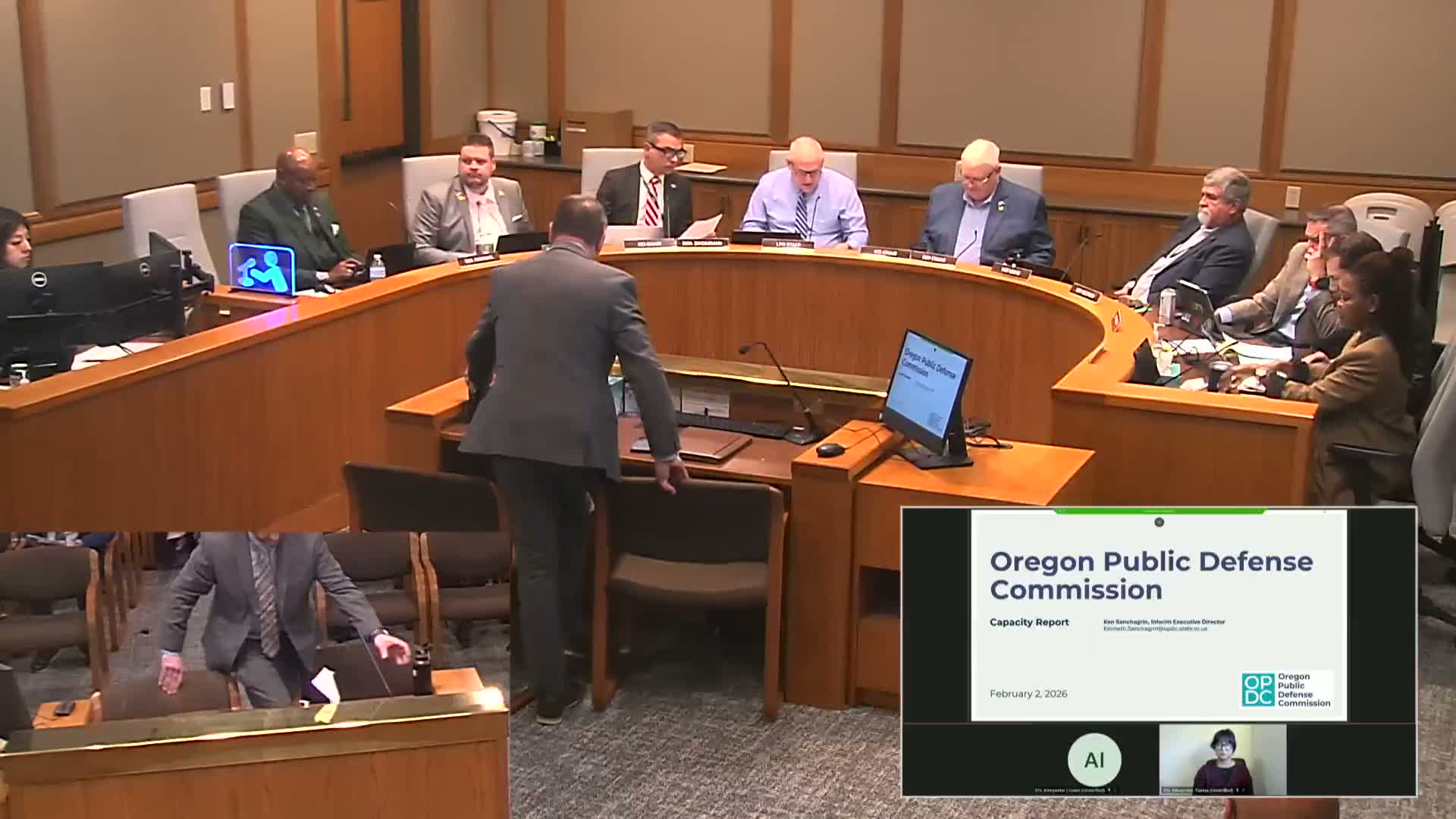
The report, presented by Ken Sandrokhin, interim executive director of the Public Defense Commission, compared budgeted attorney capacity (MAC) to actual workload using October and November data and an additional month of December data shown in updated tables. "We were at about almost 96% utilization across, across Oregon," Sandrokhin said, referring to statewide adult criminal MAC at the time the report was filed.
Why it matters: the funding is currently unscheduled pending this report. LFO told the panel that scheduling those funds would allow the Public Defense Commission to match budget assumptions with actual capacity and to provide an updated budget-versus-actual capacity report to the joint committee during the 2027 legislative session.
Key findings and follow-up: Sandrokhin described a two-tier approach to oversight. A monitoring tier includes 46 providers with subcategories such as 13 specialty or statewide contracts and nine providers affected by a "MAC reset" from contract transitions; some very small contracts were identified as too small for reliable month-to-month analysis. "For example, one of our contractors in this group is only at around 25% MAC, but if they had 4 more misdemeanors, then they would be at 90%," he said, explaining a proxy metric used to show practical gaps for small providers.
An intervention tier of 24 entities was identified for active follow-up, grouped by operational barriers (low filings), temporary staffing shortages, ongoing MAC adjustments already being implemented, vacancies, and jurisdictional caseload assignment plans with timelines to reach 90% MAC.
Sandrokhin also reported early results from an "enhanced caseload" pilot that allowed providers to contract above 100% MAC with pay for the overage. "So far what we've seen across all 3 of those tiers is that the folks who were in the exceed program are actually exceeding the program that we had set out for them," he said, and added that the initiative had produced the equivalent of nearly 400 misdemeanors taken under those contracts.
Committee action: Legislative Fiscal Office recommended "acknowledging receipt of this report" and asked the Department of Administrative Services to schedule the $22,100,000 general fund for the Public Defense Commission. Representative Anthony Broadman moved to forward the request to the full committee with the LFO recommendation. With no objections raised by the subcommittee, the motion passed by voice vote and Cochair Paul Evans was designated to carry the measure to the full Ways and Means committee.
Questions from members focused on how LFO and the commission communicate with monitored providers. In response to Cochair Evans’s question about whether contractors are told they are being watched, Sandrokhin said, "They know that we're monitoring and we have had conversations with all of these entities to have those discussions."
Next steps: The subcommittee action forwards the LFO recommendation and the request to the full committee; the Public Defense Commission is directed to report updated budget-vs-actual capacity information to the joint committee during the 2027 legislative session. The committee also announced a public hearing on proposed agency reduction options for the evening of Feb. 3 (5–8 p.m.).