Get Full Government Meeting Transcripts, Videos, & Alerts Forever!
Get email alerts on the Battery EPR topic
No spam. Unsubscribe anytime.
Lawmakers hear safety and recycling case for battery EPR bill HB 4144
Summary
At an informational session, lawmakers heard witnesses blame lithium batteries for frequent transfer-station and route-truck fires and outline House Bill 4144, a producer-funded battery takeback program designed to reduce fire risk and recover metals without a point-of-sale fee.
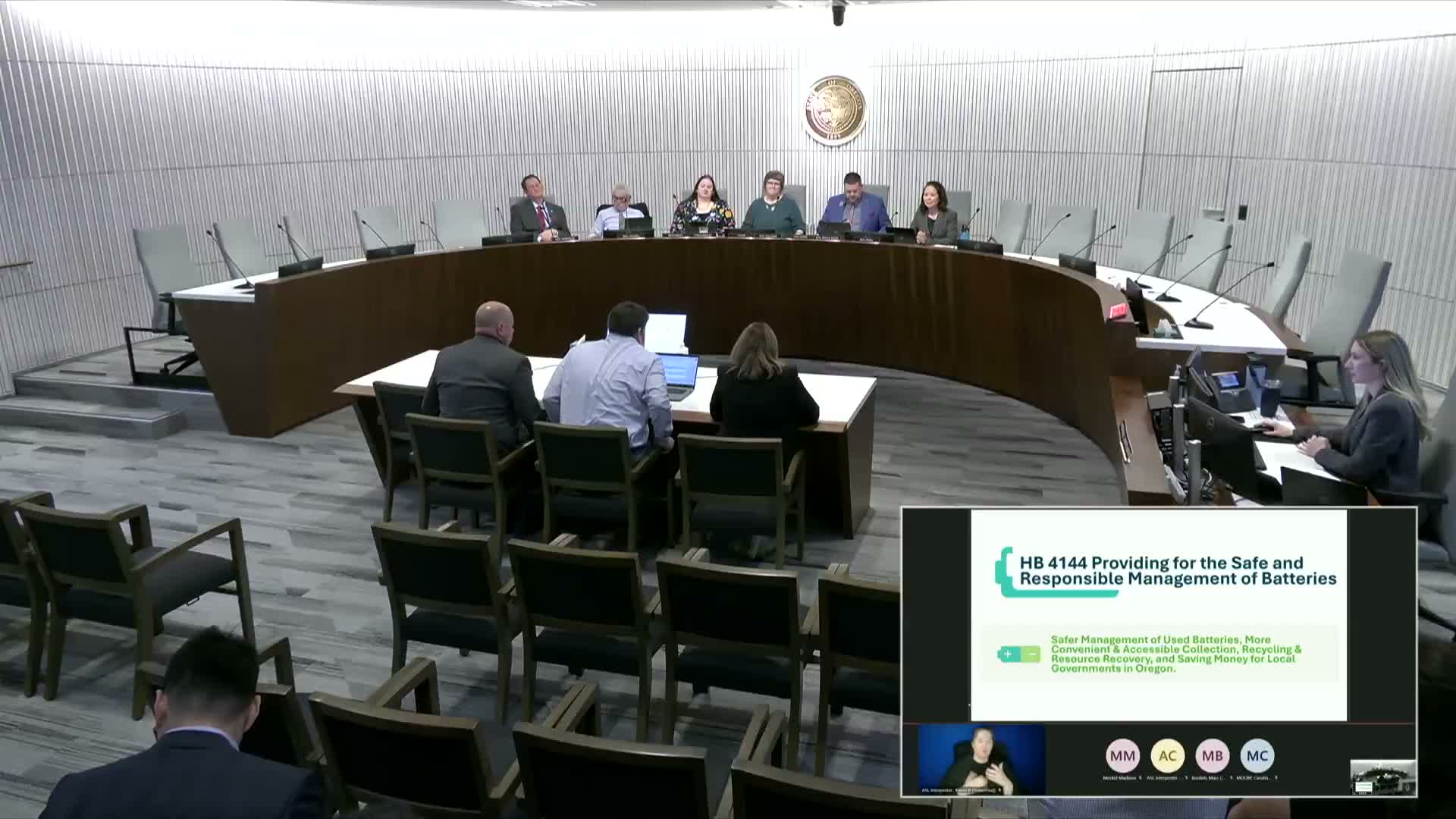
Representative Emerson Levy introduced House Bill 4144 to the Senate Energy and Environment Committee on Feb. 2, saying lithium batteries are igniting in waste streams and posing wildfire and facility-safety risks. "In Deschutes County Landfill, they had 54 fires last year caused by lithium batteries," Levy said, framing the bill as a safety and materials-recovery measure.
Tom Eggleston, policy and program development manager for Metro, told the committee Metro recorded 61 transfer-station fires in 2025 and that medium-format lithium-ion batteries were the ignition source in many cases. "In the last year, in 2025, we had 61 fires at our transfer stations in Metro," Eggleston said, and described how punctured battery envelopes can self-ignite and start large fires in compactors and pits.
Eggleston outlined key elements of HB 4144 as they appear in the briefing: the bill would cover medium-format and primary-format batteries (for example e-bike and power-tool batteries and AA/AAA/9-volt primary cells), exclude battery-energy-storage systems and electric-vehicle batteries, and establish a producer-funded takeback program with no point-of-sale fee. He said the bill would include a convenience standard aimed at ensuring 95% of residents live within 15 miles of a drop-off location.
Trent Carpenter of Southern Oregon Sanitation described practical impacts his company has seen, saying his firm experienced nine fires over three years — eight while trucks were en route — and that some incidents caused total-loss truck damage. "In the last 3 years, we've had 9 fires. And of those 9 fires, 8 of them were actually out on the trucks out en route," Carpenter said, urging more accessible local drop-off options to prevent batteries from entering route loads.
Mark Bulish, executive director of the Rechargeable Battery Association (PRBA), said the industry supports safe end-of-life management and that HB 4144 closely follows model legislation used in other states. "We strongly support the safe and responsible management of our products at end of life," Bulish said, noting several states are pursuing similar producer-responsibility laws.
Committee members pressed witnesses for cost and benefit estimates. Senator Robinson asked how much the program would cost consumers and whether existing private collection (for example, at some retail stores) would be sufficient. Panelists said producer fees are typically a fraction of product cost and that early-adopter states offer limited data so far. Eggleston described capital spending already required to cope with fires — for example, a remotely monitored "fire rover" Metro system that he described as a roughly $1,000,000, 10-year agreement to detect and respond to hot spots — to illustrate existing costs to solid-waste systems.
Witnesses and lawmakers also discussed practical limits: cameras on trucks provide limited visibility at night, and panelists said there is currently no practical onboard suppression system for route trucks capable of extinguishing the high-temperature fires lithium batteries can produce, so early detection often requires evacuation and emergency response.
No formal action was taken; the session was informational. Committee members asked staff to provide or develop more specific cost and savings estimates to help evaluate whether the producer-funded model will meaningfully reduce risks and offset program costs.