Get Full Government Meeting Transcripts, Videos, & Alerts Forever!
Get email alerts on the E Permitting topic
No spam. Unsubscribe anytime.
DOGAMI says e‑permitting project is on track; committee acknowledges report
Summary
The Joint Committee on Ways and Means Natural Resources Subcommittee heard a DOGAMI update Feb. 4 that its $2.5 million e‑permitting project is on schedule and budget, with phased go‑live dates from November 2026 to April 2027; the committee acknowledged receipt of the report.
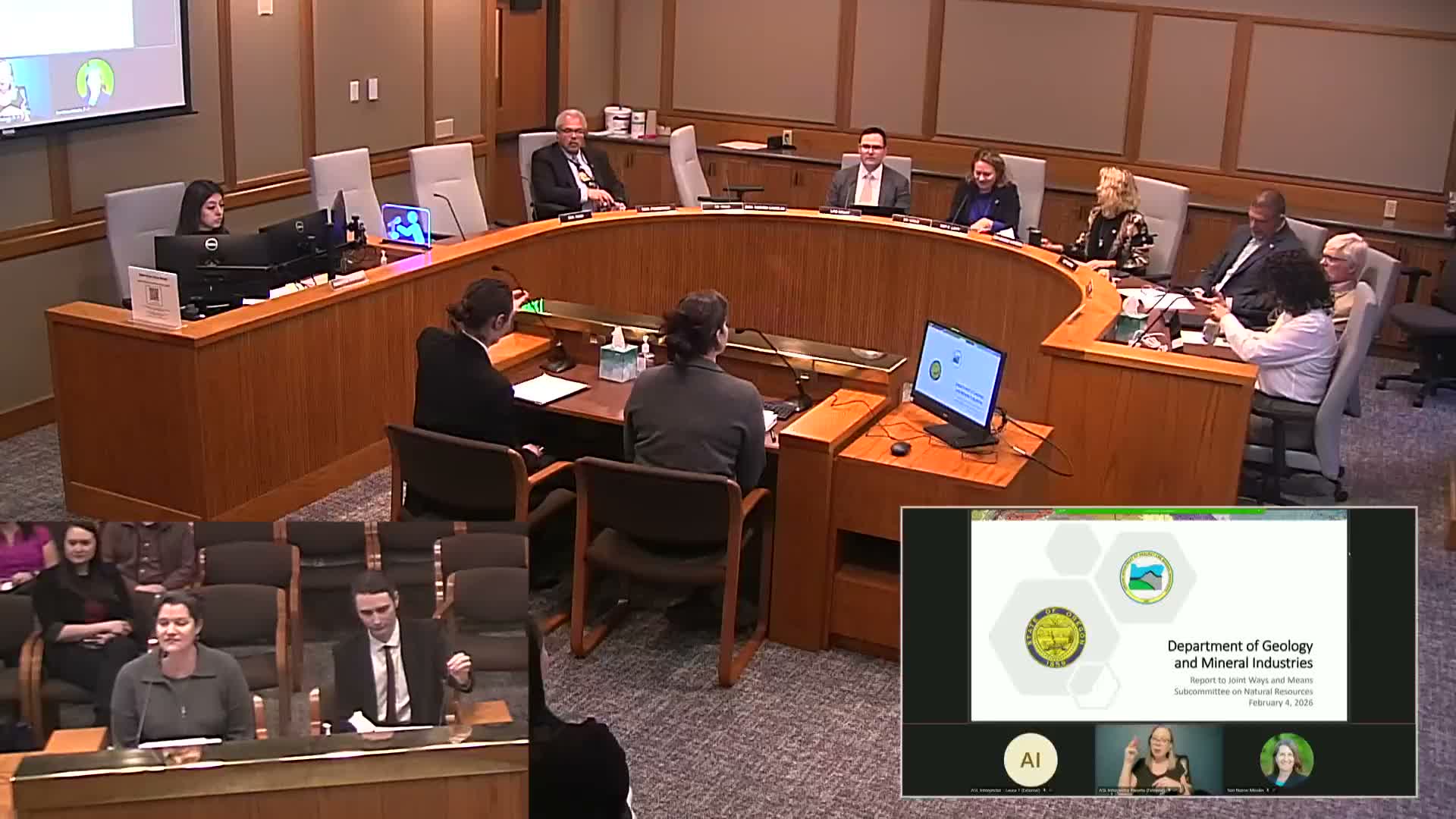
The Joint Committee on Ways and Means Natural Resources Subcommittee was briefed Feb. 4 by Sarah Lewis of the Oregon Department of Geology and Mineral Industries (DOGAMI) on the agency's electronic permitting project, which DOGAMI estimates will cost $2,500,000 and be completed in phases between November 2026 and April 2027. "I am pleased to share that we are on target to meet budget and complete the project in this biennium," Lewis told the subcommittee.
Lewis, Mineral Lands Regulation and Reclamation (MLRR) Program Manager, said the e‑permitting system will replace a heavily manual process and provide online submission and tracking of permit applications, renewals and fee payments, as well as public access to permit records and a complaint portal. She told the committee that MLRR administers more than 1,000 permits statewide held by over 500 unique companies or individuals, and that about 85% of current workload is operating permits for aggregate mining.
DOGAMI described the project as a modernization effort that leverages the Department of Environmental Quality's (DEQ) existing Your DEQ online work. The agency reported Stage Gate 1 approval in January 2024 and said procurement equivalent to Stage Gate 2 completed in July 2025. The project team plans to request formal Stage Gate 3 approval in April 2026; if approved, DOGAMI will issue a notice to proceed to the vendor to move the project into system configuration and testing.
The agency provided a phased rollout schedule: the financial module and exploration permits are planned to go live in November 2026; surface mining operating permits and exclusion certificates in December 2026; drilling permits for gas and geothermal wells in January 2027; and chemical process mining applications in February 2027, with full implementation and transition to maintenance by April 2027.
Lewis identified two primary risks. First, MLRR staff are already fully allocated to permitting tasks and will be stretched to take on the additional work of developing and transitioning to the new system, which could temporarily lengthen permitting timelines; DOGAMI's mitigation includes staging a phased go‑live across four months and strategic hiring (an IT position was hired in November and additional hires from the 2025–27 budget are expected to be completed by May 2026). Second, DOGAMI said vendor scheduling delays reduced spending in the 2023–25 cycle, prompting the agency to roll over some funds to 2025–27 and to request reallocation of reverted funds; the agency emphasized the overall scoped project cost has not changed.
Asked about current tools, Lewis said the agency uses an internal Microsoft Access database built in the late 1990s for permit tracking and that payments are handled entirely by mailed checks processed manually at DOGAMI's Albany office. She said the new system will support electronic payments (credit card and electronic check) through a financial module and that ongoing maintenance is expected to be supported by a surcharge on fee payments rather than continued general fund support.
Addison Rowe of the Department of Administrative Services (DAS) Chief Financial Office told the subcommittee that the Legislative Fiscal Office recommends acknowledging receipt of DOGAMI's report. Representative Rhys Iverson moved to adopt the LFO recommendation; the chair called for objections, none were raised, and the motion was declared passed.
The next procedural milestone DOGAMI cited is the planned request for formal Stage Gate 3 approval in April; if approved, the project will move into vendor configuration and testing. The committee acknowledged the report and adjourned.