Get Full Government Meeting Transcripts, Videos, & Alerts Forever!
Get email alerts on the Ai Aas topic
No spam. Unsubscribe anytime.
Southwest Tennessee Community College pitches first-in-state AI AAS, cites industry partners and fall 2026 start
Summary
Southwest Tennessee Community College presented a 60-credit AAS in Artificial Intelligence Technology with an embedded 18-credit technical certificate, dual-enrollment pathways, and planned fall 2026 launch at Macon Cove; presenters cited industry guidance and detailed year‑one costs and enrollment projections.
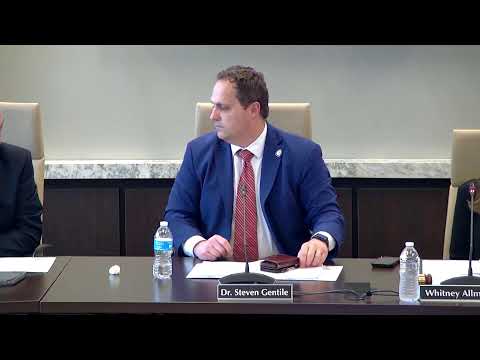
Southwest Tennessee Community College presented a proposed 60-credit Associate of Applied Science in Artificial Intelligence Technology to the Tennessee Higher Education CommissionAccess, Academics and Student Success Committee, describing the program as a first-of-its-kind community-college credential in Tennessee designed for direct workforce entry.
President Tracy Hall and academic staff said the curriculum will include 15 credit hours of general education, 15 credit hours of major core, and 30 credit hours of AI-focused coursework, plus an embedded 18-credit technical certificate enabling stackable credentials. The program includes dual-enrollment options for high school students and planned articulation agreements with four-year partners; spring implementation planning targets fall 2026 at the Macon Cove campus.
Presenters cited development support from Intel's "AI for Workforce" initiative, the American Association of Community Colleges, CompTIA, and the Greater Memphis IT Council. Enrollment and finance details shown to the commission included a projected year-one cohort of 16 full-time and 4 part-time students (20 headcount; FTE 18), with expense estimates for year 1 near $108,000 (about $29,000 nonrecurring equipment costs and recurring expenses including personnel and software licenses). Presenters said recurring costs include a full-time program coordinator who will also teach, marketing funds, and AI software licenses. They forecast a positive bottom line by year 2 once nonrecurring costs drop.
Commissioners asked about advisory-board membership (no representatives yet from some recently announced data centers), the difference between headcount and FTE, and how early employer hires affect funding formulas. TBR and college staff explained headcount versus FTE calculation and said the program is designed to be scalable with potential concentrations (logistics, healthcare, IT) added as the program grows.
The committee voted to approve the program by roll call. The college said it will continue to develop advisory-board membership and finalize articulation agreements prior to full implementation.