Get Full Government Meeting Transcripts, Videos, & Alerts Forever!
Get email alerts on the Cost Allocation topic
No spam. Unsubscribe anytime.
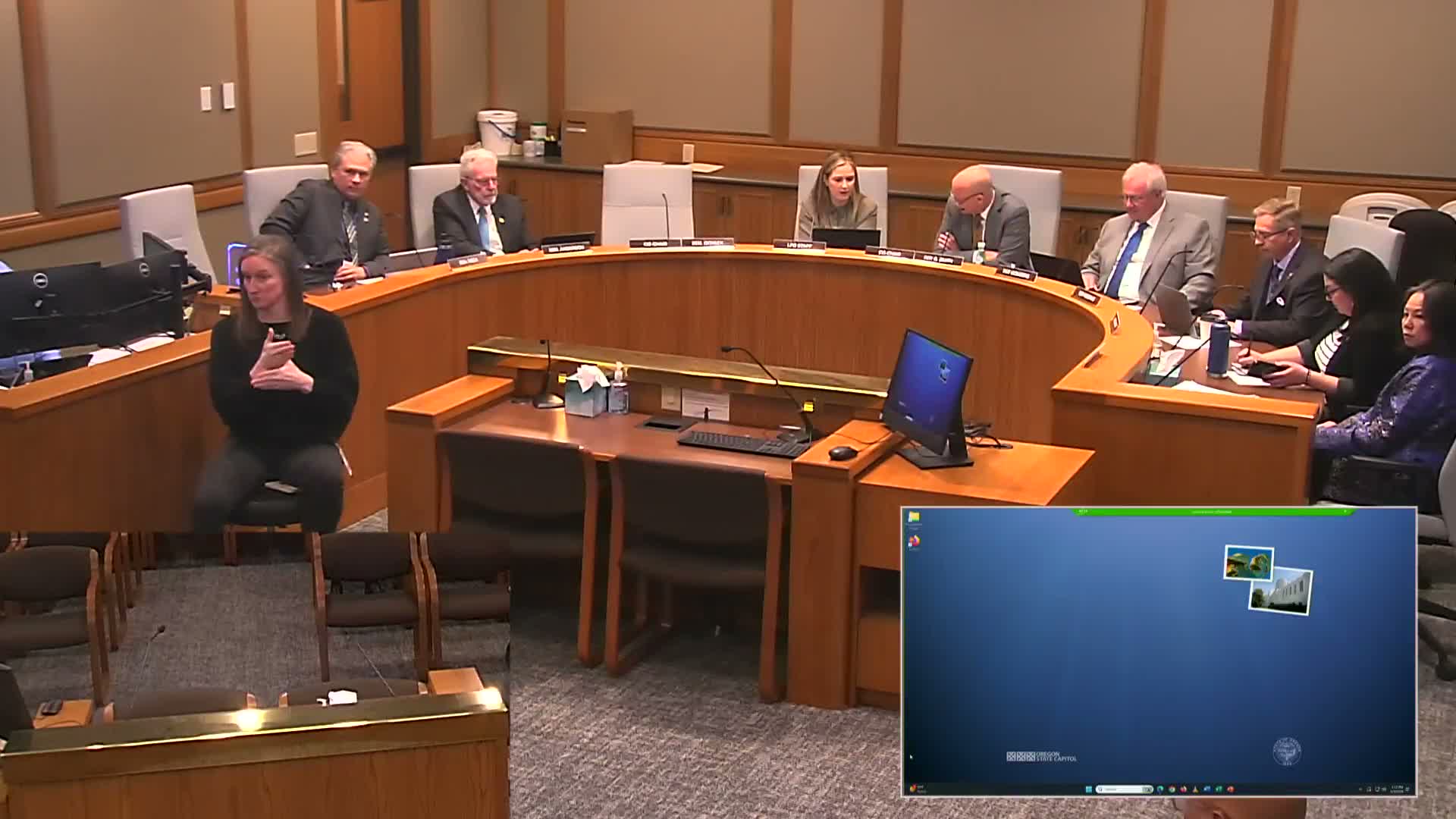
Department of Revenue outlines new cost‑allocation plan; committee forwards report to full Ways and Means
Summary
The Department of Revenue presented a proposed, updated cost‑allocation methodology to the Joint Committee on Ways and Means Subcommittee on General Government and provided examples showing winners and losers across revenue streams; the subcommittee moved the report to the full committee with the Legislative Fiscal Office recommendation to acknowledge receipt.
SALEM, Ore. — The Department of Revenue on Feb. 4 told a legislative subcommittee it has developed a modernized method for dividing administrative costs among the 64 revenue streams it administers, a change officials say will produce more accurate, data‑based allocations and require ongoing updates as programs and statutes evolve.
David Gerstenfeld, director of the Department of Revenue, described the work as the culmination of a third‑party review and multiyear stakeholder engagement prompted by a budget note in Senate Bill 5536. "Cost allocation is kind of how you divide up the pie," Gerstenfeld said, adding that the agency had not updated its methodology in more than a decade and had since taken on 17 additional revenue streams.
The proposed methodology distinguishes direct and indirect costs and uses program‑level measures — for example, charging human resources overhead by proportion of full‑time equivalent staff and allocating accounting costs by number of transactions. For complex collections work that touches multiple debts, the department proposes apportioning costs based on the number of financial statements related to each revenue stream.
Using last biennium's data, the department provided examples of net impacts. Applying the new methodology would increase administrative charges to the corporate activity tax (CAT) by about $3.2 million per biennium, which the department estimates would reduce transfers to the Student Success Fund by roughly the same amount. Conversely, the TriMet payroll tax would see about $6.5 million less in administrative charges, freeing that money to go to its final destinations. Gerstenfeld also flagged property‑tax industrial valuation work as a special case: that work is currently paid from the general fund by statute, and making charges fully proportional could shift roughly $17.2 million in the biennium but would require separate statutory changes and reduce distributions to counties, school districts and other local governments.
Gerstenfeld said the department did not ask for additional resources to implement the methodology and proposed administrative steps such as creating internal cost pools, updating assumptions every biennium and instituting quarterly "truing up" so allocations reflect mid‑biennium changes. "We want to set up a structure that allows us to keep evolving and not have to come back in another 10 years," he said.
The department held a kickoff and later in‑person and hybrid work sessions with roughly 200 registrants representing about 150 state and local entities; about 100 attended in person or virtually. Stakeholders' top concern, Gerstenfeld said, was clear: "They wanted to know, will this hurt my budget or will it help my budget?" He addressed why the agency used program‑lead estimates instead of an employee time study, saying both are accepted standards but that a time study would be more costly and increase the administrative cost base.
Representative Reschke asked whether changing the allocation methodology would alter fiscal‑impact calculations for new legislation. Gerstenfeld responded that it would not: the fiscal impact statement estimates an incremental implementation cost for new laws, while cost allocation determines how total agency costs are borne across revenue streams. He noted, however, that the new methodology would allow the department to update allocations more accurately when statutes or programs change.
Russ Casler of the Department of Administrative Services' chief financial office recommended the subcommittee acknowledge receipt of the report. The Legislative Fiscal Office recommended the joint committee acknowledge receipt and instruct the Department of Revenue to include any adjustments to administrative charges in its 2729 budget development and to propose legislative concepts for statutory changes needed to implement the methodology.
A co‑chair moved the report to the full Joint Committee on Ways and Means with the LFO recommendation; the motion was approved by the subcommittee with no roll‑call vote recorded.
The subcommittee did not take final statutory action. The department said it stands ready to meet with affected agencies about the detailed impacts and will present policy proposals through the biennial budget process if the Legislature chooses to act.