Get Full Government Meeting Transcripts, Videos, & Alerts Forever!
Get email alerts on the Revenue Forecast topic
No spam. Unsubscribe anytime.
OEA: Recession odds fall to 20% as Oregon’s revenue picture brightens but filing‑season risk remains
Summary
The Office of Economic Analysis reported a stronger-than-expected outlook—recession odds fell to 20% and the biennial ending balance moved from a projected deficit to a $198 million surplus—while warning that April tax filings could materially change the forecast.
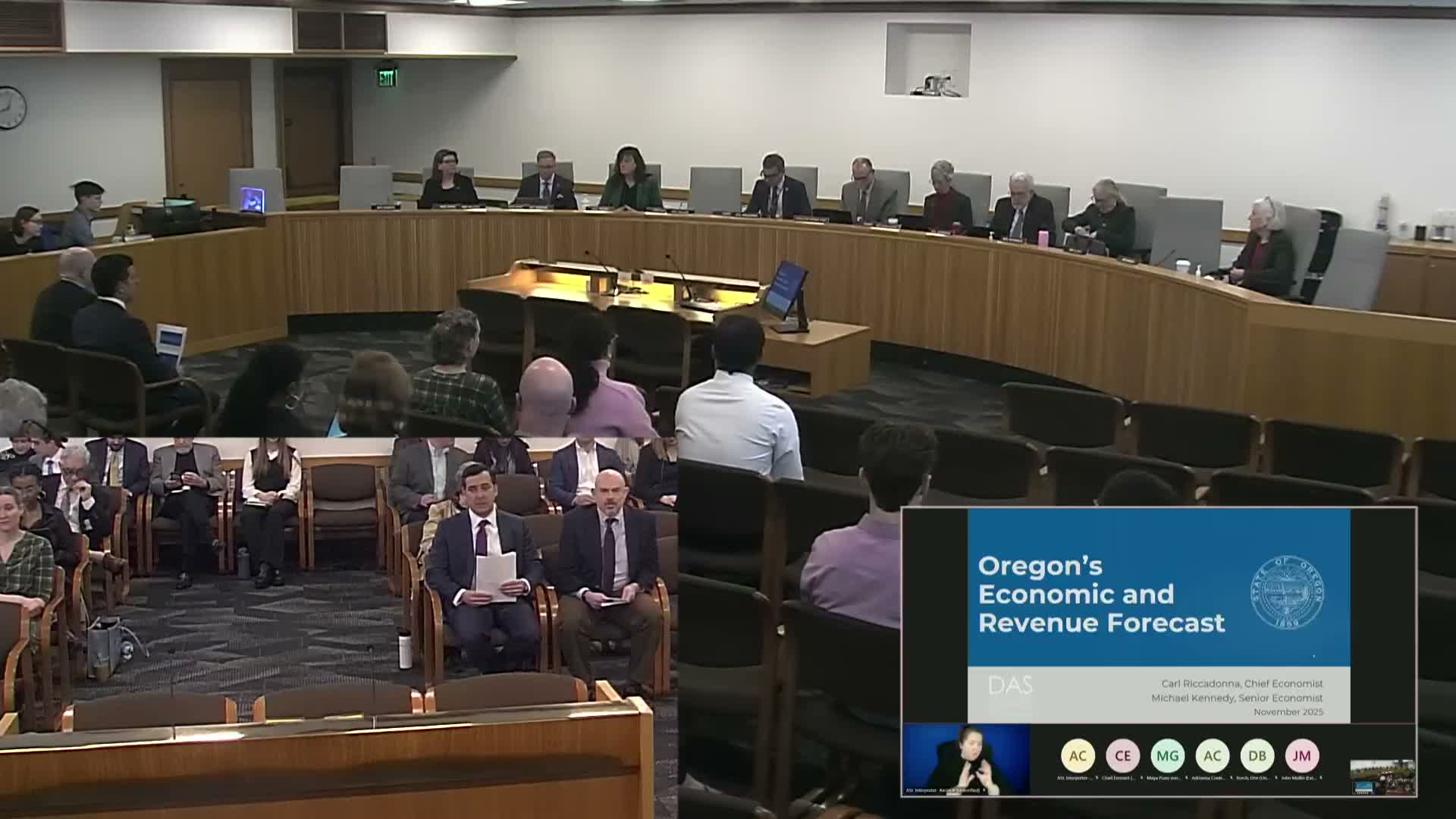
The Office of Economic Analysis told the Senate Committee on Finance and Revenue on the revenue‑forecast briefing that national and state indicators have improved enough to reduce recession risk to about 20 percent and to boost near‑term state revenues.
State Chief Economist Carl Riccadana said four factors are lifting activity: federal tax stimulus from HR 1, recent Federal Reserve rate cuts, greater clarity on tariffs and a surge of investment tied to data centers and high‑tech industries. "We have economic growth that seems to be firming," Riccadana told the committee, adding the national forecast and private consensus are tracking a healthier picture than earlier in 2025.
Why it matters: Michael Kennedy of OEA said the revenue effects have already shown up in preliminary data. Kennedy reported that lower‑than‑expected expenditures for the prior biennium increased the ending balance by $147 million and that revenues rose roughly $106 million—largely from corporate income taxes—yielding about $253 million in additional available resources and turning a previously projected -$63 million ending balance into a projected +$198 million at the end of the biennium.
The forecast is conditional, Kennedy cautioned, with the main risk coming from the 2025 tax‑filing season. "To the degree we are right or more wrong about that, that's going to change our understanding of 2025 up or down," he said, noting that Oregonians paid in roughly $14.3 billion in withholding and estimated payments for 2025 and that individual returns will determine how much of that settles up as refunds or additional tax liabilities.
OEA also highlighted a puzzling labor market divergence: output and productivity have strengthened but employment gains have lagged, a pattern the economists described as a "labor market malaise." Riccadana said academic work and interstate comparisons suggest the current productivity surge is more likely cyclical (firms right‑sizing after pandemic hiring) than structural AI displacement, but stressed that uncertainty remains.
Other non‑general fund changes cited included a higher‑than‑expected Powerball jackpot and stronger video‑lottery receipts, which Kennedy said added about $34 million, and corporate activity tax adjustments of about $18 million.
What happens next: OEA and the Legislature will watch the March–April tax filings and benchmark revisions closely. Kennedy said major forecast updates typically follow the end of the filing season in April, with any final adjustments consolidated in the quarterly forecast process.
The committee requested county‑level heat maps and additional breakdowns; OEA said those materials are available in the written report and on its website.
The briefing closed with committee members thanking OEA for the presentation and noting the forecast frames upcoming decisions for short‑session tax considerations.