Get Full Government Meeting Transcripts, Videos, & Alerts Forever!
Get email alerts on the Child Welfare Investigations topic
No spam. Unsubscribe anytime.
Oregon committee weighs HB 4059 changes to DHS investigations amid split testimony
Summary
On Feb. 5 the House Committee on Early Childhood and Human Services heard extensive testimony on HB 4059, a bill that would narrow ODHS and OTIS authority to investigate alleged abuse by non‑caregivers and minors and raise the substantiation standard; DHS, OTIS, prosecutors, law enforcement, parents and advocates outlined data, safeguards and risks.
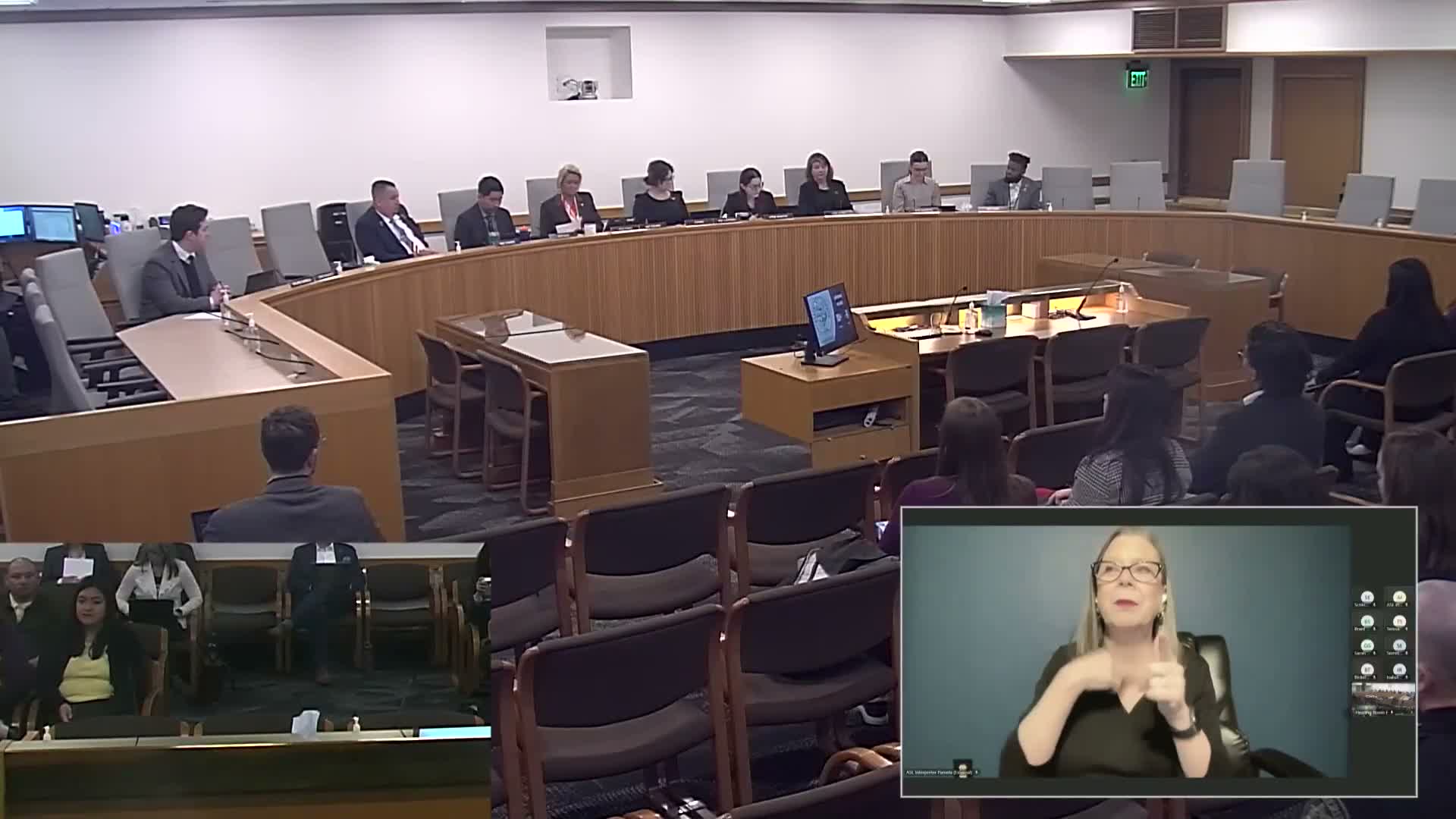
The Oregon House Committee on Early Childhood and Human Services on Feb. 5 opened a multi‑part public hearing on House Bill 4059, a proposal that would narrow when the Department of Human Services (ODHS) and the Office of Training Investigations and Safety (OTIS) must investigate allegations of child abuse by third parties and minors and raise the standard to substantiate a founded finding to a preponderance of the evidence.
Taylor, the committee staffer who summarized the measure, said the bill “modifies the definition of child abuse and threatened harm, requires ODHS to investigate a report of child abuse only when the alleged perpetrator is a specified individual, and raises the standard to substantiate a finding of child abuse from a reasonable cause to believe to a preponderance of the evidence.” She also noted a dash‑2 amendment posted to OLIS and that portions of the measure will be considered over two meetings.
Several presenters gave data and operational context. Molly Miller, ODHS deputy director for child welfare, said the state recorded 179,862 alleged perpetrators assigned between Jan. 1, 2023, and Dec. 31, 2025, of which 2,549 were age 18 (excluding roughly 300 children who are parents); of that subgroup, 18.6% were founded and 50% unfounded. Miller described the hotline screening framework and response timelines used by ODHS (24 hours, 72 hours, and 10 business days) and said ORCA (Oregon Child Abuse Hotline) screening filters aim to avoid assigning developmentally typical behavior.
Lindsay Bigelow of OTIS told the committee that OTIS’s work expanded after Senate Bill 155 (2019) to include many third‑party reports. She said OTIS screened 8,721 reports in 2024 and that a majority of those investigations were third‑party or non‑professional alleged perpetrators; those cases often rely on law enforcement for forensic work and can remain open for long periods while agencies wait for investigative records.
Speakers who work directly with children and families urged the panel to preserve early intervention. Lisa K Williams, a juvenile public defender, said Oregon’s practice of naming minors as perpetrators has produced due‑process harms and long‑term negative outcomes, citing research that, she said, found CPS contact was associated with worse well‑being by age 15. “The research shows that CPS contact in no way improved child well‑being,” Williams told the committee.
Prosecutors and law enforcement raised practical concerns about the proposed narrowing. Brian Powell of the Oregon District Attorneys Association said the bill’s definitions — in particular the added term "severe harm" and the phrase "reasonably likely to occur in the near future" for threatened harm — risk creating gaps in protection, especially in early‑stage cases where criminality may not yet be clear. “Many of our cases ... involve months of sexualized communication between adults and children,” Powell said; he warned narrowing could leave vulnerable children without a path for intervention.
Marion County Sheriff Nick Hunter echoed worries about ambiguity and local capacity, saying some counties lack detectives and that narrowing ODHS authority risks shifting responsibility to under‑resourced law enforcement. Hunter gave a rough breakdown—drawn from his sergeant—for cross reports from DHS: about 60% are closed, 20% closed after some investigation, and 20% become criminal investigations.
Family testimony underscored potential real‑world stakes. Fourteen‑year‑old Alexander Martinez testified briefly about a classroom practice, saying, “I don’t like the blue mats inside the break room,” and his mother, Mary Anne Martinez, urged the committee to oppose HB 4059, arguing the bill “asks that we wait longer to react in those scenarios” and that waiting “feels like being seen but not being helped.” Brandt Solar, another parent, argued the bill would “legally bar the state from intervening in physical and emotional abuse until the precipice of tragedy.”
Committee members asked about comparative practices in other states and about immediate response criteria. ODHS and OTIS staff said many other states limit investigations to caregivers or professionals and rely on law enforcement for third‑party criminal activity; ODHS staff clarified that the most urgent cases can require contact within 0–2 hours from ORCA, while the 24‑hour classification is the statutory immediate response timeframe.
Multiple witnesses pressed for statutory guardrails if the committee narrows investigative scope — including standards for when DHS may terminate an investigation without making a finding, how expunction would work for minors, and how to ensure that narrowing does not reduce reporting or leave systemic gaps in under‑resourced counties. Prosecutors and sheriffs urged precise statutory language so partners know when to act and to whom responsibility will shift.
The committee paused public testimony to allow time for more speakers who traveled; Chair Hartman said the hearing will continue Tuesday with additional discussion on threatened harm and substantiation standards. No final committee action on HB 4059 occurred on Feb. 5.
Next procedural step: the committee will reconvene to continue consideration of the dash‑2 amendment and remaining sections of HB 4059.