Permanent Fund officials defend active management, warn CPI+5 target only probabilistic
Loading...
Summary
APFC executives told the House Finance Committee their diversified, active approach outperformed APFC's benchmark over 5- and 10-year horizons, defended fee disclosure practices and warned that meeting a CPI+5 draw target has about a 50% probability given market variability and reliance on realized gains.
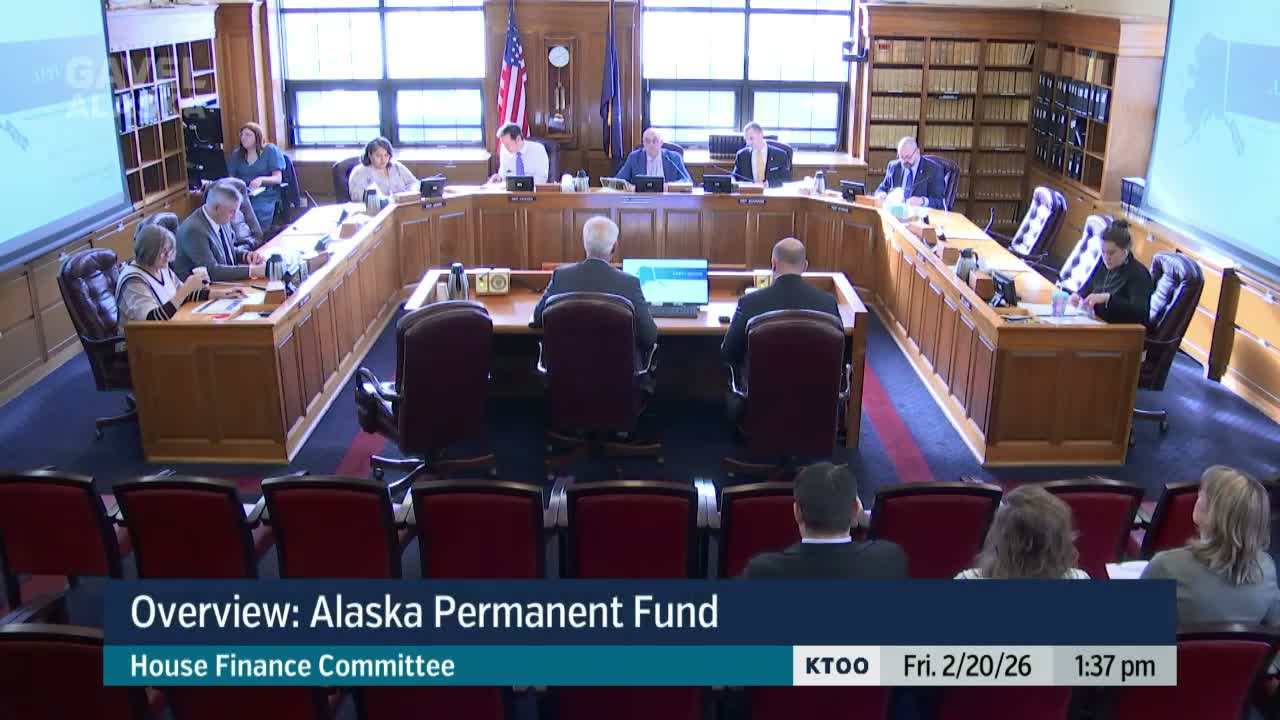
Devin Mitchell, chief executive officer and executive director of the Alaska Permanent Fund Corporation, and Marcus Frampton, the fund's chief investment officer, told the House Finance Committee on Feb. 20 that the Permanent Fund's long-term investment approach is intended to achieve an inflation-plus-5% return while managing risk through diversification.
Mitchell reviewed the fund's origins, noting that the 1976 constitutional amendment to create the Permanent Fund passed with roughly 75,588 votes (about 67% of voters at that time) and established three core requirements: save a portion of specified revenues, invest those savings, and allow transfers to the general fund only as permitted by law. He said APFC's current remit includes managing the principal, an earnings reserve account (ERA), and subaccounts such as the Mental Health Trust and the Power Cost Equalization program.
Frampton said APFC builds a diversified portfolio that aims to be "at a risk target equivalent to 80% equities, 20% fixed income," achieved through a mix of global equities, private equity, real assets and other strategies, rather than by putting 80% of assets explicitly into equities. He defended that active approach when questioned about passive index investing, saying passive strategies are valid but that APFC's active management has beaten its chosen performance benchmark over 5- and 10-year horizons and that short-term underperformance (three-year windows) can reflect deliberate positioning (for example, an underweight in very large, high-priced technology stocks).
On fees and reporting, Frampton said APFC reports returns net of fees and that private-market fee structures, such as carried interest in private equity, often are not fully reported by peers. He told the committee APFC produces fee reports in quarterly board materials and that APFC's reported management-fee figure (discussed in the hearing as about $900 million under APFC's measurement) reflects a comprehensive accounting method that includes private-market profit-sharing; APFC offered to provide a detailed, itemized fee breakdown to the committee.
Committee members pressed APFC on several specifics: the size and performance of an Alaska-focused private-equity program (APFC committed about $200 million in 2018 to two firms; some capital remains illiquid and the program has underperformed relative to expectations, but it is a small portion of the private-equity sleeve), the firm's proxy-voting practices and whether managers vote against Alaska resource interests (Mitchell said APFC uses voting services and that an independent review of selected proxy votes found APFC's voting aligned with maximizing economic value, with a small number of anomalies corrected), and the fund's internal investment governance (Frampton described a 3-member investment committee for private commitments and a multi-stage due-diligence process for private-market investments).
Frampton explained statutory net income (realized return) vs. total return (including unrealized gains), and why statutory net income matters for ERA replenishment and for the Percent of Market Value (POMV) draw. He said baseline statutory net income (interest, dividends and rents) produced about $2 billion last year, and APFC's projection of roughly $6 billion statutory net income depends on realizing a portion of about $17 billion in unrealized gains; he noted those realizations are variable and said there is roughly a 50% probability of achieving CPI+5 with the current portfolio and market assumptions.
On inflation-proofing, APFC staff said the legislature forewent inflation-proofing in FY25 and FY26 to preserve ERA liquidity; APFC supports returning to a rules-based inflation-proofing approach when prudent and suggested that the legislature could consider appropriations to principal to offset foregone years. APFC reported roughly $4 billion segregated for the FY27 draw, about $6.6 billion of spendable earnings, and approximately $2.8 billion of unrealized earnings held in ERA accounting (figures discussed at the hearing and characterized by APFC as subject to accounting allocation rules).
The corporation also discussed office operations (an Anchorage office with six employees now and a seventh anticipated) and committed to follow up with committee staff to provide a detailed fee breakdown and additional inflation-proofing and ERA detail if requested. The presentation concluded and the committee recessed briefly before the Department of Revenue's budget overview.
Ending: APFC offered follow-up materials and said it would provide a more detailed fee report and inflation-proofing accounting to the committee; no formal legislative action or vote occurred during the session.