
DNR briefs Alaska House panel on rising wildfire costs, 2025 season and preparedness steps
Get AI-powered insights, summaries, and transcripts
Subscribe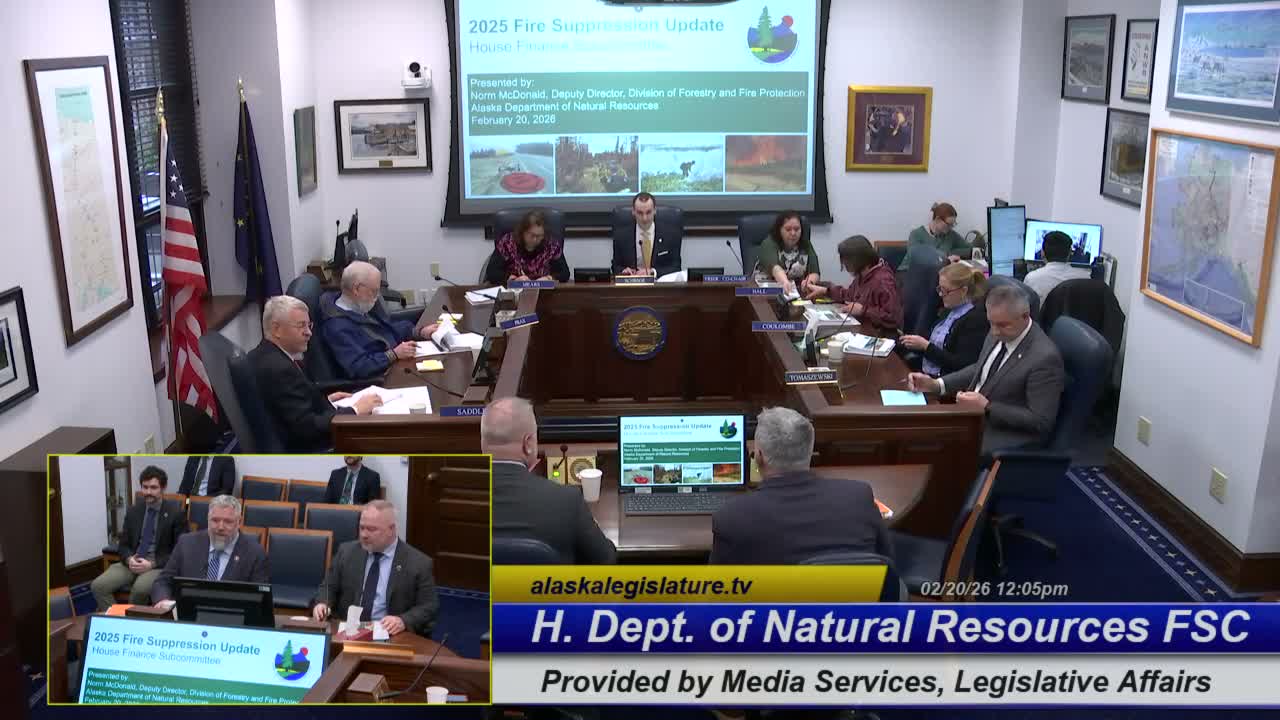
Summary
The Department of Natural Resources told a House finance subcommittee that Alaska’s 2025 fire season required heavy resource imports, cost the state more than recent averages, and highlighted investments in fuels mitigation and drone programs as ways to reduce future suppression expenses.
Deputy Director Norm McDonald of the Division of Forestry and Fire Protection briefed the Alaska House Finance Department of Natural Resources subcommittee on Friday on the state’s wildfire response, rising suppression costs, and steps the department is taking to improve preparedness.
McDonald told the subcommittee that DNR’s statutory mission is to protect state and private land and that the agency organizes work around four pillars: preparedness (a trained, equipped workforce and agreements with cooperators), prevention (public education and enforcement), mitigation (fuels reduction), and suppression (mobilizing resources where they are most needed).
The division manages roughly 350 people in the fire program, McDonald said, of whom about 250 are frontline seasonal firefighters; the rest are support staff who help with prevention, mitigation and logistics. He said Alaska relies heavily on local fire departments, the National Guard for initial helicopters, and interstate and international mutual‑aid compacts when incidents exceed state capacity.
McDonald described how jurisdictional responsibility and cost‑share work in Alaska: protection and response are governed by four protection levels (critical, full, modified, limited) set by land managers; cost responsibility typically follows jurisdiction and is calculated on acres burned. "Critical" areas—communities where life safety is at risk—receive the highest priority for full suppression, he said.
Reviewing the 2025 season, McDonald said an early active season was predicted because of low snowpack, but cool spring weather delayed activity. A warm, dry stretch around the summer solstice, followed by intense lightning, produced a large number of fires in late June. He said 173 fires in a short period were associated with about 55,000 lightning strikes and that many interior incidents exhibited extreme fire behavior, producing evacuations in Fairbanks, Healy and Toke and highway closures on the Parks Highway.
McDonald highlighted two incidents: the Himalaya Road fire near Fairbanks and the Bear Creek fire (about 32,000 acres, between Healy and Clear), which he said accounted for most structure losses in 2025. He described one roadside incident with an estimated total suppression cost of about $10,000,000; roughly 60% of that acreage was state or private (approximately $6,000,000) and 40% federal (about $4,000,000). For qualifying incidents, DNR applies for a Fire Management Assistance Grant (FMAG) from FEMA that can reimburse states for about 75% of eligible costs; McDonald said that reimbursements typically take about three years to flow back into the state's fire fund.
To meet demand in 2025, McDonald said Alaska imported more than 3,500 personnel from the Lower 48 and Canada, including 43 fire crews, 20 firefighting aircraft and roughly 2,600 overhead orders (incident management and support personnel). He told the panel that federal reorganization of fire services (a move to a single U.S. Wildland Fire Agency for DOI lands) and compacts such as the Northwest Compact (five Canadian provinces plus several U.S. western states) help streamline mutual aid and reimbursements.
McDonald also discussed rising costs for logistical support and aviation: he said firefighting aircraft costs have increased 128% since 2015 and that Alaska spent over $140 million on suppression in 2025 compared with a five‑year average near $68 million. He and committee members agreed that prevention and fuels mitigation investments are among the most promising ways to reduce long‑term suppression expenses; McDonald noted a five‑year capital improvements program (CIP) for fuels reduction supported by the administration recently concluded its final year.
Committee members asked several technical and policy questions. Representative Sadler pressed for clarification between jurisdictional land managers and protection agencies and the basis for cost shares; McDonald confirmed cost share follows burned acres and protection level agreements. Members asked whether Alaska's policy of allowing some fires to play a natural role increases future catastrophe risk; McDonald replied Alaska already uses a limited‑protection approach in many areas but must prioritize life‑safety zones. Representative Hall asked about tundra fires; McDonald said Alaska is seeing more fires in historically low‑fire areas (for example, north of Dillingham and north of the Brooks Range), and that suppression decisions and costs vary by whether the fire is actively suppressed or monitored.
On technology and capability, McDonald said DNR has stood up an unmanned aircraft system (UAS/drone) program over the last four years, views drones as a cost‑effective complement to helicopters for some missions, and is working to expand that capacity though the program is not yet fully funded. Members requested the current 2026 seasonal forecast; McDonald said a forecast is available and offered to share it with the committee.
Chair Shrogy closed the briefing by announcing the subcommittee’s next meeting at noon on Friday, Feb. 27, when members will consider the DNR budget recommendations and member amendments; the meeting was adjourned at 12:49 p.m.